Skip to content
Thursday 27 August 2026London --:--Frankfurt --:--Zurich --:--
NewslettersSearchEN · DE · FR
MorningWire

European business, markets and politics

FTSE 100
10,792.54
-0.79%
DAX
26,367.24
+0.31%
CAC 40
8,319.87
-1.68%
STOXX 50
6,424.73
-0.71%
  • Europe
  • Markets
  • Business
  • Economy
  • Regulation
  • Politics
  • Opinion
More
GermanyFranceEU InstitutionsCompetitionPublic AffairsBankingTechnologyEnergy
  • Germany
  • France
  • Europe
  • Markets
  • Business
  • Economy
  • Regulation
  • Politics
  • Opinion
  • DE
Tuesday 10 December 2019 3:16 am  |  Updated:  Monday 09 December 2019 6:43 pm

It would be a colossal error for the UK to opt out of the creative thinking study
By: Bill Lucas and Hasan Bakhshi

Add as a preferred source on Google
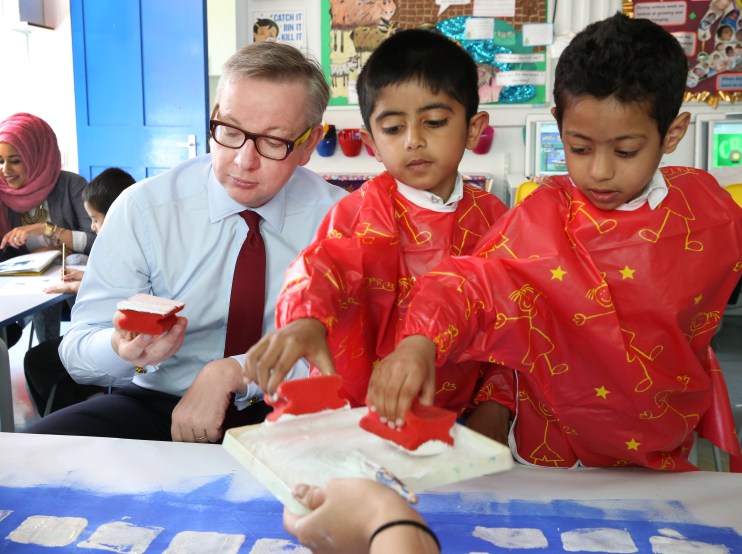
LONDON, ENGLAND - JUNE 25: Education Secretary Michael Gove holds a paint sponge as he helps paint a picture of Canary Wharf during a visit to Old Ford Primary School on June 25, 2013 in London, England. Tomorrow Mr Osborne will announce the Government's spending review for 2015-1016. Earlier the Chancellor announced that spending on schools will be ring fenced. (Photo by Peter Macdiarmid/Getty Images)

Each of the major parties’ manifestos for the upcoming election recognises the importance of creativity in our schools and workforces. 

It seems that policymakers are finally responding to a growing body of international evidence that employers, as they navigate an increasingly digital and complex world, will value human skills like original thinking and complex problem solving. 

Meanwhile, educators are talking more and more about the importance of “creative thinking” — the process by which we generate, refine, and critique ideas. It requires specific knowledge, skills and habits of mind. It involves making connections across topics, concepts, disciplines and methodologies, and it improves outcomes beyond school. 

The evidence suggests that creative thinking is not innate. It can be learned, and assessed, all which explains why countries such as Singapore, Finland, Canada and Australia are prioritising it in schools. 

UK policymakers must realise that the stakes here are exceptionally high. Research suggests that creative occupations (of which there is a growing number) — spanning not just designers and artists, but also engineers, chemical scientists and mathematicians too — are over twice as likely as other roles to be immune to automation. 

And if these countries are right, the implication is that those setting school priorities should also be investing in the teaching of creative thinking. 

This is a difficult area, where cause and effect are notoriously tricky to unpick. We need rigorous evidence to understand how well our education system is already providing creative skills, and where we can improve. 

The good news is that England has an opportunity to address this need. In 2021, the guardian of global comparative education standards, the Programme for International Student Assessment (PISA) will introduce a new test of creative thinking as part of its commitment to innovation in education. This will allow us to measure how well young people in England demonstrate creative thinking, and assess how this correlates with their knowledge in English, maths and science.

Read more

3 ways AI is rewriting the rules of private equity

A person interacting with a chatbot on a smartphone, with a laptop in the background, showcasing AI and technology.

Because of the standardised nature of PISA, it will be a unique opportunity for our policymakers to collect data that is strictly comparable with that in other countries.

 Perhaps the biggest research opportunity of PISA, however, is that it enables a fuller evaluation of creative thinking on the outcomes across the labour market, largely by lookings at how well individuals fare when it comes to their careers. 

Participating in the PISA study only requires the government to bear the relatively small costs of administering the tests. However, worryingly, it’s been recently reported that the Department for Education has decided to turn down this opportunity. 

This would be a colossal error of judgement. Fortunately, it may still not be too late to reverse. 

If a new government is prepared to recognise the many advantages that our participation in the new PISA 2021 test of creative thinking would bring, it needs to be one of its first decisions early in the New Year. It would be a powerful statement of intent in terms of the employability of young people.

Whatever your political persuasion, we can all agree that education should prepare young people for the future workforce. PISA 2021 is an important opportunity to add to the evidence base, and to help the UK to make the best decisions for young people as we enter a period of rapid change and complexity. 

The next government should not throw it away.

Read more

David Brent was supposed to be a satire, now he looks like a model for political leaders

Ricky Gervais as David Brent performing on stage, wearing sunglasses and a patterned vest.

Share this article

  • Facebook
  • X
  • LinkedIn
  • WhatsApp
  • Email

Similarly tagged content:

Sections

  • Jobs and Money
  • News
  • Opinion

Categories

  • Opinion
  • Personal Development
  • Politics

Trending Articles

  • Pensioners to hand over bank statements in government benefits crackdown

  • Jamie Carragher: HMRC petitions for Sky Sports star to be declared bankrupt

  • Andy Burnham hints at tax rises in Autumn Budget

  • Brewdog founder James Watt hits out at ‘total silence’ over new venture

  • Lloyds Bank and Halifax users unable to use app in latest outage

More from Morning Wire

  • 3 ways AI is rewriting the rules of private equity

    AD
    A person interacting with a chatbot on a smartphone, with a laptop in the background, showcasing AI and technology.
  • David Brent was supposed to be a satire, now he looks like a model for political leaders

    Opinion
    Ricky Gervais as David Brent performing on stage, wearing sunglasses and a patterned vest.
  • ‘Absurd’: Government seeks quantum tech chief – no experience necessary

    Tech
    Advanced quantum computer with intricate circuits and glowing interface, illustrating cutting-edge technology innovations
  • Improve technical education for women to plug engineer shortage

    Opinion
    Two engineers in hard hats and high-visibility gear inspecting a large, illuminated tunnel under construction.
  • Arc’teryx Introduces System 0™, a New Framework for the Future of Product Design and Circularity

    Business Wire
  • Richard Branson: Support founders to build the next Virgin in Britain

    Opinion
    Richard Branson smiling with arms outstretched in front of a blue HBO Max Branson backdrop
  • What Burnham’s Sporting Events Bill means for brands and media owners

    Sport Business
    Andy Burnham, Mayor of Greater Manchester, in glasses, showing enthusiasm at a sporting event.
  • What Guardiola and Mourinho teach business, and other Premier League managers

    Sport Business
    Close-up of Jose Mourinho and Pep Guardiola looking intently, side by side, during a football match.
MorningWire

Independent European business, markets and political news for decision-makers.

Morning Briefing

Europe

  • Germany
  • France
  • EU Institutions
  • Europe

Business

  • Markets
  • Business
  • Economy
  • Regulation
  • Competition
  • Public Affairs

Editorial

  • Opinion
  • Editorial Policy
  • Corrections
  • Contact

Company

  • About Morning Wire
  • Privacy Policy
  • Terms of Use
  • Cookie Policy
© 2026 Morning Wire Ltd · Published by Morning Wire Media, Bahnhofstrasse 65, 8001 Zürich, Switzerland
Privacy · Terms · Cookies · Facebook