Skip to content
Thursday 13 August 2026London --:--Frankfurt --:--Zurich --:--
NewslettersSearchEN · DE
MorningWire

European business, markets and politics

FTSE 100
10,805.27
-0.26%
DAX
26,442.92
+0.42%
CAC 40
8,686.87
+0.14%
STOXX 50
6,564.64
+0.47%
  • Europe
  • Markets
  • Business
  • Economy
  • Technology
  • Politics
  • Opinion
More
GermanyFranceBankingAIEnergyFintechPropertyCapital Markets
  • Germany
  • France
  • Europe
  • Markets
  • Business
  • Economy
  • Technology
  • Politics
  • Opinion
  • DE
Monday 21 October 2019 4:29 am  |  Updated:  Monday 21 October 2019 2:44 pm

It’s not just about avoiding another Carillion scandal, reforming public procurement can build a better Britain
By: Ben Glover and Rose Lasko-Skinner

Add as a preferred source on Google
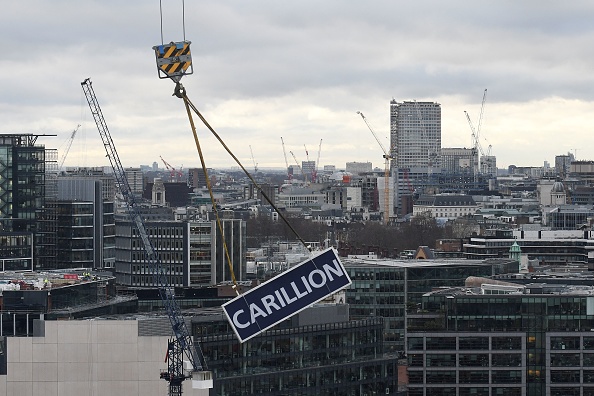
A sign showing the name of liquidated British construction and outsourcing group Carillion swings as it is lowered after being taken down off a construction crane on a building site in Canada on January 23, 2018. British construction and outsourcing firm Carillion, which has a variety of private and public service contracts in Britain and employs 43,000 staff worldwide, announced its immediate liquidation on January 15 after the heavily-indebted company failed to secure a last-minute financial rescue by the government and banks. / AFP PHOTO / Daniel SORABJI (Photo credit should read DANIEL SORABJI/AFP/Getty Images)

From the collapse of Carillion to the Brexit ferries fiasco, public procurement has had a rocky few years.

But while the focus has rightly been on ensuring that such disasters don’t happen again, we must not forget that public procurement can actually be an enormous force for good.

Public procurement is the act of the government buying things from external providers, from stationery to submarines, nurses’ uniforms to IT systems. It’s the government’s largest spend, amounting to almost £300bn a year and representing around 13 per cent of the UK’s GDP. That’s a huge figure: almost three times what we spend on the NHS in England. 

And it’s not just money, it’s an opportunity. In fact, new Demos research published yesterday outlines how this vast spending power represents the enormous potential to shape a fairer Britain.

How? By using it as leverage to encourage the companies seeking these contracts to act more in the interests of society, from how they treat workers to the tax they pay to reducing their impact on the environment.

The fundamentals are already in place. Through “social value” criteria, the government can try to maximise the social, environmental and economic impact of procurement. But standards, definitions and priorities for social value remain disjointed and unaligned across the government. 

Our report recommends that these criteria are clarified and properly aligned with the government’s priorities for building a fairer, greener, more prosperous Britain. New cross-government objectives could foster a “mission-oriented” approach to public procurement, ensuring that we reach the full potential of the pioneering legislation that introduced these powers.

For example, in-work poverty could be tackled by requiring government suppliers to offer their workers the real living wage, as pioneering councils such as Preston are already doing. 

Read more

‘Social value’ procurement rules are an absurd waste of time and money

Tunnelling for the Euston link finally kicks off this week.

To increase their chances of winning government contracts, some companies are striving to offer the government more social value, such as by providing high quality training and skills to areas in need. But this could be taken so much further.

Or take the environment. The government’s drive to tackle climate change and improve biodiversity could be fostered by public procurement demanding that suppliers meet strict new environmental criteria, dramatically “levelling up” the playing field. 

It could also drive better tax behaviour. Our research identifies that almost three quarters of the biggest state suppliers have operations in tax havens. Tackling tax avoidance in a globalised world through legislation is complex, but new standards should allow government departments to include a bidder’s effective tax rate – the amount of tax they pay to the Exchequer – when considering who to award contracts to, rewarding those firms that pay their fair share. 

None of this, however, will have much impact if the government doesn’t have a fair and competitive market to choose providers from. But this happens far too rarely: almost one in four public sector contracts only receive just one bid, leaving commissioners no choice at all. 

It is therefore vital that steps are taken to increase the number of companies competing. This involves ensuring that procurement works better for small and medium-sized enterprises, which too often feel that they have little or no chance of winning government contracts. 

That’s why we are calling for small business advisory councils – made up of small business owners themselves – in the biggest government departments. We also need to provide businesses with more information about why and how bids are awarded, improving their chances of winning contracts in the future.

Government procurement can be so much more than the purchasing of goods or services. It should be seen as a route to a fairer, greener Britain – something that politicians of all stripes should welcome.

Main image credit: Getty

Read more

Net zero and DEI targets cut from procurement rules as firms pressed to raise pay and hire NEETs

Louise Haigh, Andy Burnham, and another man smiling in front of a dark door with 10 visible.

Share this article

  • Facebook
  • X
  • LinkedIn
  • WhatsApp
  • Email

Similarly tagged content:

Sections

  • News
  • Opinion

Categories

  • Business
  • Opinion
  • Politics

Trending Articles

  • Five-star Mayfair hotel hit with HMRC winding-up petition

  • It’s not just Jason Arday, most of sociology is a scam

  • IT consultant ordered to pay £50,000 after being accused of stealing Soho House members’ personal details

  • Revolut takes flight with launch of new airport lounges

  • As it happened: FTSE 100 falls as Iran and US clash over Strait of Hormuz; Oil stockpiles ‘rapidly depleting’

More from Morning Wire

  • ‘Social value’ procurement rules are an absurd waste of time and money

    Economics
    Tunnelling for the Euston link finally kicks off this week.
  • Net zero and DEI targets cut from procurement rules as firms pressed to raise pay and hire NEETs

    Politics
    Louise Haigh, Andy Burnham, and another man smiling in front of a dark door with 10 visible.
  • ‘Good growth in every postcode’ is a woeful catchphrase

    Opinion
    Andy Burnham adjusting his tie, overlooking white cliffs and the sea on a sunny day
  • Babcock and Rolls-Royce stocks rally after Healey appointment

    Industrials
    Defence secretary John Healey is leading calls for further investment in the sector.
  • BAE Systems raises guidance yet Burnham wavers on defence

    Industrials
    Andy Burnham and Volodymyr Zelenskyy walking, with uniformed military personnel in background.
  • OpenAI’s proposed ‘Trump stake’ raises ‘governance overhang’ fears ahead of IPO

    Tech
    Sam Altman discussing OpenAIs ChatGPT advancements at a press conference, emphasizing AI innovation and future developments
  • UK government backs British business to get slice of £33bn in Morocco World Cup contracts

    Sport Business
    Getty Images logo displayed on a modern digital screen, representing media and stock photography in a business context.
  • Burnham promises to ‘build new economy’

    Politics
    Andy Burnham, Mayor of Greater Manchester, speaking at an event
MorningWire

Independent European business, markets and political news for decision-makers.

Morning Briefing

Europe

  • Germany
  • France
  • Europe
  • UK & Ireland

Business

  • Markets
  • Banking
  • Technology
  • Energy
  • Property
  • Fintech

Editorial

  • Opinion
  • Editorial Policy
  • Corrections
  • Contact

Company

  • About Morning Wire
  • Privacy Policy
  • Terms of Use
  • Cookie Policy
© 2026 Morning Wire Ltd · Published by Morning Wire Media, Bahnhofstrasse 65, 8001 Zürich, Switzerland
Privacy · Terms · Cookies · Facebook