Japan’s growing military power will help the West challenge China’s threat

Old memories die hard and there will inevitably be scepticism of reinvigorated foreign policy from Japan, but it should be a change we embrace to face off the threat of China, writes Eliot Wilson
Last December, the UK, Italy and Japan agreed to combine their respective projects and build next-generation military fighter aircraft in a scheme dubbed the Global Combat Aircraft Programme (GCAP). At the DSEI international arms fair in London earlier this month, the three principal contractors, BAE Systems, Leonardo SpA and Mitsubishi Heavy Industries concluded a Collaboration Agreement to develop long-term working arrangements and capability requirements for GCAP. The plan is for the aircraft to enter service in 2035.
This is a major step for Japan. After the country’s surrender at the end of World War II, it adopted a constitution which renounced the use of force to resolve international disputes. It maintains military units purely for self-defence, and it was only in 2015 that the government introduced legislation to allow the armed forces to be deployed overseas in a potential combat role in “collective self-defence” with allies. Even that modest amendment was greeted with protests.
But it is part of an emerging trend. In 2007, the government created a fully fledged ministry of defence for the first time, expanding the Japanese Defence Agency which had been a unit within the Cabinet Office. In 2013, the prime minister, the late Shinzo Abe, a nationalist who refused to condemn completely the actions of Imperial Japan before 1945, created the National Security Council and National Security Advisor, and issued a National Security Strategy, centralising much of the control of foreign and defence policy in his own hands.
These structural changes have been mirrored by changes in equipment. In 2015, the Japanese Maritime Self-Defence Force commissioned its first Izumo-class “helicopter-carrying destroyer”, effectively a small aircraft carrier capable of supporting at least 12 Lockheed Martin F-35B Lightning multi-role fighter aircraft; this capability was at first concealed for fear of political or public protest. A second vessel in the class, JS Kaga, was commissioned in 2017. The importance of these ships was not just in their ability to project military force but in symbolic terms: the aircraft carrier remained a potent symbol of the war in the Pacific from 1941 to 1945 and had been firmly renounced by post-war Japanese governments.
Last year, the government issued a revised National Security Strategy which set out the challenges posed by Russia’s expansionist policy, Chinese territorial aggression in the South China Sea, the ongoing threat of North Korea. In very elliptical terms, it concluded that Japan must be prepared to take more active military measures than in the past to ensure peace while protecting its own interests.
For cultural and historical reasons, this was all expressed in very euphemistic terminology, but there is a decided shift of attitude and many on Abe’s wing of the ruling Liberal Democratic Party, which has been in power for all but four years since it was founded in 1955, want Japan to become in essence a “normalised” global power with influence appropriate to its size and economic heft.
Old memories die hard and there will inevitably be scepticism of a reinvigorated and more self-confident foreign policy by the Japanese government. But we should embrace it. There is no serious prospect of Japan becoming a rogue nation and endangering the security of its neighbours, though that is a trope which the Chinese Communist Party will promote ceaselessly. Recently the government in Tokyo announced that it would double defence spending over the years 2024-28, committing $310bn compared to $122bn for the previous four-year period. This will take the country’s military expenditure to around the two per cent NATO benchmark, approaching the 2.5 per cent spent by neighbours Taiwan and South Korea.
A more militarily capable Japan provides us with a reliable ally in the Pacific. This is a huge advantage for the West’s national interests, as it acts to counterbalance the ability of the People’s Republic of China to expand its influence and make good its more outlandish maritime territorial claims. And if, as I expect, China launches some kind of effort to subdue and control Taiwan within the next five to seven years, the US, treaty-bound to defend the island, will be grateful for support and assistance from a major regional economy.
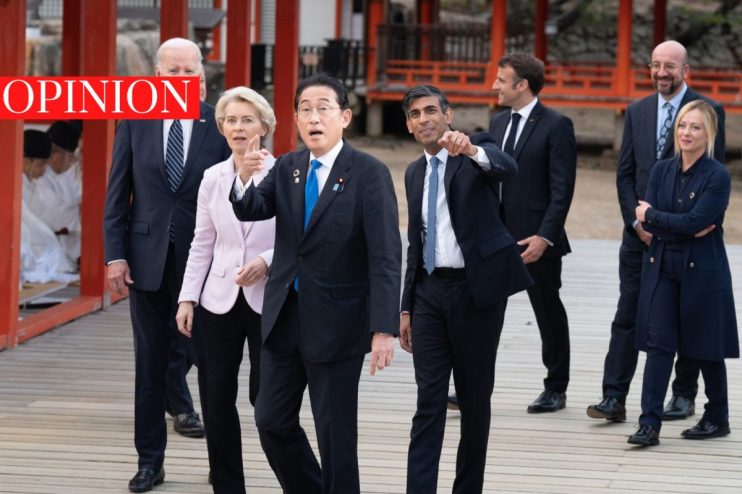
It is easy to caricature Japan’s rearmament in negative and backward-looking terms. But Japan is one of our most reliable allies. Earlier this year, Rishi Sunak met his Japanese counterpart, Fumio Kishida, and agreed the Hiroshima Accord, a partnership covering security, economic prosperity, research and resilience; and the UK’s accession to the Comprehensive and Progressive Agreement for Trans-Pacific Partnership (CPTPP) only reinforces the importance of our relationship.
2025 will mark the 80th anniversary of Japan’s surrender and the end of the war in the Pacific. London and Washington, as well as allies in other capitals, should acknowledge that Japan has changed immeasurably in those decades, and is now stepping up as a full member of the international community. If, as we say, China is our greatest strategic threat, then we should welcome Japan with open arms to their new strategic posture.