Josh Kerr took the mile record. But how much further can we go?

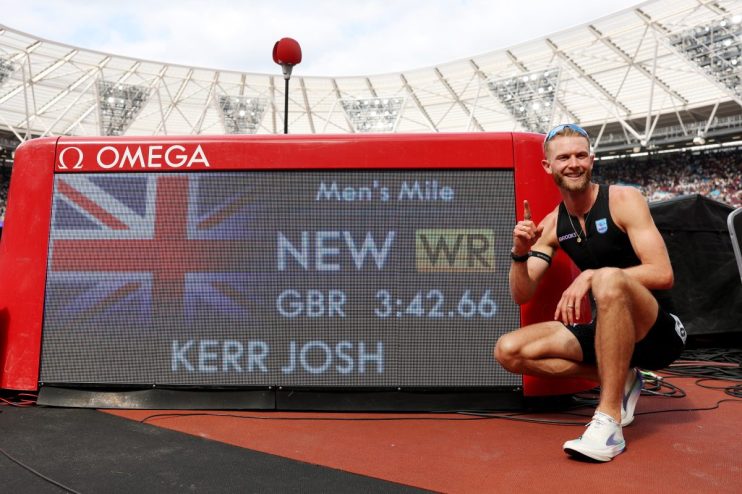
Josh Kerr’s performance prompts the question as to how much further world records might be expected to improve, says Paul Ormerod
As the end of summer finally begins to hover into sight, we can enjoy the fact that it has not been too bad a one for our sportsmen and women. True, the cricketers lost the series 2-1 to New Zealand, but the football team did after all make the semi-final of the World Cup, which cements us as one the world’s top sides.
It is in athletics where our boys and girls have really shone. Josh Kerr took the mile record in three minutes 42.66 seconds. And Amy Hunt became the first person ever to win four gold medals at a single European Championship.
Kerr’s performance prompts the question as to how much further world records might be expected to improve. The plain fact is that progress overall is definitely slowing down. Records both stand for longer and the improvement when it comes is usually pretty marginal.
World records over the last 100 years
100 years ago, for example, the world mile record for men stood at four minutes 10.4 seconds. 50 years later, in 1976, just over 20 seconds had been taken off it, with a time of three minutes 49.4. Fast forward another 50 years to Kerr’s record, and we see that this is only seven seconds faster.
This year at the London marathon Sebastian Sawe became the first person to run under two hours in a competitive event. His time was 10 seconds faster than in 1976, which in turn was another 20 seconds faster than the 1926 mark.
The same slowing down of progress is observed in women’s events, although here the half century between 1926 and 1976 did see massive progress as the discrimination which had deterred many female athletes began to fade away. A century ago, for example, the marathon record was three hours 40 minutes, falling by a whole hour by 1976.
But it is the blue riband event of the 100 metres where the real questions arise about improvements. Even in 1926 the record stood at 10.4 seconds, a time which could win most events short of top international standards in 2026. By 1976, this had been cut to 9.9 seconds.
Usain Bolt’s incredible 9.58 in 2009 on the face of it suggests that progress did not slow. He took 0.4 off the record set 40 years previously, which in turn was 0.5 seconds faster than the time set 50 years before that.
Yet if we flash back to the 1964 Tokyo Olympics, a different picture starts to emerge. The American Bob Hayes was hand timed on the 4×100 metre relay final leg at between 8.5 and 8.9 seconds.
He had previously won the individual event in 10.0 seconds. But he ran it in borrowed shoes, having left one of his own behind. And in those days, incredibly, even the Olympics were run on cinder tracks, and Hayes’ lane had been churned up by the previous event, the 20 kilometre walk.
The role of science
We will never know, especially since Hayes then left athletics to make a lot of money as wide receiver for the Dallas Cowboys. But all this leaves the distinct impression that on modern tracks with modern shoes, Hayes would have been close to Bolt’s record.
The science of training, the science of diet, the science of shoes, the science of tracks, these have all progressed substantially in recent decades. World records obviously remain very hard to beat, but it does seem that progress is mainly due to science.
In fact, thinking of science, what a pity the Ancient Greeks did not invent the stopwatch. Then we would have had a time for the original marathon of Pheidippides, who ran from the battlefield at Marathon to Athens in 490BC. He brought news of the Greek victory and promptly collapsed exhausted.
Paul Ormerod is an honorary professor at the Alliance Business School at the University of Manchester. You can follow him on Instagram @profpaulormerod