Jurassic Park’s sound designer reveals the secret sounds of the dinosaurs

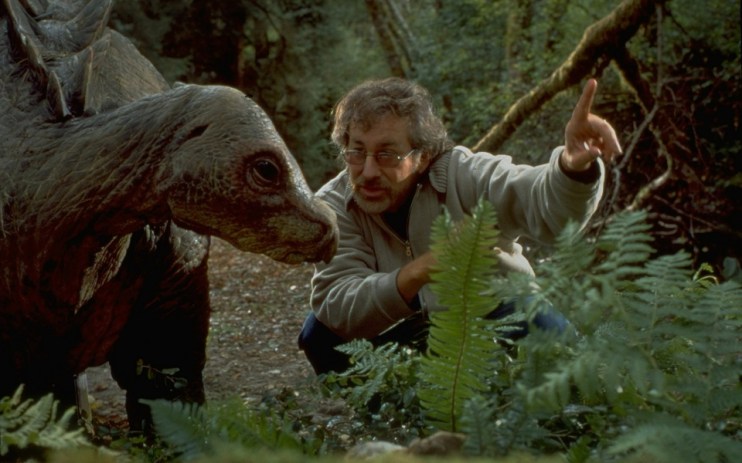
For sound designer Al Nelson, jobs don’t come much bigger than Jurassic Park. When the technician started out in the industry in the late nineties, one of his first big jobs was The Lost World, Steven Spielberg’s follow-up to Jurassic Park, the film which birthed the seismic dinosaur franchise.
In the 25 years since, Nelson has risen to a leading designer at post-production house Skywalker Sound, and has sound designed all three follow-up Jurassic Park films, including the newly-released final entry to the franchise, Jurassic World Dominion, as well as some of the biggest Hollywood releases of recent times, including Wall: E, Toy Story and the new Top Gun.
With each new Jurassic Park, Nelson and his team have the challenge of introducing a dinosaur more formidable and terrifying-sounding than the last – but how do you out-do the T-Rex?
“T-Rex is still the top of the pyramid in terms of sound design,” says Nelson, Zooming from his home in northern California. “You could be walking down the sidewalk and if you heard a T-Rex coming out a TV or a cellphone, you’d be like, ‘Oh, I know that sound.’”
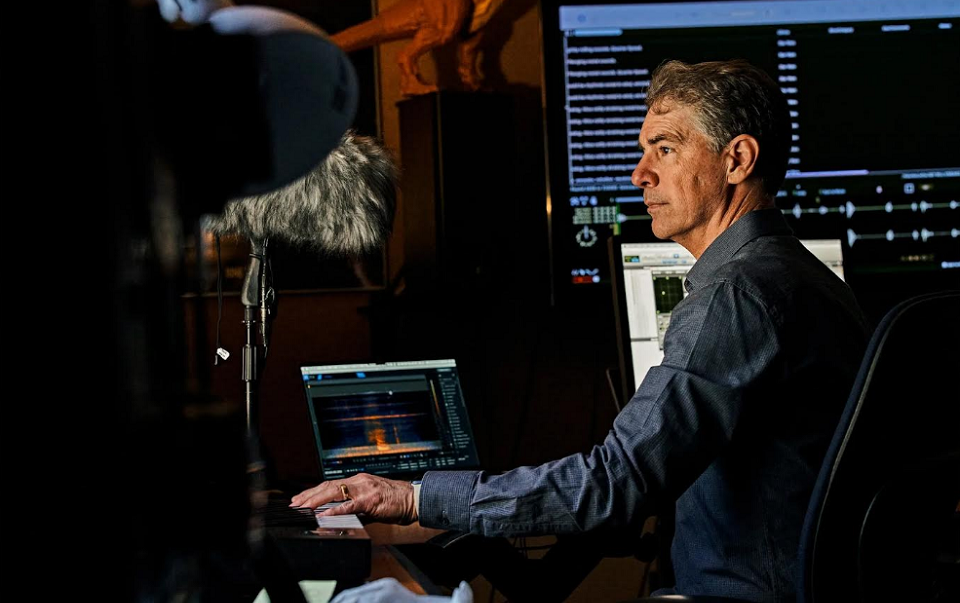
For the final instalment, in cinemas now, Nelson says the producers, one of whom is Steven Spielberg, wanted to take “the next step”. Having recorded lions and tigers in the past, Nelson went on the trail of a new animal to appropriate.
It takes days of immersing in nature, just listening. Hearing unusual animal screeches, observing behaviour patterns, there’s no electronic sound library for ‘dinosaur noises’ – that simply doesn’t exist. All sounds are from reallife animals, even in 2022.
“We haven’t found a way to make a more believable version of a footstep or a roar,” says Nelson. “We can’t just synthesise it, we don’t have the technology, so we need to use naturally existing sounds we can manipulate and put in the mouths of these dinosaurs. It’s a bit of trickery and it requires a good animal performance.”
The new apex predator in Dominion is the Giganotosaurus, a direct descendant of the T-Rex that actually existed on Earth around 93 million years ago. “We wanted something that had a different personality,” says Nelson. “We thought about what had already been used. We’d used pigs, we’d used elephants in the case of the T-Rex, we’d used big cats like tigers and lions, so what new flavours can we use that still make it sound dangerous? How can I come up with something that’s large and has dramatic vocalisation and can sound intimidating and unique?
“I decided I wanted to record big stallions. When a stallion is near a mare during mating season, they get crazy. When they’re arguing for territory or arguing for access to food or just anxious, they scream, they bellow, they make some very dangerous sounds. And they’re big animals so they produce a lot of air. They sound angry to me, but they might not be angry. I don’t know what the horse would tell you they’re feeling, but they definitely have personality.
Once the field sounds are captured by multiple recorders in different parts of the animal’s environment (in order to capture a diverse array of sounds), Nelson then begins mixing them at a sound desk – for the new film they added sounds to the stallion noises, including “an ancient female lion who did these raspy desperate bellows.”
Discussing his process across the Jurassic Park franchise, he adds: “It’s taking that stallion scream, and that lion ‘oof,’ and morphing that. Sometimes it’s [blending] one into the other, sometimes it’s one followed by the other. We generally pitch them down a bit; sometimes not, but we manipulate the pitch, and if we’re doing our job right it sounds like one unique voice.
“The visual is the dinosaur, not a horse and not a mule, we’re tricking the mind into thinking that sound is familiar by the way it’s been manipulated. It really sounds like it’s coming out of that animal. But if it just sounds like a pig or lion, you don’t believe it. If you listen to the 1933 King Kong film it’s just a lion and a tiger. Close your eyes and listen to the roars they just sound like tiger roars.”
Less is nearly always more when it comes to creating authentic dinosaur noises. “If you’re continuing to add, you’re probably using the wrong ingredients,” says Nelson. “To make something big doesn’t necessarily mean using everything in your kit – if you have 10 sounds stacked on top of each other, that’s just a big mess.”
The approach to gathering sound for film hasn’t changed much in the last 100 years – “We’re still on a quest for sound that helps tell the story” – but the technology used to mix the sound has been dramatically overhauled in the three decades since the original Jurassic Park was mixed in 1992.
Working as a technical recorder on The Lost World in 1996 alongside industry giant Gary Rydstrom, Oscar-winning sound designer of Titanic and Saving Private Ryan, Nelson remembers the technical process of mixing in an analogue world that was slowly moving toward digital.
“There were some late, late nights and some early mornings and weekends,” Nelson remembers of The Lost World era. “Back then everything was linear, we were using tape still, so you had to wait for things to wind up and wind down. Every time you made a change it took probably ten times as long. I was in a machine room just watching in wonderment at everything going on. The process of generating visual effects was also very tedious and time consuming.”
Small changes could take days, whereas today sound tweaks can be almost instantaneous. “Everything is right there for us now. You can be on the mix stage with the filmmaker and he can say, ‘instead of this, can you do this,’ and boom, boom, boom, you can try it out in real time. Back in the day, we’d show you tomorrow.”
Today he’s able to spend his time doing the fun stuff: chasing hungry stallions around fields with a microphone.
Jurassic World Dominion is in cinemas now; Jurassic Park: The Lost World is available on YouTube and Amazon Prime.
Read below for our brief history of sound and film, featuring the innovations of Skywalker Sound, the company Al Nelson works for that spearheaded sound design for some of the biggest movies ever made, including the Jurassic Park and Star Wars franchises
1927 – The Jazz Singer
The first feature film to introduce recorded sound with a musical backing was The Jazz Singer in 1927. It was voted by the American Film Institute as one of the most important American films of all time, ranking at number 90, despite featuring a character in blackface.
1928 – Lights Of New York
The first all-talking feature film was Lights of New York, released in 1928. It was filmed using the the Vitaphone sound-on-disc sound system and cost a less than princely $23,000 to produce.
1977 – Star Wars
The original Star Wars, released in 1927, changed the face of sound in cinema again. Filmed in Dolby Stereo, it allowed viewers to hear the screeching of space ships like never before. The sound was produced by Skywalker Sound, where Al Nelson works, which has won 15 Academy awards and has been nominated for one every year since 1977
1979 – APOCALYPSE NOW
The term ‘sound designer’ was first coined in 1979 by Francis Ford Coppola for Walter Murch’s work on Apocalypse Now. He used a synthesizer to create artificial sounds, including the famous “ghost helicopter” from the opening scene.