Kings Cross spinout district could create 20,000 new jobs

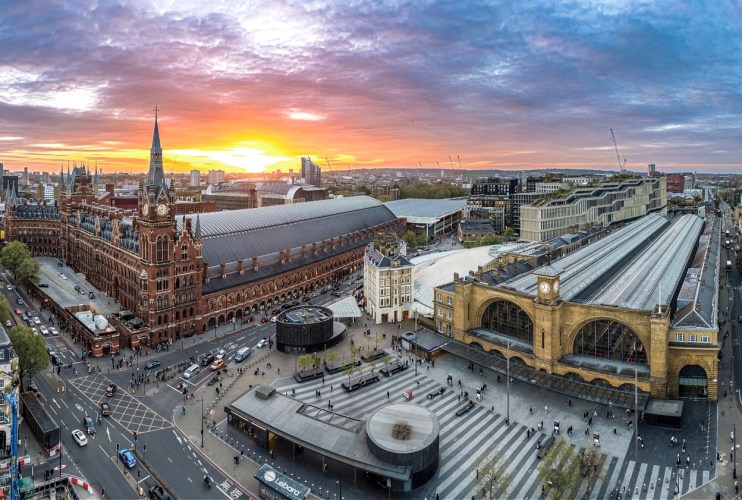
The innovation district around Kings Cross and Euston has the potential to grow into the UK’s version of Kendall Square, writes Professor Geraint Rees
A smiling Oscar Murphy, 28, was all over the news this week. Oscar had become the first patient with leukaemia to be treated with cutting-edge personalised immunotherapy on the NHS. The incredible CAR-T therapy sees a patient’s ‘T’ cells extracted, modified to recognise and target cancer cells, and then injected back into the patient.
Behind this inspiring story is a decade-long journey – one that should make us very optimistic for London’s life sciences sector. That journey began with brilliant research by academics at UCL’s Cancer Institute. They were then helped by UCL Business to form Autolus, a spinout company dedicated to developing, trialling and bringing the CAR-T therapy Aucatzyl to market. Crucially, its clinical trials drew on NHS patient data and hospital infrastructure.
Autolus has grown into a company that has raised $1.1bn, employs 450 people and operates a state-of-the-art UK manufacturing facility. This is a story that couldn’t have started anywhere other than London. And specifically, the innovation district around King’s Cross and Euston.
Why here? Because modern life sciences require mathematicians, AI specialists, engineers, biologists and clinicians working together. Such a concentration of researchers, accelerators, founders and investors creates the random collisions that energise the district.
That’s why Isomorphic Labs, spun out from Deepmind in 2021 for AI-driven drug discovery, works by hiring machine learning researchers who can walk down the street to collaborate with medicinal chemists and structural biologists. Proximity is its business model.
Kings Cross could become UK’s Kendall Square
The district has evolved organically over two centuries. UCL, celebrating its 200 birthday this year, is at the heart of an ecosystem that has grown as the Francis Crick Institute and Alan Turing Institute opened within walking distance, and commercial players like Google Deepmind arrived.
This isn’t a curated science park erected by planners – it’s an ecosystem that evolved with demand, which is precisely why it works. For a biotech company managing burn rate while accessing UK and European markets, the economics are compelling: direct rail to Paris and Brussels for regulatory meetings, four international airports for global recruitment and proximity to world-class hospitals for clinical trials. British researchers can work alongside the world’s best. Talent flows from over 100 countries, while building companies that create British jobs manufacturing British treatments.
These are exciting times. We are hitting critical mass and I believe the district has the potential to be the UK’s answer to Kendall Square in Boston – more life-changing treatments, more jobs, more growth.
Last year, London overtook San Francisco, New York and Boston in life sciences and AI investment, hitting $766m so far this year versus $450m in the same period last year. We asked Public First to put a figure on this life science boom. With 12,000 life sciences workers packed into 1.5 square kilometres, this area generates over £8bn annually, equivalent to the entire economic output of Cambridge.
If London matches Tokyo’s Otemachi district growth rate, it adds another £2.7bn in annual economic value over the next decade. Match Kendall Square’s trajectory, and that figure reaches £3.5bn, with 20,000 new high-value jobs. The government’s commitment to innovation-driven growth in the Budget and its Life Sciences Vision show it recognises this opportunity.
But we face genuine competition. Singapore is investing heavily in biotech recruitment because they see the prize. Boston’s Kendall Square benefits from federal research spending that creates competitive advantage. And the European Union is rolling out integrated regulatory approval and clinical trial infrastructure across 27 countries.
However, London has natural advantages they cannot replicate: our integrated health system, world-leading universities and two centuries of organic ecosystem development.
The question is whether we align our efforts to press that advantage.
To do this, we need better coordination in three areas: specialist researcher visas processed in weeks, not months, capital allowances for laboratory construction that actually cover modern clean-room facilities, and streamlined clinical trial approval across NHS trusts.
These aren’t requests for new spending but are about removing friction and aligning processes. Some will say this is just more London-centric thinking and that success in the capital comes at the expense of Manchester, Leeds or Newcastle.
The data tells a different story. Public First’s economic modelling quantifies the spillover effects underlining the importance of connectivity. Manchester biotech firms received £127m in London venture capital last year, directly supporting 840 jobs. Leeds-based medical device companies running clinical trials through London hospital networks generated £43m in local economic activity.
Oscar’s story brings this to life – a London spinout, a Stevenage plant and a smiling patient in Manchester.
The pieces are in place. UCL, our hospital partners and the 400+ companies in this cluster are ready to accelerate this opportunity. The question is whether we can align planning, infrastructure and regulatory processes to match the pace of growth.
Professor Geraint Rees is the vice-provost of research, innovation and global engagement at UCL