King’s Speech shows incremental change is all Starmer knows

Keir Starmer says incremental change won’t cut it, yet his King’s Speech was nothing but tinkering and rearranging, writes Matthew Bowles
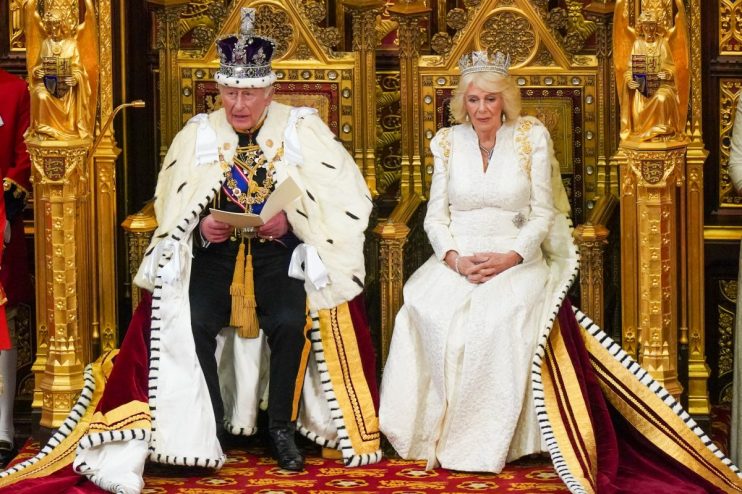
The King’s Speech has been delivered, in the shadow of a government attempting to project its stability whilst contending with visible internal strain. The familiar choreography of the British state – ceremony, tradition and legislative set-pieces – proceeded as expected but against a political backdrop that feels less settled than the formality of the occasion suggests.
What emerged from the Speech itself was a programme that points in a predictable direction: increased regulatory entanglement with Europe and a continued reluctance to confront the structural barriers to growth in the British economy.
For a government that has supposedly made “growth” its defining mission, the gap between rhetoric and policy substance remains remarkably large. Productivity has grown at about 0.4 per cent since the 2007/08 Financial Crisis, compared with around two per cent in the period preceding it. Yet there was once again little in the Speech that suggests any meaningful break from the regulatory and fiscal instincts that have contributed to this lost generation of growth.
‘Dynamic alignment’ with the EU
One of the most consequential strands in the programme, and something many supporters of the Labour Party seem to see as their saving grace, is the continued movement towards so-called “dynamic alignment” with EU rules. This will impact areas such as food standards and agriculture. Framed as technical cooperation and trade facilitation, in practice it binds Britain to compliance with ever-evolving EU regulation in sectors that include SPS rules, carbon pricing via the EU Emissions Trading System (ETS) and product standards, all without any corresponding role in shaping those rules. This reality has been outlined in the Prosperity Institute’s recent paper, A Road to Nowhere.
This creates the constitutional aberration of regulation imposed on Britain and rubber stamped by a supposedly sovereign parliament. Dispute resolution mechanisms in these areas remain tied to external legal interpretation, with European Court of Justice influence persisting indirectly through alignment frameworks.
Economically, the implications to British business are clear. In the food and agriculture industries, businesses will face ongoing compliance costs in adapting to rules over which they have no formal influence, even those who don’t ship goods to the EU In some export-sensitive sectors, frictions are estimated to add around five to 15 per cent to shipment costs, particularly for smaller firms operating at the margins of profitability.
Promised leasehold reform
Elsewhere, the Leasehold and Commonhold Reform Bill has been presented as one of the more significant domestic reforms in Labour’s programme, and there are few who would argue that the existing leasehold system is not in need of change. It is widely regarded as complex, opaque and in parts archaic, with structural features that distort the housing market. Reform has been promised by successive governments of different stripes.
However, the manner of reform has drawn significant criticism from institutional investors and pension funds on issues of property rights and legal certainty. Major investors, such as Nationwide Building Society, have warned that the decision to cap and reduce ground rents to £250 risks undermining confidence in Britain as a stable investment environment.
Estimates cited by industry bodies suggest that the reforms could redistribute between £10bn and £13bn in value from freeholders to leaseholders, with a significant proportion of that ultimately flowing not to owner-occupiers but to institutional or overseas landlords. This has prompted warnings that the measures represent not simply reform, but a wealth transfer achieved through retrospective alteration of long-standing contractual arrangements.
Action on employment
The King’s Speech also contained emphasis on tackling youth unemployment and increasing labour market participation, with the government pledging to respond to the upcoming Milburn Review, which is investigating the causes of record youth unemployment and is due this summer. In principle, this is one of the few genuinely growth-adjacent announcements. However, it sits uneasily alongside existing legislation that pushes in the opposite direction.
The Employment Rights Act 2025, alongside increases in employer National Insurance contributions, has already raised the marginal cost of hiring. Even where certain elements of the Act have been softened in passage, there are greater obligations on employers, more procedural hurdles around flexibility and higher wage costs associated with entry-level recruitment than there was before the legislation was introduced late last year.
This matters most for young people, who are disproportionately represented in entry-level and lower-productivity roles where hiring decisions are most sensitive to cost. ONS Labour Force Survey data shows that around 957,000 young people aged 16-24 were “not in education, employment, or training” (NEET) in late 2025, equivalent to 12.8 per cent of the cohort.
This leaves youth inactivity hovering just below the symbolic one-million threshold and underscores the extent to which the labour market amongst young people remains fragile by historical standards.
It is also difficult to separate this from the broader structure of the British welfare state, which continues to generate significant incentives toward remaining jobless at the margin. When combined with higher hiring costs, this creates a heavy burden on potential new entrants to the labour market rather than existing employees. The emphasis on movement into work, should be refocused towards making hiring it economically and regulatorily attractive to employers.
The King’s Speech failed to reset
Alongside this sits the proposed Energy Independence Bill, which commits the government to ending the issuance of new North Sea oil and gas licences and placing a statutory ban on fracking. At a time when advanced economies are competing to secure reliable energy supplies amid persistent global price volatility, the decision to foreclose domestic licensing raises severe questions about the coherence of Labour’s energy strategy.
It may be too much to have expected a genuinely radical departure in the King’s Speech. That is not Starmer’s style, and his government has been bureaucratic, procedural and incremental in approach. But that only raises the stakes of some of the language being used by the Prime Minister. If “growth” and “reset” are to mean anything more than rhetorical packaging, they will require a reinvention from the policy instincts not seen since the last election.
The King’s Speech was not without legislative activity, but it is difficult to identify any serious attempt to alter the underlying conditions that constrain British growth. In an economy where productivity has barely grown for over a decade, incremental management falls far short of what is required.
Matthew Bowles is a senior policy researcher at the Prosperity Institute