Skip to content
Friday 7 August 2026London --:--Frankfurt --:--Zurich --:--
NewslettersSearchEN · DE
MorningWire

European business, markets and politics

FTSE 100
10,901.09
+0.31%
DAX
26,319.45
+0.69%
CAC 40
8,714.93
+0.17%
STOXX 50
6,523.86
+0.33%
  • Europe
  • Markets
  • Business
  • Economy
  • Technology
  • Politics
  • Opinion
More
GermanyFranceBankingAIEnergyFintechPropertyCapital Markets
  • Germany
  • France
  • Europe
  • Markets
  • Business
  • Economy
  • Technology
  • Politics
  • Opinion
  • DE
Wednesday 27 November 2019 6:55 am  |  Updated:  Tuesday 26 November 2019 7:00 pm

Labour’s rejection of conventional economic theory ignores important insights

By: Paul Ormerod

Add as a preferred source on Google
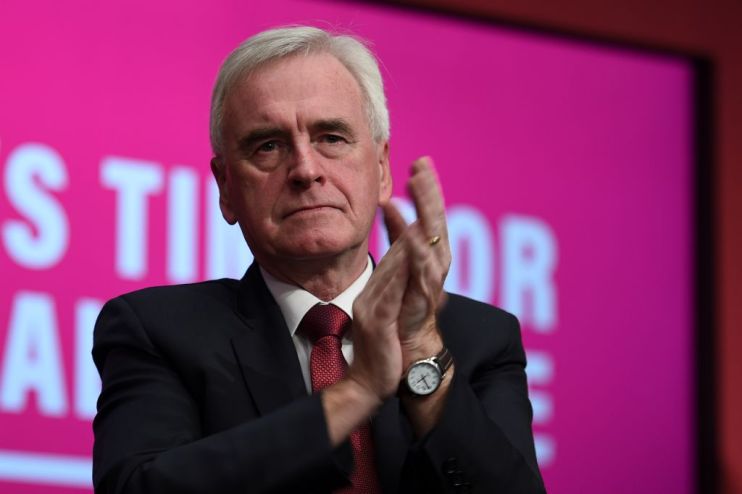
BRITAIN-EU-POLITICS-BREXIT-VOTE-LABOUR
Labour's John McDonnell has radical plans for the UK

One of the first tasks facing whoever becomes chancellor after the General Election will be choosing the next governor of the Bank of England.

Getting to make this choice would be a key step in the plans of Labour’s shadow chancellor John McDonnell to  shake up the Bank of England, but his radicalism is not simply a matter of practical policies. McDonnell appears to want a new intellectual approach at the central bank and across government, one not based on existing economic theory.

Many people on the left, such as McDonnell, have criticised austerity ever since the financial crisis of the late 2000s. They often believe this to be a criticism of conventional economic theory. 

But these are two different things. They are not the same. It is certainly possible to construct a coherent critique of austerity purely on the basis of standard theory.  

Economists disagree on the matter because of different interpretations of the empirical evidence, rather than on the basic theory.

However, Labour’s election manifesto appears to want to ditch the most powerful insight of the whole of economic theory. Namely, that people react to changes in the incentives which they face. If incentives change, behaviour changes.

For example, even the most dedicated critic of economics will slow down when approaching a speed camera if they are exceeding the speed limit. On the open road, there is a chance of being stopped by the police, but it is very small. Yet the probability of incurring a penalty rises sharply in the presence of a speed camera. And so behaviour changes — the driver slows down.

We can apply this insight to taxation. Already, the top one per cent of earners in the UK pay well over 30 per cent of all income tax, according to calculations by the Institute of Fiscal Studies.  

Read more

Burnham’s cheerfulness could turn the economy around

Andy Burnham laughing outdoors in a candid moment, May 2026, capturing a lighthearted political event atmosphere.

Before tax, to be in the top one per cent you have to earn at least £166,000 a year. After tax, the figure falls to £111,000. So these individuals — just over 300,000 of them — are already handing over one third of their income to HMRC.

We know from Labour’s manifesto that McDonnell wants to raise many billions more in tax from the top five per cent of earners. 

Much of this would potentially fall on the top one per cent, where the money is really concentrated. But this would require these taxpayers to stand still and wait to be plucked like so many golden geese. Economic theory, supported by a vast amount of empirical evidence, suggests that this just would not happen.  

The same ignorance of fundamental, well-supported economic theory is seen in Labour’s policy on corporation tax. The proposal is to raise the rate from 19 to 26 per cent.

The basic problem here is that if the tax rate changes, the behaviour of a company will change.

The company may hold down wages. It may not take on extra staff, or even get rid of existing employees. It may cut dividends, so that pension funds and the income of pensioners is reduced. Or it may slash investment, so that the workers in the firms which supply to the company will suffer.

Instead of jettisoning economic theory, Labour should learn from its most powerful insights.

Main image credit: Getty

Read more

What are we to make of John Healey? Time will tell.

John Healey - Chancellor

Share this article

  • Facebook
  • X
  • LinkedIn
  • WhatsApp
  • Email

Similarly tagged content:

Sections

  • Markets & Economics
  • News
  • Opinion

Categories

  • Economics
  • Opinion
  • Politics

Related Topics

  • General election 2019
  • John McDonnell
  • Tax

Trending Articles

  • Revolut founder’s wealth set to balloon amid talks of share award at $500bn valuation

  • Rupert Lowe axes pensions triple lock and pledges tax cuts in economic plan

  • WPP slashes jobs as revenue continues to fall

  • Liverpool owners tipped to sell – but not to Amazon boss Bezos – by former CEO

  • As it happened: Stocks rise as oil fluctuates after Red Sea attack; US-Iran deal ‘being circulated’

More from Morning Wire

  • Burnham’s cheerfulness could turn the economy around

    Opinion
    Andy Burnham laughing outdoors in a candid moment, May 2026, capturing a lighthearted political event atmosphere.
  • What are we to make of John Healey? Time will tell.

    Economics
    John Healey - Chancellor
  • IMF warns Bank of England against cutting interest rates

    Economics
    IMF Chief Kristalina Georgieva issues caution to Bank of England amid economic concerns
  • Will Britain follow Japan’s great growth gamble?

    Opinion
    Japan Prime Minister Sanae Takaichi speaking at a press conference, highlighting her leadership and political agenda
  • Four charts revealing scale of Andy Burnham’s economic challenge

    Economics
    Due to the lack of article title, content, categories, and tags, its impossible to create a specific, keyword-rich alt tex...
  • Atlanta set for major economic boost as England World Cup fans spend

    Sport Business
    Breaking news illustration with digital world map and stock market graphs, highlighting global economic trends.
  • The Debate: should Andy Burnham have made a woman his Chancellor?

    Opinion
    Rachel Reeves delivering a speech at a press event, wearing a navy blazer and standing in front of a backdrop with logos.
  • Voters expect Burnham to hike taxes

    Politics
    Andy Burnham discussing capital gains tax increase during a press conference, highlighting potential economic impacts
MorningWire

Independent European business, markets and political news for decision-makers.

Morning Briefing

Europe

  • Germany
  • France
  • Europe
  • UK & Ireland

Business

  • Markets
  • Banking
  • Technology
  • Energy
  • Property
  • Fintech

Editorial

  • Opinion
  • Editorial Policy
  • Corrections
  • Contact

Company

  • About Morning Wire
  • Privacy Policy
  • Terms of Use
  • Cookie Policy
© 2026 Morning Wire Ltd · Published by Morning Wire Media, Bahnhofstrasse 65, 8001 Zürich, Switzerland
Privacy · Terms · Cookies · Facebook