Lessons in liberty from Argentina and the Milei revolution

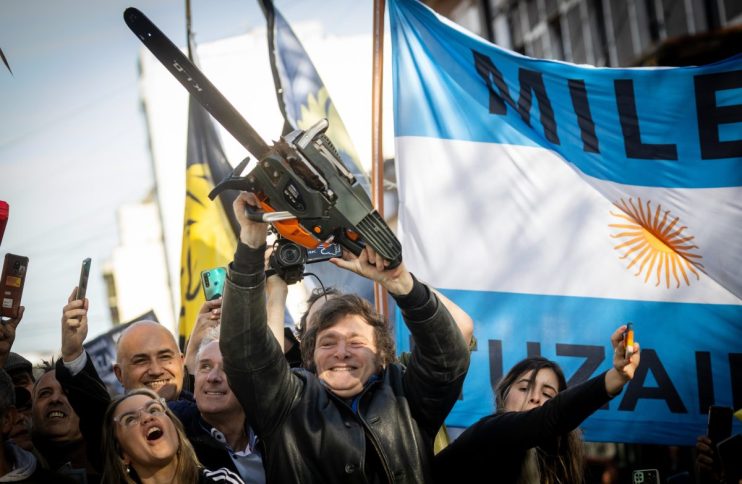
Javier Milei is turning his country around, but just like Britain in the 1970s, things in Argentina had to deteriorate dramatically before capitalist reformers like him and Thatcher stood a chance, says Rainer Zitelmann
During my visits to Argentina in 2022, 2023 and 2024, I had the opportunity to witness first-hand the movement that propelled anarcho-capitalist Javier Milei to victory in the presidential elections. Milei’s presidency has since attracted a lot of interest from both left-wing anti-capitalists and libertarians alike. While some seek to demonstrate that Milei’s policies are plunging people into poverty, others view him as a beacon of hope.
Argentina holds a sad record. No country in the world has descended so dramatically in the last 100 years as Argentina. In the early 20th century, the average per capita income of the population was among the highest in the world. The expression “riche comme un argentin” – rich as an Argentinean – was commonly heard at the time.
In the late 19th and early 20th centuries, Argentina’s per capita income exceeded that of Italy, Japan or France. In 1895, it even achieved the highest per-capita income worldwide, according to some estimates. Moreover, Argentina’s six per cent annual GDP growth for the 43 years preceding World War I is the largest in recorded history. Argentina’s impressive economic performance was not based on the export of raw materials alone: between 1900 and 1914, the country’s industrial production tripled, reaching a level of industrial growth similar to that of Germany and Japan. All of this was accompanied by unprecedented social progress. In 1869, between 12 and 15 per cent of Argentina’s economically active population belonged to the middle class; by 1914, this number had reached 40 per cent. At the same time, illiteracy was reduced to less than half of the population.
However, this success story was followed by a hundred years of unprecedented decline. The ratio between real GDP per capita in 2018 and the same figure in 1913 shows that Argentina’s ratio has barely risen and is the lowest of all countries for which data are available for both years.
I met Fausto Spotorno, Chief Economist at Centro de Estudios Económicos of the consultancy firm OJF. He showed me an impressive statistic, according to which Argentina has almost constantly experienced double-digit inflation rates since 1945 – with the exception of the 1990s, when Carlos Menem pegged the currency to the dollar, thereby eliminating inflation for a decade but negatively impacting exports as Argentine goods were no longer competitive.
Peronism: A national religion
For decades, Argentina was a country where belief in the state was unwavering. Peronism, a statist ideology, was the national religion. However, by 2022, I could already see that the mood had changed. I visited various cities, such as the city of Corrientes, which reminded me of the south of France and is home to palm trees and one of the largest rivers in the world. I met Eduardo Tassano, the mayor of the city. I could tell that libertarian ideas were on the upswing when Tassano, who sees himself more as a social democrat, was asked what he would change in Argentina and immediately mentioned deregulation of the labor market and tax cuts.
When my survey on the image of the market economy was conducted in Argentina in 2022, it revealed a significant shift in sentiment: more than a year before Milei’s election victory, a majority of Argentines had a more positive opinion of the market economy than people in most other countries around the world.
I also met some of the Milei movement’s leading politicians for the first time in 2022 and was impressed by their innovative approach to marketing. Milei attracted a lot of attention by launching a lottery: anyone who registered via social media could win Milei’s final month’s salary as a congressman. That’s 350,000 pesos, equivalent to about $1,800 in May 2022. Considering the average income in Argentina was around 60,000 pesos, it was an attractive sum. In the three months since he announced he was raffling off his last pay check, two million Argentines signed up for the lottery. Milei wanted to prove: “I didn’t go into politics for the money”.
I returned to Argentina immediately after Milei’s election. When I arrived in Latin America on 19 November, 2023, I found two Whatsapp messages on my phone. “We won,” a representative of Javier Milei’s party had written. I had been talking about Milei a lot for about a year and a half and thought he had a good chance of becoming president. The second Whatsapp message was from José Fucs, editor-at-large of the leading Brazilian newspaper O Estado de S. Paulo: “You were the first one to tell me he had huge support in Argentina, mainly among younger people, and could win the election.”
I wondered whether the people of Argentina would stand by Milei, even if the situation temporarily deteriorated as a result of his free market economy reforms? I knew there would be a period of initial hardship, as other successful capitalist reforms (for example, under Thatcher in the UK and Balcerowicz in Poland) also saw things get worse for about two years before they got much better. Would people have the patience and resilience to endure this lean period?
I knew there would be a period of initial hardship, as other successful capitalist reforms (for example, under Thatcher in the UK and Balcerowicz in Poland) also saw things get worse for about two years before they got much better. Would people have the patience and resilience to endure this lean period?
In August 2024, I was in Argentina for a third time. The prevailing sentiment was still pro-Milei, with polls showing that more than 50 per cent of the population supported him. In Córdoba, Argentina’s second largest city, I had a long conversation with the mayor Alfredo Cornejo. He belongs to the Radical Party and initially harbored doubts about Milei. His scepticism, he told me, had since transformed into confidence. According to Cornejo, Argentina is now headed in the right direction.
In Buenos Aires, I met Agustin Etchebarne, general director of the libertarian think tank Libertad y Progreso. He said: “Young people and the poor continue to stand by Milei. Most of them voted for him and they remain steadfast in their support”. If they criticise him at all, explained Etchebarne, it was at most because they thought he was not being radical enough. They wanted him to take even tougher action against the despised “Casta” that had brought such ruin upon the country.
In the meantime, inflation in Argentina, which was running at almost 26 percent a month (!) when Milei became president, has now fallen to 2.3 percent. The poverty rate initially rose, as I had expected, but at the end of the year 2024 it had dropped below the level it had been at when Milei took office.
One major change under Milei is that funds are now allocated directly to those in need, bypassing the intermediaries, the left-leaning political organizations, that claimed to support the poor but siphoned off most of the money for themselves. “Milei,” said Etchebarne, “gives the money directly to the poor, while the left-wing organizations are left empty-handed.”
That is the big difference between Milei and the conservative Macri, who inadvertently bolstered his left-wing political adversaries with massive cash payments during his time in office. By cutting out the intermediaries, the poorest Argentines now receive much more assistance than they used to get.
What can we learn from Argentina? Similar to the UK in the 1970s, the situation has to deteriorate dramatically before capitalist reformers like Thatcher or Milei have a chance. But even that is not enough. A shift in public opinion must precede any meaningful reform. Prior to Thatcher’s leadership, influential think tanks like The Adam Smith Institute, the Institute for Economic Affairs and the Centre for Policy Studies played a crucial role in shaping the public discourse. In Argentina, libertarian think tanks also paved the way for Milei, who is now able to reap what they had previously sown.
Excerpt from Rainer Zitelmann, The Origins of Poverty and Wealth: My world tour and insights from the global libertarian movement