Let’s be honest, China’s economy is suffocating under President Xi

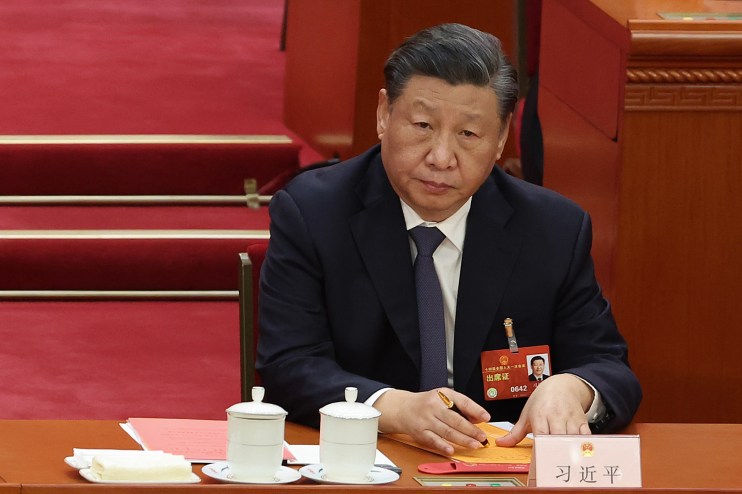
President Xi’s protectionist policies and hostility to foreign investors mean China is no longer the country to bet on for growth – and that’s a lesson for the West too, says Matthew Lesh
Prior to entering government, Foreign Secretary David Lammy said the Conservatives’ approach to China was excessively confrontational and inconsistent. He reportedly now wants to rebalance relations, focusing on closer cooperation and economic engagement.
The government’s interest in boosting trade and investment with China makes sense in the context of their ‘mission’ to boost economic growth. It is also equally easy to see why this will offend those concerned about China’s threat to the liberal international system, the treatment of Hong Kongers and Uyghurs, and the risk of conflict with Taiwan.
But too few have bothered to ask whether China really is the country you want to bet on for growth. During the ‘golden era’ in UK-China relations under David Cameron, it seemed obvious that the populous and booming country was on an unstoppable trajectory. That’s much less the case today.
It’s not that China’s economy has crashed, albeit the country’s property and debt bubbles still raise that risk. It’s more that the increased geostrategic tensions and shift under President Xi towards national security are doing damage.
China prospered over the first two decades of the 21st century after it decided to liberalise the economy, allow the development of a private sector and open up to global trade and investment. By contrast, President Xi has taken greater central control, harassed entrepreneurs and foreign companies, cracked down on internal critics, and subsidised domestic production. The behaviour has been justified under the ‘national security’ banner, but it is just as much about securing domestic control by a paranoid Chinese Communist Party. Indeed, it is much more difficult to maintain a monopolistic grip on power in a liberalised economy.
Whatever the reason, the results are becoming clear. Foreign direct investment, once a torrent fueling China’s economic engine, has slowed to a trickle. The latest figures show that foreign direct investment has reached its lowest point since records began in 1998. This isn’t a blip – it’s a trend and one that’s accelerating.
Why the investor exodus? Look no further than Beijing’s increasingly harsh approach to foreign companies. In 2023 alone, we witnessed a string of high-profile crackdowns on foreign firms like Mintz Group and Bain & Company, including the arrest of employees.
It’s not just foreign companies feeling the chill. In the latest edition of Economic Affairs, the IEA’s academic journal, China analyst Dr Kerry Liu develops a new security policy index using data from China’s largest search engine, Baidu. This is a proxy for official emphasis and public attention being paid to national security.
The central finding is that as the focus on national security has grown, foreign investment, industrial growth, and the value of the biggest companies on China’s stock market have markedly reduced. In other words, the sectors that powered China’s economic miracle are now sputtering under the weight of excessive regulation and state interference.
Perhaps most notable is the impact on innovation. China’s tech giants, once the darlings of the global investment community, are facing difficulties from data localisation laws and restrictions on foreign collaboration that threaten to cut them off from the global knowledge economy. It’s a similar story for Fintech, after the state crackdown, and the focus on domestic production has pushed up costs and down quality.
Perhaps Western leaders can learn something from China’s emerging malaise. Strangling private enterprise and disconnecting from the interconnected global economy have real and negative consequences. Openness and dynamism were not only essential for China’s rise, but our own as well.
Matthew Lesh is the Director of Public Policy and Communications at the Institute of Economic Affairs