Let’s get kraken: How the Octopus Group is making waves

For a long time, it seemed like the bosses of finance, energy, and property corporations were laughing – the heartless belly laughs of those raking in stacks of money at the expense of their customers.
Now there’s a growing trend for companies that care about the people they serve, a feeling that this should be their priority, and that profits will follow suit. But when Octopus was starting out almost two decades ago, that definitely wasn’t the case.
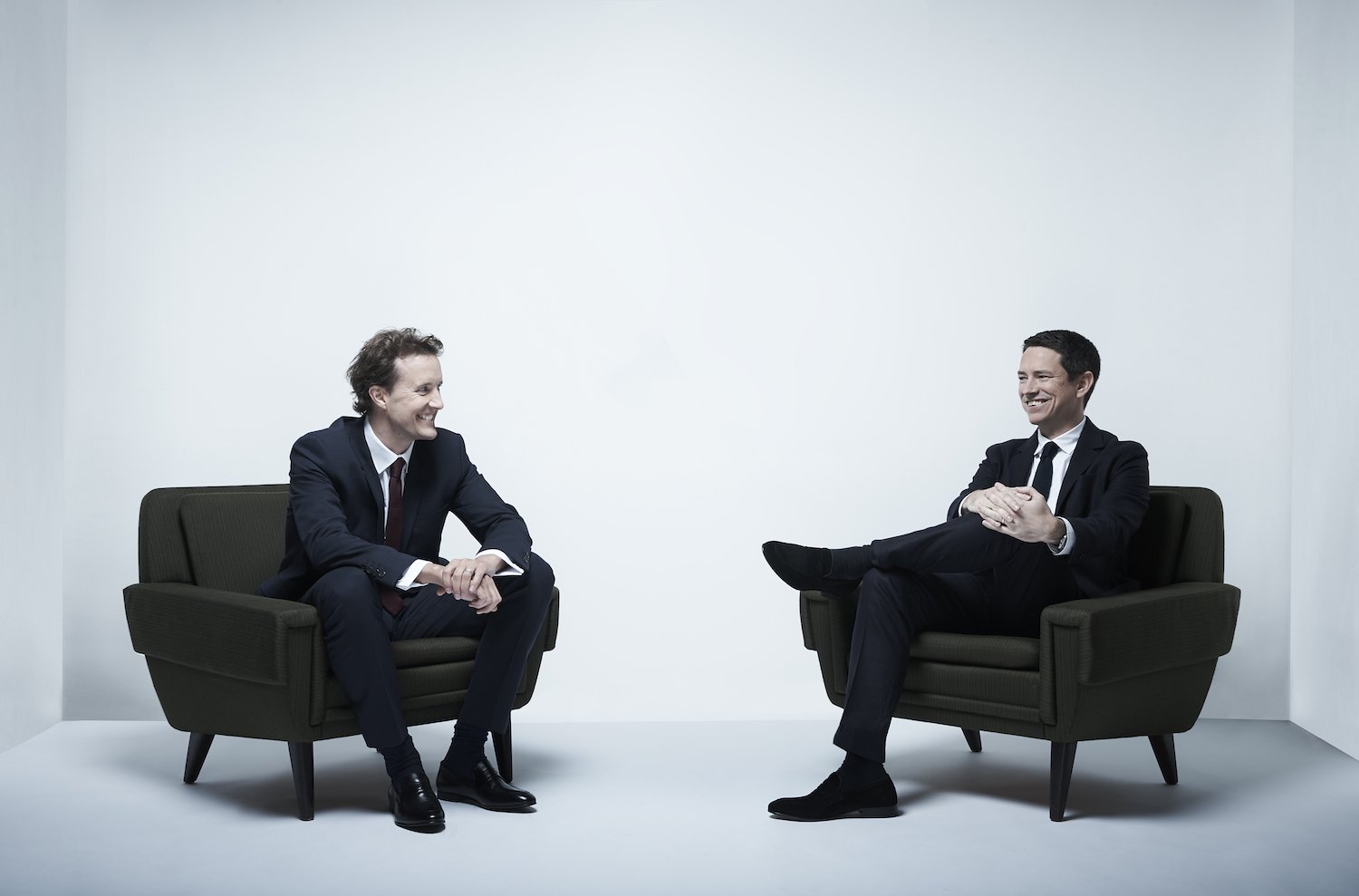
“Companies used to think that they’d done their bit just by hiring people and paying their wages – but that isn’t okay anymore,” says co-founder and chief executive Simon Rogerson (pictured left). Now, he says, businesses should also be trying to fix things, to make the planet a better place.
Day of the tentacle
In truth, one of the reasons that this caring-about-customers craze has caught on is because organisations like Octopus have proven that it’s possible.
Rogerson, Chris Hulatt (pictured right), and Guy Myles (who left in 2014) launched Octopus as a fund management company in 2000. But over the years, the group has expanded into renewable energy, property lending, venture capital, healthcare, and fintech.
The problems in each sector revolve around lack of trust – and this is where Octopus wants to stir things up.
Take Octopus Energy. Set up as a challenger to the big six energy suppliers, it offers low rates, lets you manage your bills online, has no exit fees, and almost 70 per cent of its energy comes from renewable sources. In just two years, more than 400,000 customers have signed up. I’ll admit, I am one of them.
“People didn’t think it was possible to care about energy – but it turns out people do care about renewables and customer service,” says Hulatt.
The idea of caring has been the strategy with the group’s other businesses too – they are either filling the funding voids in the small business and property worlds, offering jargon-free investment products, or building much-needed care homes, hospitals and surgeries.
Against the current
With companies increasingly being held to account via platforms like Twitter and Trustpilot, the power is shifting to the end consumer. As Hulatt says: there’s no hiding place for bad businesses anymore.
Nowadays, companies need a conscience – they should say please, thank you, or sorry if they get something wrong, says Rogerson. The trouble is that many firms in the energy and financial sectors tend to forget the human element to running a business.
“Most of the big incumbents still think they are the adult and the customer is the child” he says. “People want businesses to be genuine in their values – not to say one thing and then behave completely differently.”
Like so many other challenger businesses, Octopus has learned from the failings of the big providers, creating a service that actually meets people’s needs, while cutting out the unnecessary complexity that plagues so many sectors.
A kraken system
Given how integral technology is to the group now, it’s surprising to hear that it was an afterthought in the early days. The co-founders admit that they used to outsource the digital side of the business, because – at the time – they saw tech as a mere support function.
But a few years ago, the group set up Octopus Labs to weave technology into the core of each business. Now, it has a central in-house system called Kraken, which means that the team can tweak things quickly without having to contact a third-party provider.
“If you have lots of separate systems, it’s almost impossible to reengineer from that position,” Hulatt explains.
The octoposse
What strikes me about the two co-founders is how different they seem – Hulatt is soft-spoken and careful about his choice of words, while Rogerson talks rapidly, often launching full pelt into an eloquent stream of consciousness.
Their roles within the group also differ, with Rogerson building the “new stuff”, and Hulatt talking to institutional investors and politicians about things like sustainability and creating better conditions for entrepreneurs.
And yet, in 18 years of working together, they say they’ve never had an argument. “There’s lots of respect – we know what we’re good at,” says Rogerson. “Chris is the massive voice of reason, so he brings me back down to reality. I would never make a big decision without talking to him.”
We’ve had people tell us things can’t be done a certain way for 20 odd years
As a whole, there is a willingness to listen to other points of view – helped by having two founders with different perspectives (Hulatt says being a solo founder must be lonely), but also in listening to the staff they employ.
Octopus has gone as far as to set up a scheme, known as Springboard, which allows employees to spend four months building their own startup. They’re even paid a salary and given working capital to pursue their ideas.
“We don’t want to be a company of two entrepreneurs – we want to be a company of 700 entrepreneurs,” says Rogerson. “The world is changing so quickly that we need people who are willing to try different things. It also means that, if they come back to work at Octopus, they’re more valuable.”
Sink or swim
Octopus hopes to reach every household in the UK via at least one of its businesses, which certainly sounds ambitious for a firm still in its teens.
“We’ve had people tell us things can’t be done a certain way for 20 odd years,” says Rogerson. But the cynics have nearly always been proven wrong, forced to watch from the sidelines while the group has gone from strength to strength (it now manages £8bn on behalf of clients).
In many ways, the Springboard scheme seems like a reaction to the narrow-minded mode of thinking that is rife among the group’s larger peers. “Corporate people who say ‘you can’t do it that way’ drive me up the wall,” says Rogerson. “The world is changing unbelievably quickly – you have to be open-minded.”
One thing is for sure: it’s the outdated leviathans that will sink when customers have run out of patience, while businesses like Octopus will continue to make waves.