Like Covid, we ignore AI exponentials at our peril

The Notebook: Where the City’s movers and shakers have their say. Today, it’s Marc Warner, chief executive of AI firm Faculty
It’s February 2020. A little known disease called coronavirus is spreading exponentially. It seemed early to act – but before long, the NHS risked being overwhelmed and lockdown was unavoidable. It’s almost a cliche to say humans are bad at processing exponentials, but it’s true. I worry we’re similarly underestimating the exponential “rising tide” of AI.
I’m thinking about this because an organisation called METR recently published a paper, Measuring AI Ability to Complete Long Tasks. It’s one of the clearest demonstrations of exponential AI progress yet. Their approach was simple: test AI on how long it takes to complete tasks compared to humans.
The result? AI capabilities have doubled every seven months since 2019. GPT-2 could handle two-second tasks, GPT-3 could do nine-second ones, and current models handle tasks that take humans two hours. If this trend continues, AI could autonomously tackle month-long projects within five to seven years.
We set up a team at Faculty to examine what this means for different sectors. Mapping METR’s results onto banking tasks, for example, shows the tide rising, fast. 15-minute tasks could be automated by 2026, four-hour tasks by 2029, and multi-day work by the early 2030s.
Like any forecast, this has caveats. It works best on well-defined, “low-messiness” tasks with abundant data. It also depends on continued heavy investment in infrastructure, like computing and energy. But for routine, well-defined processes, the trend could be meaningful.
If you were governing an island nation faced with rising sea levels, you might retreat from some areas, defend others, and create new harbours. Businesses will have to do the same. This analysis, while not perfect, might provide a window into AI’s likely progress – a rarity in scientific discovery. We can use it to help businesses build their “sea defences,” protect their most valuable assets and seize new opportunities.
As the Danish saying goes, “prediction is hard, especially about the future.” But before you dismiss this trend, think back to 2020. Staring at exponentials and taking them seriously may not be the complete answer, but it’s a strong starting point.
US boosterism v UK cynicism
I recently visited San Francisco. Four years ago, people said the city was dying. Today it is booming. The confidence is palpable. The naysayers were wrong.
In the UK, things are undoubtedly tough. But it’s worth remembering how fast sentiment can change. Of course, strong fundamentals are needed. These take time to fix. But we also need to be confident in our ability to change things. I think we need more boosterism.
It’s one reason initiatives like the Looking for Growth movement are exciting. They have the energy and determination to push us forward. Their biggest event ever is on 23 October. If you believe decline isn’t inevitable, and want to create an ambitious, exciting vision for Britain, come along!
The good, the bad and the ugly
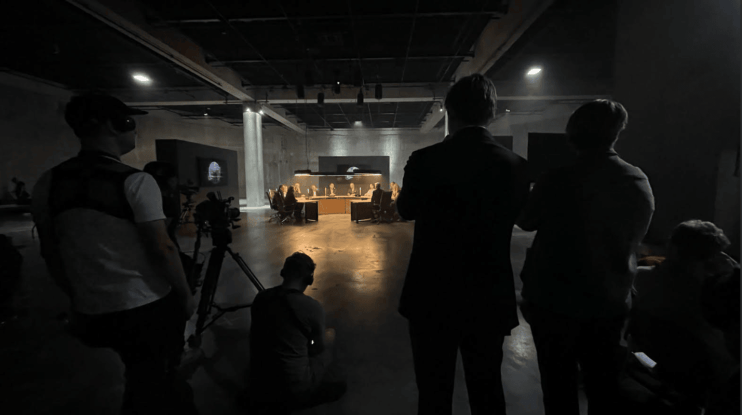
The picture above might look like an underground bunker, but it’s actually a behind the scenes shot of a documentary. Intelligence Rising was developed to increase awareness amongst world leaders and the public of the realities and risks resulting from the global race towards artificial general intelligence (AGI). The benefits of AI are vast, and society is increasingly beginning to appreciate them. But the same cannot be said for AI’s risks, which remain poorly understood. When released, I hope this documentary will play an important role in illustrating both.
Airforce thinking
Recently, I stumbled across a freshly digitised speech by Admiral Rickover, an American Naval officer called ‘the Father of the Nuclear Navy’, from 1954. There’s a famous quote about him: “the Navy has three enemies: the Russians, the Airforce, and Admiral Rickover”. If you know anything about driving change in bureaucracies, you’ll know there’s no higher complement. It is striking how applicable his advice is to organisations today, particularly those thinking about transformation (likely AI related), and how much we have forgotten. I could have saved myself lots of pain by following it more closely over my company’s history.
Quote of the week
Alongside Rickover’s organisational advice, this Warren Buffett quote resonates
In looking for people to hire, you look for three qualities: integrity, intelligence, and energy. And if you don’t have the first, the other two will kill you