London Marathon has never been more popular so why not make it bigger?

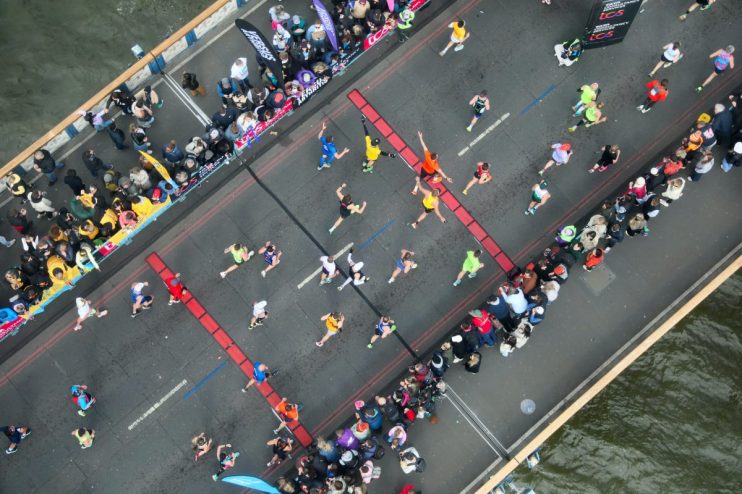
The ballot for entry to the 2026 London Marathon opens tomorrow and closes next Friday. Over 840,000 entered the draw for this weekend’s race.
Strip out places bought for fundraising runners by charities as well as club slots and age-graded, guaranteed entries, and the odds of ballot success were just one in 50. Rarity value is unlikely to deter bucket-list aspirants though.
If anything, the slimmer the odds, the greater the cachet that comes with success. Don’t be surprised to see 1m ballot entries, if not for 2026 then soon.
Sunday will be the 45th edition of the race. Just over 7,000 runners took part back in 1981. Last year, 54,218 crossed the start line, 98 per cent of whom went the distance.
This year, the number of finishers should set a global record. The Marathon’s organisers have progressively squeezed more runners into their event by elongating its start window and keeping the route open for longer.
Although they move the finish from The Mall to St James’s Park during the evening of the race, the slowest athlete still has until one second before midnight to record an official finish time. That runner may only have started their race at 11:30am, almost three hours after the elite wheelchair racers.
In one way, the London Marathon appears not to have grown over the best part of half a century. Crowds lining the city’s streets were estimated at 1m for the inaugural race. Numbers in recent years have been said to be around 750,000.
My own experience suggests that guesstimating may be a little more efficient and less hyperbolic nowadays. Whatever the truth, the crowds are a vital element in the event’s allure – after all, there are other 26.2 mile races, in the UK and worldwide, which do not require crossed fingers or the treadmill of charity fundraising to secure a bib number.
As a reward for commitment to the grassroots infrastructure of British running, the London Marathon provides places to formal running clubs and also makes available 6,000 slots for athletes who meet time targets that are graded according to age.
As the popularity of the race has continued to swell, so these “good for age” times have become faster. Twenty years ago, for example, the cut-off for a male in his early 40s was 3:15 hours. For the 2026 race it is 2:57.
It’s not just London that’s in demand. Boston is the Major with easily the longest history, having been established in 1897. It requires almost all entrants to have recorded an age-related qualifying time. Over the past couple of decades this has been sliced by 15 minutes for the youngest men and women to 2:55 and 3:25 respectively.
This is not an indication of a faster nation, or of a swifter cohort of runners within the population (though the advent of carbon-plated “super shoes” will have had some effect at the margin).
Nor is it that significantly more people are now committed runners (indeed, Sport England data shows a 600k+ drop from pre-pandemic levels). Rather, it is the lure of the iconic event itself, an attraction amplified in the past few years by social media.
Enter the race and you will be astounded by the number of runners talking into their phones as they video their marathon experience. Unless, of course, you are one of those doing just that. A simple GoPro? So yesterday.
Commentaries and selfies are essential apparently. Just give these wannabe influencers a wide trip hazard berth if you’re running.
One demographic trend that is particularly striking has been the growth in the number of women in races. They made up 42 per cent of the finishers in last year’s London Marathon, and 49 per cent of ballot entrants this time.
Ten years ago, 38 per cent of finishers were female. A decade before that it was 30 per cent. Head back to that first race in 1981 and fewer than five per cent of the runners were female.
And it’s not just the Marathon. Today, the majority of participants in some smaller, local races are women.
There is no guarantee that the London Marathon, or indeed its Abbott World Marathon Majors compatriots around the world, will continue to thrive.
After all, cycling’s RideLondon event is not taking place this year, entries having become easier and easier to secure in recent times for those eager to cycle 100 miles from the city into Essex and back again.
London Marathon Events also organises RideLondon, so will be acutely aware of the danger of swings in mass participation fashion.
Fine margins dictate the success or failure of races of all sizes – their costs largely fixed, but income highly variable. Small and mid-sized running events struggled in the immediate aftermath of the pandemic.
Both London Marathon Events and the owners of the Great North Run have taken the opportunity to expand their event portfolios, taking over races and investing in organisers. As well as creating operational efficiencies, there are marketing and cross-selling angles, as well as the portfolio effect of reducing the impact any single event failure might have on the whole.
While the expansions of these two empires might be deemed a reaction to their core events being at or near capacity – the Great North Run also has demand overload – you can be sure that both are still actively exploring ways to grow their headline races.
One solution to the constraints of start and finish zones, as well as route congestion, would be to run the London Marathon and the Great North Run through a whole weekend. Two editions of each race. Or, perhaps, through the night, which might have a special appeal for the Insta generation.
Either option would stretch the goodwill of the host cities, as well as the endurance of organisers and volunteers. You could double the latter, but maybe not the former. Sadiq Khan: how do you fancy London being the first city to host a midnight World Marathon Major?
All that, though, is for the future. For now, if you were lucky enough – by whatever means – to secure your 2025 entry, rest up, fuel up, pray the 20C forecast is wrong, and run well on Sunday!
Twist and shout
I was much taken by an article in The Guardian by John Nassoori last weekend about yet another development in the data-driven analysis of footballing talent. This time it’s psychological cues taken from players’ body language, in particular their mannerisms when off the ball.
A contact familiar with the work suggests the most significant data set is something as simple as head movements by midfielders. Those who “scan” the most also deliver the greatest number of completed forward passes – a key metric in sorting the wheat from the chaff.
Doubtless there will be much more of such stuff in the years ahead as football – and indeed all sport – moves further and further away from scouts’ and managers’ gut instincts.
You can read Nassoori’s piece on the work of Inside Out Analytics here.
Ed Warner is chair of GB Wheelchair Rugby and writes his sport column at sportinc.substack.com