Lunchtime Tourism: Cannon Street’s blink-and-you’ll-miss-it London Stone

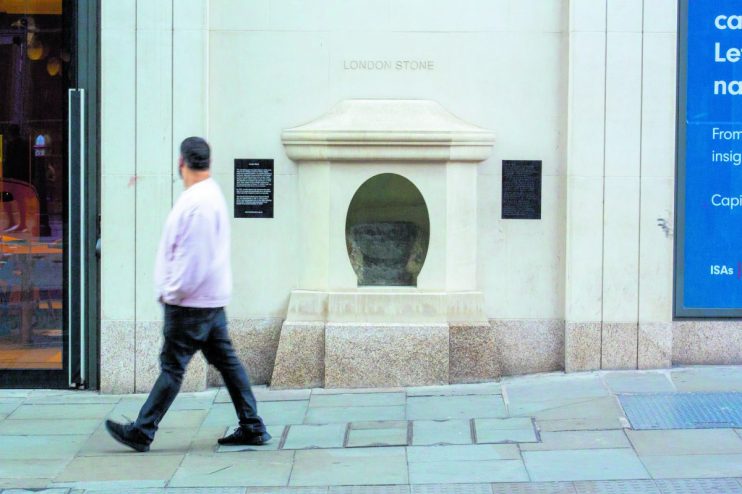
You wouldn’t know it, but London’s heart beats from a small alcove just opposite Cannon Street station.
The city’s heart is made of limestone, wrenched from Rutland and its beats are faint. But its power is unmistakable. Passing office workers fear it so much they’re reluctant to even look at it, let alone stand near it.
What’s left is a fragment of what once would have been a much larger stone, but now it sits unceremoniously in the wall of an office block.
Good thing it is out of harms’ way. “If carts do run against it through negligence, the wheels be broken, and the stone itself unshaken,” historian John Stow wrote in 1598. That would be bad for business.
But London Stone has been around long before those lines were written. Its origin is unknown, as is its purpose.
Perhaps it was brought to London from the ruins of Troy by Britain’s mythical founder Brutus, a talisman to ensure the city remained in good health.
Or perhaps it has a darker history. William Blake wrote that victims of druidic sacrifice “groan’d aloud on London Stone” while “the Druid’s golden knife, rioted in human gore, in offerings of human life”.
For some 19th century folklorists it might have been the centre of a great stone circle on the site of St Paul’s, rivalling Stonehenge. It could have been a killing field on the northern bank of the Thames.
Unlikely. A waymarker for Roman soldiers then, to mark the distance travelled and the distance still to go? Or part of a gate outside a prominent Roman official’s house? Possible.
For a long time it has been a site of power, a symbol of London’s authority. Shakespeare writes that Jack Cade, a Kentish insurgent, used the stone’s authority when he rebelled against Henry VI.
“And here, sitting upon London-stone, I charge and command, that, of the city’s cost, the pissing-conduit run nothing but claret wine this first year of our reign,” he said.
But there’s one story which has attached itself to London Stone like no other: that it is vital for the stability and health of London.
“So long as the stone of Brutus is safe, so long shall London flourish,” the proverb runs.
But this is not a deep and distant epigram. It is, like so much of British culture, a 19th Century invention.
The phrase was invented by Richard Williams Morgan, or Môr Meirion to give him his bardic name.
Môr Meirion was a Welsh nationalist preacher with an imagination that often got the better of him. He likely used a genuinely ancient Welsh adage – as long as there is sea, there will be Britons – as a template for his own verse.
This older verse had become something of a patriotic slogan for Welsh nationalists in the 19th Century. After all, it is the Welsh and not the English who have the greater claim to be “true Britons”.
Before too long, however, Môr Meirion’s words had been adopted by a variety of London writers who were unaware of its nationalist undertones.
It suggests that the City’s guardian spirit has a sense of irony: London Stone – the city’s talisman – has become, in a small way, a vehicle of resistance to English imperial hubris.
Turn a corner and you find more evidence of Welsh resistance, further proof of the City’s dark sense of humour.
In a small park in what would have been St Swithun’s church stands a memorial to Catrin Glyndŵr. Catrin was daughter of Wales’ greatest freedom fighter Owain Glyndŵr, who led a 15 year revolt against Henry IV.
She helped seal an alliance between rebellious English lords and the Welsh rebels, marrying the turncoat Edmund Mortimer. Glyndŵr’s revolt failed, however. Although Owain was never captured, Mortimer died at Harlech siege in 1409 and Catrin was taken hostage.
She died in the Tower of London a few years later alongside her two young children. The court rolls laconically document the “expenses and other charges incurred for the burial and exequies of the wife of Edmund Mortimer and her daughters”.
She was buried in St Swithun’s. On the base of her monument is a brief poem written in English and Welsh. It is called an exile’s silent song.
At the tower end – far away from home,
Longing is a woman’s song.