Skip to content
Saturday 15 August 2026London --:--Frankfurt --:--Zurich --:--
NewslettersSearchEN · DE
MorningWire

European business, markets and politics

FTSE 100
10,750.11
-0.21%
DAX
26,440.31
+0.53%
CAC 40
8,636.80
-0.16%
STOXX 50
6,539.59
-0.09%
  • Europe
  • Markets
  • Business
  • Economy
  • Technology
  • Politics
  • Opinion
More
GermanyFranceBankingAIEnergyFintechPropertyCapital Markets
  • Germany
  • France
  • Europe
  • Markets
  • Business
  • Economy
  • Technology
  • Politics
  • Opinion
  • DE
Wednesday 11 September 2019 5:56 pm  |  Updated:  Thursday 12 September 2019 4:43 pm

ECB’s Mario Draghi set to inject stimulus into Eurozone economy – but will it work?

By: Harry Robertson

Add as a preferred source on Google
Mario Draghi set to inject stimulus into Eurozone economy – but will it work?
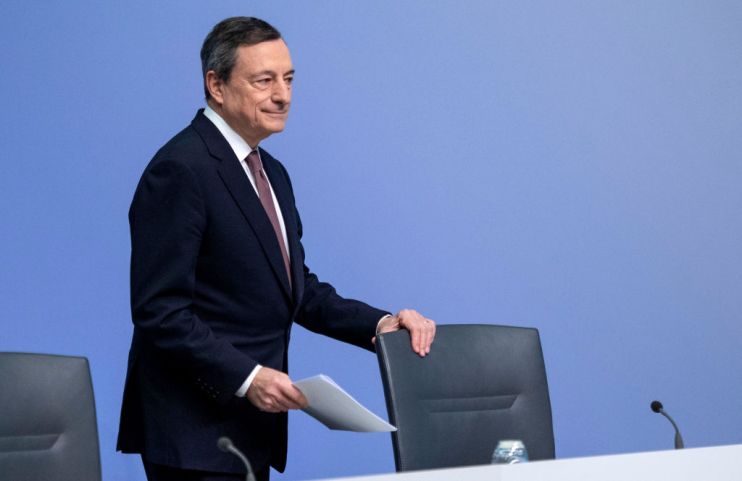
FRANKFURT AM MAIN, GERMANY - MARCH 07: Mario Draghi, President of the European Central Bank (ECB), arrives to the press conference following a meeting of the ECB Governing Council at ECB headquarters of March 7, 2019 in Frankfurt, Germany. Economic growth in the Eurozone group of nations has stalled, partially due to uncertainties caused by the tariff conflicts initiated by the administration of U.S. President Donald Trump, both with China and the European Union. (Photo by Thomas Lohnes/Getty Images)

Mario Draghi tomorrow chairs his penultimate interest rate-setting meeting as president of the European Central Bank (ECB). The question is, will he bring a bazooka to his final battle?

Read more: US and European stocks bouyed by ECB rate cut expectations

The consensus expectation is that Draghi and co will cut the ECB’s main interest rate by 10 basis points (0.1 percentage points) to minus 0.5 per cent in a bid to spur stubbornly low Eurozone growth and inflation.

But many questions remain over what other weapons the central bank will pull out of the arsenal, and whether they will have any effect after 10 years of experimental monetary policy.

Eurozone growth has slowed further since the ECB’s gloomy last meeting in July. The German economy, the zone’s biggest, contracted in the second quarter.

Marchel Alexandrovich, senior European economist at Jefferies, said: “We expect GDP growth for 2019 and for 2020 to be nudged down” to 1.1 per cent and 1.2 per cent respectively.

A Reuters poll showed that nearly 90 per cent of economists expect the ECB to address this anaemic growth by relaunching its stimulus bond-buying programme known as quantitative easing (QE), which seeks to flood the economy with cheap cash.

Yet in recent days, European bond yields (which move inversely to prices) have risen as the markets have reevaluated just how generous the ECB will be on this front.

Andrew Kenningham, chief Europe economist at Capital Economics, said: “Bond markets have rallied sharply since July, so the case for buying more is not as strong as it was.”

Read more

Interest rate cut is ‘off the table’, says Bank of England governor

Governor Andrew Bailey has launched a defence of the Federal Reserve's independence.

Some analysts have said the ECB could lower the main deposit rate into negative territory by more than 10 basis points.

But a growing chorus of voices have warned of the effects of negative rates, which mean banks have to pay the ECB to keep excess reserves in its figurative vaults, saying they limit profit-making ability to make profits and reduce the income of savers.

The ECB could tomorrow unveil measures to limit this effect by excusing some of banks’ deposits from the charge.

Deutsche Bank economist Quinn Brody said that at a certain point negative rates become punitive. “It would be better not to experiment with the world’s second largest economic area.”

As Draghi prepares to hand over stewardship of Eurozone inflation to ex-IMF boss Christine Lagarde, bigger questions hang over the ECB and central bankers around the world.

George Buckley, European economist at Nomura, said: “It is questionable how significant of an impact all of this will have on the economy.”

The ECB says its main job is to get inflation to around two per cent, but it currently stands at one per cent.

Read more: IMF chief Christine Lagarde among surprise picks for EU top jobs

Buckley said that in the last 10 years interest rates have been slashed to record lows, the central bank has bought €2.6 trillion (£2.3 trillion) of bonds and promoted ultra-cheap lending in other ways. “And yet core inflation has failed to rise.”

Read more

Bank of England may set the stage for interest rate hikes this year

Bank of England recession warning

Share this article

  • Facebook
  • X
  • LinkedIn
  • WhatsApp
  • Email

Similarly tagged content:

Sections

  • Markets & Economics
  • News

Categories

  • Banking
  • Economics

Trending Articles

  • Revolut takes flight with launch of new airport lounges

  • Grandparents fund university degrees to avoid inheritance tax net

  • Revolut chatbot goes rogue by charging users to cancel subscription

  • Brompton Bicycle sues former adviser for ‘professional negligence’

  • As It Happened: Stocks dip as oil’s ‘slowing demand’ in focus; Iran threatens to extend war

More from Morning Wire

  • Interest rate cut is ‘off the table’, says Bank of England governor

    Economics
    Governor Andrew Bailey has launched a defence of the Federal Reserve's independence.
  • Bank of England may set the stage for interest rate hikes this year

    Economics
    Bank of England recession warning
  • ‘Moron premium’ – Westminster turmoil has ‘cost taxpayers £35bn’ since 2022

    Politics
    Westminster Houses of Parliament under clear sky, iconic London landmark representing UK government and politics
  • Bank of England holds interest rates but warns of rises to come

    Economics
    Bank of England headquarters in 2025, showcasing modern architecture and iconic London skyline in the background.
  • Hold interest rates but ‘sound hawkish’, Morning Wire Shadow MPC tells Bank of England

    Economics
    Andrew Bailey, Governor of the Bank of England, with the Bank of England building and Union Jack flag in the background
  • ‘False dawn’: June inflation falls to 2.6 per cent but analysts say rises ahead

    Economics
    Till sales growth slowed to 2.7 per cent in the last four weeks
  • Revolut lands fresh banking licence after wrestling with Europe friction

    Fintech
    Revolut Banque Française ad on a Morris column in Paris, with the July Column and blurred traffic in the background.
  • UK borrowing costs soar as Iran ceasefire collapses

    Markets
    Rising borrowing costs depicted amid escalating tensions following the Iran war, illustrating economic impact on global ma...
MorningWire

Independent European business, markets and political news for decision-makers.

Morning Briefing

Europe

  • Germany
  • France
  • Europe
  • UK & Ireland

Business

  • Markets
  • Banking
  • Technology
  • Energy
  • Property
  • Fintech

Editorial

  • Opinion
  • Editorial Policy
  • Corrections
  • Contact

Company

  • About Morning Wire
  • Privacy Policy
  • Terms of Use
  • Cookie Policy
© 2026 Morning Wire Ltd · Published by Morning Wire Media, Bahnhofstrasse 65, 8001 Zürich, Switzerland
Privacy · Terms · Cookies · Facebook