Skip to content
Saturday 22 August 2026London --:--Frankfurt --:--Zurich --:--
NewslettersSearchEN · DE · FR
MorningWire

European business, markets and politics

FTSE 100
10,816.56
+0.64%
DAX
26,136.56
+0.59%
CAC 40
8,484.43
+0.37%
STOXX 50
6,462.22
+0.63%
  • Europe
  • Markets
  • Business
  • Economy
  • Regulation
  • Politics
  • Opinion
More
GermanyFranceEU InstitutionsCompetitionPublic AffairsBankingTechnologyEnergy
  • Germany
  • France
  • Europe
  • Markets
  • Business
  • Economy
  • Regulation
  • Politics
  • Opinion
  • DE
Monday 22 January 2024 12:31 pm  |  Updated:  Monday 22 January 2024 5:02 pm

Men are working much less than they used to. Women are picking up the slack.

By: Chris Dorrell

Add as a preferred source on Google
The government’s plan to give workers the ‘right to disconnect’ must allow for employers to offer flexibility, experts have warned.

Younger men have been working fewer and fewer hours per week over the last 20 years, a trend that has only accelerated post-pandemic,

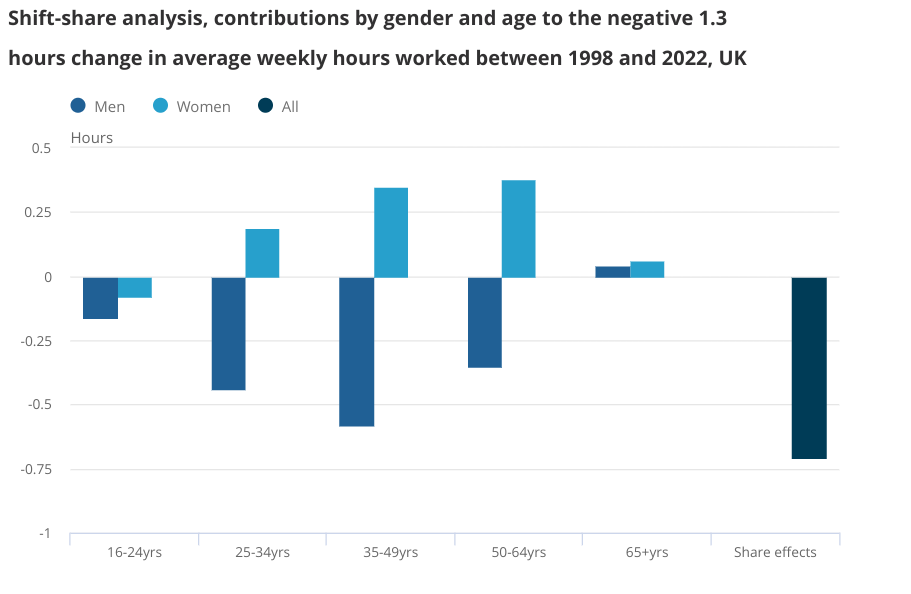
On average, men are working 3.3 hours a week less in 2022 than they were in 1998, according to figures from the Office for National Statistics (ONS).

This means the average man now works 35.3 hours a week. Every age group has seen their average working week fall, except for men aged over 65, the data shows.

The steepest fall in hours worked was among men aged between 35 and 49.
Source: ONS

An ONS spokesperson noted that men are increasingly working part-time, which reduces weekly hours.

“An ageing population has also reduced average hours worked over this period as older workers tend to work fewer hours per week,” they commented.

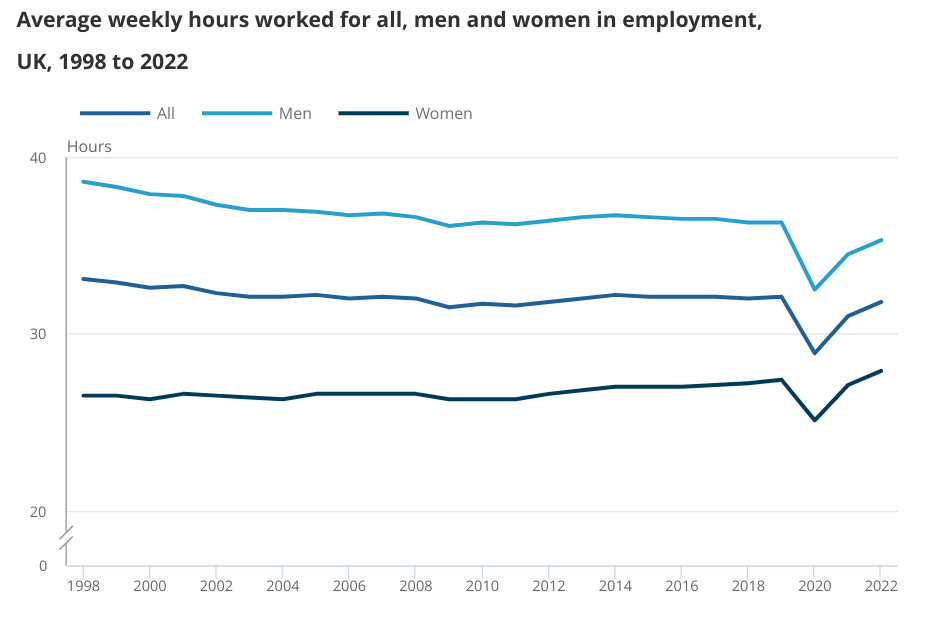
In comparison, average weekly hours for women have trended upwards from 26.5 in 1998 to 27.9 in 2022, a total increase of 1.4 hours per week. Only women aged between 16-24 were working fewer hours a week in 2022 than in 1998.

This means that across the labour force as a whole, the average worker is working 1.3 hours a week less than in 1998, clocking in at 31.8 hours.
Source: ONS

Unsurprisingly, both men and women recorded a steep fall in hours worked during the pandemic.

However, women are now working 0.5 hours a week more than pre-pandemic while men are still working 0.9 hours a week less. The proportion of female workers working full-time also increased over this period which the ONS suggested was “an indication of greater flexibility in working arrangements”.

The ONS noted that although the long-term fall in hours worked has not hit growth that much, there has been a “more significant impact” on GDP since the pandemic.

This means that growth could be supported by a “continuing recovery in average hours to pre-pandemic levels,” the ONS said. In other words, men need to get back to work.

Read more

Beyond your 9-5: things to explore in the Square Mile 

Three friends enjoying drinks on a rooftop bar with St Pauls Cathedral dome in the background.

Share this article

  • Facebook
  • X
  • LinkedIn
  • WhatsApp
  • Email

Similarly tagged content:

Sections

  • News

Categories

  • Economics

Related Topics

  • employment and wages
  • UK jobs, employment and wages
  • Unemployment

Trending Articles

  • House prices in wealthy London boroughs fall by up to £300,000

  • As it happened: FTSE 100 rallies after JD Sports drags on blue chips; oil jumps again

  • Mike Ashley’s Frasers offers to pay personal shoppers in Harvey Nichols takeover

  • Ratcliffe’s Ineos saves Runcorn plant

  • Amazon says it buys books in bulk to ‘improve products’

More from Morning Wire

  • Beyond your 9-5: things to explore in the Square Mile 

    Partner
    Three friends enjoying drinks on a rooftop bar with St Pauls Cathedral dome in the background.
  • Corgi Cafe: My day at London’s 24/7 hub for tech bros

    Opinion
    Anna, a young woman, smiles while typing on a laptop at a cafe table with a drink and potted plant.
  • House prices in wealthy London boroughs fall by up to £300,000

    Property
    Waverton Investment Management and London & Capital combined into W1M.
  • Labour’s ‘chaotic’ zero-hour crackdown could cost firms £3bn per year

    Economics
    Andy Burnham, Mayor of Greater Manchester, in a suit and glasses, looking serious against a bright sky.
  • The Debate: should we release female prisoners to make space for men?

    Opinion
    Brick prison wall with barred windows, razor wire, and a security camera.
  • City institution Simpson’s Tavern reborn as British restaurant

    Life&Style
    Three men enjoying wine and food, laughing in a cozy booth at Simpsons Tavern Cloth, Cornhill
  • John Lewis boss quits after warnings of ‘really tough’ trading

    Retail
    Two men, one in an olive green coat, the other in a blue blazer, both smiling.
  • Manchester billionaire tables £583m offer for property developer Harworth

    Property
    Harworth Group building exterior with a brick facade and prominent entrance under a blue sky
MorningWire

Independent European business, markets and political news for decision-makers.

Morning Briefing

Europe

  • Germany
  • France
  • EU Institutions
  • Europe

Business

  • Markets
  • Business
  • Economy
  • Regulation
  • Competition
  • Public Affairs

Editorial

  • Opinion
  • Editorial Policy
  • Corrections
  • Contact

Company

  • About Morning Wire
  • Privacy Policy
  • Terms of Use
  • Cookie Policy
© 2026 Morning Wire Ltd · Published by Morning Wire Media, Bahnhofstrasse 65, 8001 Zürich, Switzerland
Privacy · Terms · Cookies · Facebook