Skip to content
Sunday 9 August 2026London --:--Frankfurt --:--Zurich --:--
NewslettersSearchEN · DE
MorningWire

European business, markets and politics

FTSE 100
10,901.09
+0.31%
DAX
26,319.45
+0.69%
CAC 40
8,714.93
+0.17%
STOXX 50
6,523.86
+0.33%
  • Europe
  • Markets
  • Business
  • Economy
  • Technology
  • Politics
  • Opinion
More
GermanyFranceBankingAIEnergyFintechPropertyCapital Markets
  • Germany
  • France
  • Europe
  • Markets
  • Business
  • Economy
  • Technology
  • Politics
  • Opinion
  • DE
Wednesday 09 April 2025 5:45 am  |  Updated:  Tuesday 08 April 2025 1:15 pm

Method in Trump’s madness? What economic theory teaches us about tariffs

By: Paul Ormerod

Add as a preferred source on Google
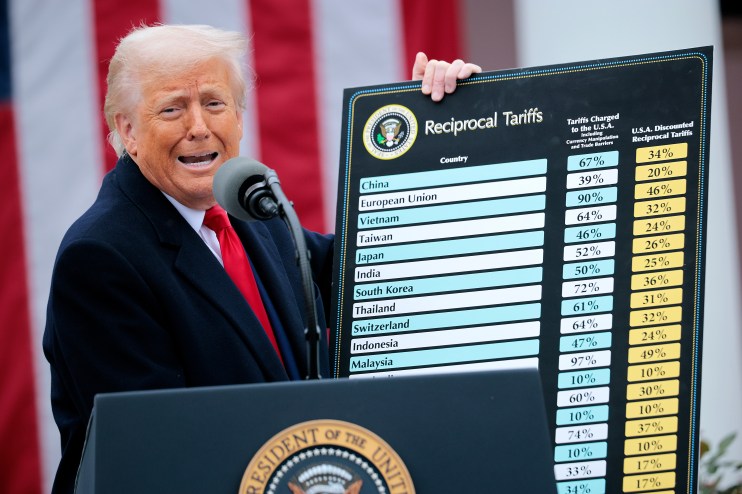
WASHINGTON, DC - APRIL 02: U.S. President Donald Trump holds up a chart while speaking during a “Make America Wealthy Again” trade announcement event in the Rose Garden at the White House on April 2, 2025 in Washington, DC. Touting the event as “Liberation Day”, Trump is expected to announce additional tariffs targeting goods imported to the U.S. (Photo by Chip Somodevilla/Getty Images)
(Photo by Chip Somodevilla/Getty Images)

Trump’s tariffs have sent the world into a frenzy but there could be method yet. Economic theory shows that tariffs can in some cases reduce prices, writes Paul Ormerod

The reactions to President Trump’s tariffs have been frenzied, to say the least. The headline on many of the stories about them might well have read “The end of the world is nigh!”.

But once the dust is settled, it is by no means as obvious as most commentators suggest that the world will be worse off. A somewhat different pattern of international trade will emerge from which consumers might well benefit.

The basis of economic trade theory

The striking feature of international trade in manufactured goods between developed economies is that much of it involves what is known in the jargon as intra-industry trade. In other words, countries both export and import products which are in the same industry. BMW, for example, makes cars in Germany and sells them to France. In France, Renault makes cars and sells them to Germany.

Until the closing decades of the 20th century, the economic theory of international trade essentially ignored this important empirical phenomenon. Its main concern was to explain inter-industry trade.  

The idea goes back at least 200 years to David Ricardo who created the basis of trade theory in economics over the next two centuries. Ricardo used a simple illustrative example of a world of just two countries, England and Portugal and in which there are only two commodities, cloth and wine.

If England could produce cloth more efficiently than wine and Portugal wine than cloth, he showed that it made sense for England to specialise completely in cloth and Portugal wine. This creates a world of inter-industry trade.  England exports only cloth and Portugal only wine.

A very neat aspect of his theory is that Ricardo demonstrated that this trade pattern would arise even if England could produce both products more efficiently than Portugal.  

Read more

Donald Trump is creeping towards a shrewd sanctions policy

Donald Trump holding a red TRUMP 2028 hat, wearing a tuxedo with an American flag in the background

The last 40 years or so have seen a flurry of work in economics to explain why the phenomenon of intra-industry trade is so pervasive. A key paper was by future Nobel Laureate Paul Krugman in 1980. In essence, his theory was based on the concept of increasing returns. The more a company produces, the more its efficiency rises.

But the main point in the context of the Trump tariffs is that much economic trade theory, certainly that of Ricardo himself, assumes that capital is not mobile. English firms do not set up subsidiaries in Portugal, and vice versa.

Why tariffs sometimes reduce prices

Yet the world is dominated by multi-national firms who produce in many countries. BMW, for example, has eight plants in Germany, but it also builds cars in, for example, the United States, Mexico, South Africa and South America.

Confronted by an increase in tariffs on trade, large multi-nationals have the option of either setting up new production facilities or increasing the output of those which already exist in the country which is imposing the tariff. Rather than export the product from its domestic plant, the firm exports its capital to produce abroad.

Bob Rowthorn, formerly head of the economics department at Cambridge, was one of the first to analyse this phenomenon in a paper in the Economic Journal in 1992.

A crucial factor in the decision of a firm is the size of the market into which it exports. The larger the market, the more likely it Is to develop production capacity abroad. Rowthorn presciently envisages a world of three large trading blocs: North America, Europe and East Asia. Intra-industry trade within each bloc will grow strongly, but even in the absence of tariff increases, it is not at all certain that intra-industry trade between the blocs will do the same.

A range of outcomes is possible, but tariffs can, paradoxically, result in lower prices and a better outcome for consumers arising from decisions on where to locate production. There may well be method in Trump’s seeming madness.

Paul Ormerod is an honorary professor at the Alliance Business School at the University of Manchester and an economist at Volterra Partners LLP

Read more

‘I thought this would be drama-free’: Games Workshop pockets tariff reprieve

Games Workshop joined the FTSE 100 at the end of last year.

Share this article

  • Facebook
  • X
  • LinkedIn
  • WhatsApp
  • Email

Similarly tagged content:

Sections

  • Opinion

Categories

  • Opinion
  • Business

People & Organisations

  • David Ricardo
  • Donald Trump
  • economics
  • Liberation Day
  • tariff
  • tariff war

Trending Articles

  • Why the Loire Valley is about so much more than fairytale castles

  • Why HMRC is huge Premier League transfer window tax headache

  • Thames Water faces fresh threat to survival after pensions regulation breach

  • Back to basics: Sainsbury’s gradual retreat from the British high street

  • Thunder Call set to Strike in Shergar Cup Sprint

More from Morning Wire

  • Donald Trump is creeping towards a shrewd sanctions policy

    Opinion
    Donald Trump holding a red TRUMP 2028 hat, wearing a tuxedo with an American flag in the background
  • ‘I thought this would be drama-free’: Games Workshop pockets tariff reprieve

    Retail
    Games Workshop joined the FTSE 100 at the end of last year.
  • UK inks trade deal with Switzerland – despite shouting match

    Politics
    UK and Switzerland officials signing a trade deal, highlighting international services agreement and bilateral cooperation
  • Vehicle production drops in first half of year

    Transport & Infrastructure
    Car bodies on an assembly line in a UK car plant, showcasing EV manufacturing process
  • As it happened: Stocks jump as oil drops below $100; Trump in tariff blitz

    Markets
    Donald Trump speaking at a press conference with microphones, blue sky background
  • Gianni Infantino: Democrats ask to quiz Fifa boss over Trump ‘corruption’ allegations

    Sport Business
    Donald Trump and FIFA President Gianni Infantino smiling, looking upwards during an event.
  • Singapore on Thames or the Sick Man of Europe?: The Economics of Brexit Ten Years from the Referendum 

    Opinion
    UK-EU Brexit negotiations meeting with officials discussing trade agreements and policy impacts in a formal conference room
  • Infantino facing IOC probe after complaint lodged over Trump’s Balogun intervention

    Sport Business
    Getty Images logo on a smartphone screen, symbolizing stock photography and media resources for news and business websites.
MorningWire

Independent European business, markets and political news for decision-makers.

Morning Briefing

Europe

  • Germany
  • France
  • Europe
  • UK & Ireland

Business

  • Markets
  • Banking
  • Technology
  • Energy
  • Property
  • Fintech

Editorial

  • Opinion
  • Editorial Policy
  • Corrections
  • Contact

Company

  • About Morning Wire
  • Privacy Policy
  • Terms of Use
  • Cookie Policy
© 2026 Morning Wire Ltd · Published by Morning Wire Media, Bahnhofstrasse 65, 8001 Zürich, Switzerland
Privacy · Terms · Cookies · Facebook