Murdoch’s long shadow

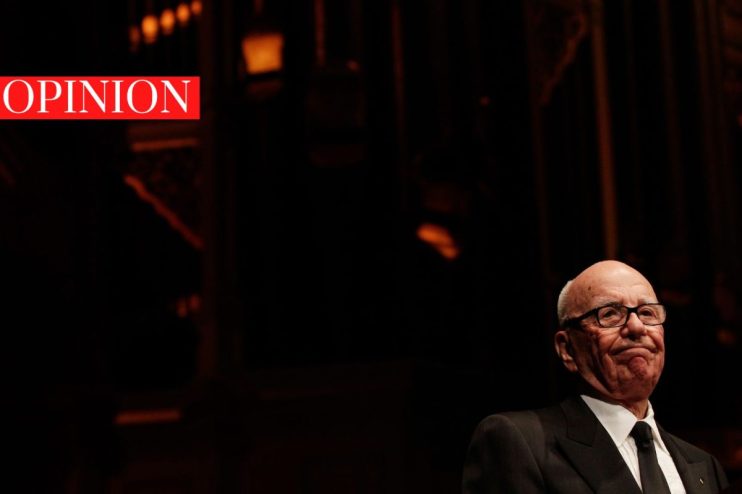
There are some events that you know, rationally, are inevitable and even impending, but still cause a shock when they happen. Rupert Murdoch has announced that he is stepping down as chairman of News Corp and the Fox Corporation, handing the reins to his eldest son, 51-year-old Lachlan Murdoch. This is a momentous day for the global media landscape, as a proprietor and mogul every bit a match for William Randolph Hearst begins to release his grip on the multi-billion dollar empire he has painstakingly created.
Murdoch, the Australian-born media magnate, who has been an American citizen since 1985, will celebrate his 93rd birthday next year. If age has taken its toll on his physique, there is little outward sign of mental decline: he remains sharp, curious and alert, his lively and calculating mind clearly still running at a very high rate.
The span of his career is almost impossible to encompass. He graduated from Worcester College, Oxford, in 1953, a PPE graduate before it became the refuge of the superficial scoundrel. His father, influential newspaperman Sir Keith Murdoch, had died the year before and the young Rupert returned to Australia to take control of News Limited, the family business. It was ravaged by taxes and death duties, and Murdoch focused on The News, an Adelaide afternoon tabloid with a readership of 100,000 in a city of half a million, as his main project.
Murdoch’s journey from a South Australian tabloid newspaper to a media network which spans the globe has been told almost exhaustively. What stands out are his ruthless relentlessness, his keen eye for new technologies and, in such a long and controversial business career, his relatively few missteps. He is now regarded as the dominant figure in UK media, controlling The Sun, The Times, TalkTV, the Wireless Group and Harper Collins; Fox News, Dow Jones and The Wall Street Journal give him American clout.
He has, for better or worse, flexed his media muscle in pursuit of his own interests. Murdoch is an avowed libertarian, but he is politically flexible. He supported Margaret Thatcher’s Conservative government in the 1980s but deemed Sir Tony Blair’s New Labour acceptable by 1997, a huge boost to the party’s electoral fortunes. That flexibility has always been matched by an almost uncanny ability to read the mood of the British public.
His reputation has suffered because of his single-minded pragmatism, though the grotesque phone hacking scandal which engulfed News International, his UK subsidiary, from 2006 onwards blackened him irredeemably in many eyes. It led in 2011 to the collapse of The News of the World, after 168 years in print, and Murdoch’s abandoning of an effort to take over BSkyB, and saw the establishment of the Leveson Inquiry into press standards. His public image was cemented as a man who would do, or permit, anything in pursuit of profits and a story.
In some ways, though, we are all to blame, because we have all bought his newspapers and watched his TV channels. If we hate tabloid culture in Britain, we need to look at how who it is that is consuming that. Murdoch can read the room politically, but he also has an insatiable desire to “give the people what they want”. Such was the creation of Fox News in the US, catering to a demographic unseen by the existing media institutions.
What has marked out Murdoch’s continued success is his ability to create or acquire new products that will keep the News Corp empire flexible to the whims of a modern audience. If one brand isn’t making money, another can balance it out. Look, for a moment, at the range in Britain: a massive online presence through the digital output of The Sun and The Times, a radio station designed to rival BBC’s Radio 4, a new TV channel TalkTV and a social media vetting operation in the form of Storyful.
As Lachlan junior steps up to the plate, he faces a world hostile to “the media”, but also one where what “the media” even is is up for debate.