Nationalising London buses fixes a nonexistent problem

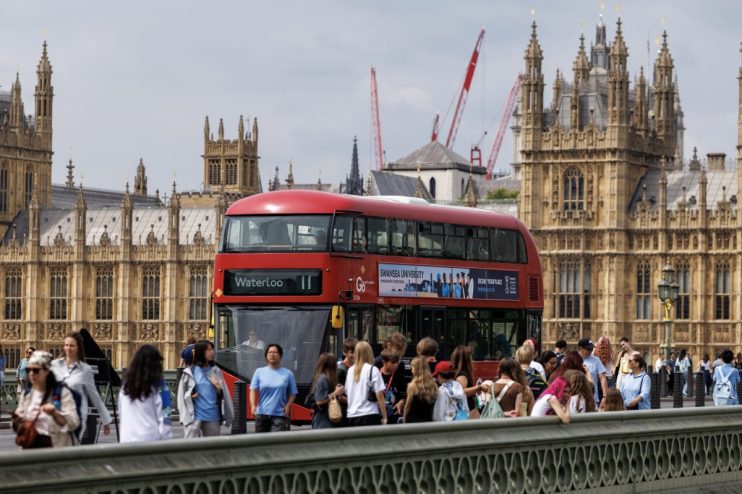
City Hall already controls London’s bus network, so why is Sadiq Khan humouring a proposal to build a publicly owned bus operator, asks Festus Akinbusoye
London’s bus franchising model is the envy of cities in the UK and around the world, who have sought to replicate its success. Even Andy Burnham, when Mayor of Greater Manchester, looked to London’s model when bringing buses back under public control through franchising. That is why it is so frustrating that, rather than concentrating every available resource on improving and refining the network Londoners already have, Transport for London (TfL) has confirmed it is pressing ahead with a feasibility study into a publicly owned bus operator. Instead of sensible leadership focused on passengers, City Hall risks embarking on an expensive ideological experiment.
Building a publicly owned operator from scratch will require years of effort and taxpayers’ money, when Sadiq Khan should be asking how the strengths of London’s existing model can be extended elsewhere.
London buses are already under public control
The first problem with the proposal is simple: London’s buses are already under public control. Under London’s franchising model, TfL sets the routes, fares, frequencies and standards. Private operators compete for contracts to deliver those services and can be replaced if they underperform. Public authorities decide what service Londoners should receive; competition determines who can deliver it effectively. That distinction between public control and public operation matters. There is no need for City Hall to own a bus company simply to exercise control over the network – it already has it.
There is also a serious question of cost. Londoners have already endured years of inflation and a higher cost of living, while TfL’s bus operating subsidy rose from £870m in 2024/25 to £1.2bn this year. It is budgeted at £1.28bn in 2026/27 and forecast to reach £1.7bn by 2029/30 – growth TfL itself has called unsustainable.
Creating a new public operator would introduce further financial risk. City Hall would need to consider new layers of management, staffing, vehicles, depots and procurement at a time when TfL is already carrying nearly £14bn of borrowing and spending close to £500m a year financing that debt.
Every pound and every hour of political attention devoted to changing who operates London’s buses is a pound and an hour that could instead be spent tackling the problems passengers currently experience.
The actual problems
Passengers care whether their bus arrives, runs its full route and gets them to work, school or a night out on time – not whose name appears on the ownership documents. Bus speeds have fallen, millions of bus miles have been lost in outer London and scheduled services are not always delivered. Those failures cost commuters time and money and, collectively, cost London productivity.
Those are the problems the Mayor should be fixing.
As Mayor, I would focus on reversing lost bus mileage in outer London, speeding up routes, improving frequencies, removing bureaucratic bottlenecks and strengthening connections between communities. I would also publish borough-by-borough data comparing scheduled services with those actually delivered, so Londoners can see whether TfL and its operators are delivering what they have been promised.
There is a wider question here about what genuine public control of transport could achieve. City Hall already controls London’s bus network, yet has long sought greater influence over suburban rail services. Better integration between rail and bus – making journeys across London simpler, faster and more reliable – would do far more for passengers than changing the ownership structure of the companies operating their buses.
The principle should be straightforward: public authorities set demanding standards in the interests of Londoners, while competition and enterprise help deliver them efficiently. Competition gives operators an incentive to perform, controls costs and allows TfL to replace those that fail. Removing that competitive pressure should only be contemplated if there is compelling evidence that passengers and taxpayers would be better off.
So my message to Sadiq Khan is straightforward. If a publicly owned bus operator will save Londoners money and improve their services, publish the evidence and make the case. If it cannot, City Hall should drop the idea and concentrate its resources on making buses faster, more reliable and better connected, while tackling problems such as fare evasion that place further pressure on the network.
London does not need an expensive change of ownership. It needs a transport system that works. That is sensible leadership, not a costly experiment dressed up as reform.
Festus Akinbusoye is a prospective Conservative Candidate for Mayor of London