Nearly one million UK homeowners to have £500 a month eaten up by higher mortgage payments
UK homeowners are poised to hand over a bigger chunk of their income to their lenders every month after they roll on to a new mortgage with a much higher interest rate, the Bank of England has warned today.
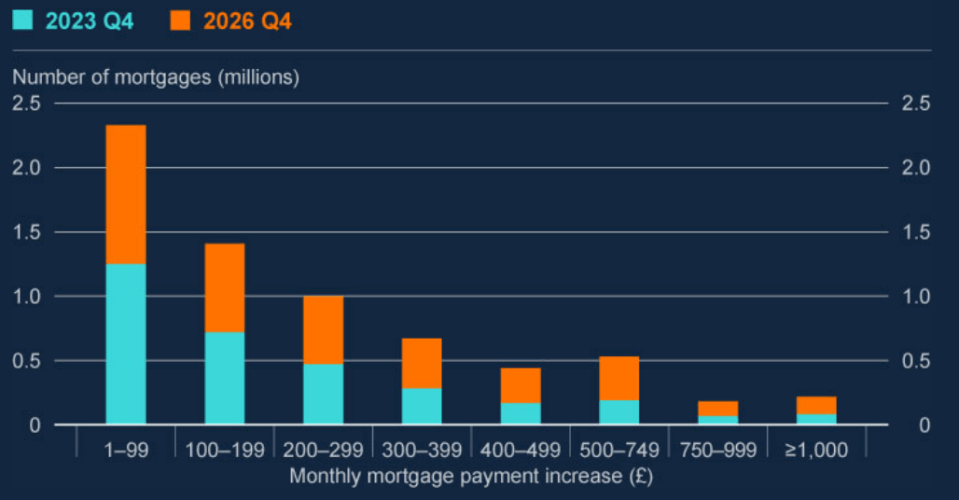
By the end of 2026, around 1m families will be paying an at least additional £500 a month to service their mortgage, amounting to a £6,000 annual increase, according to calculations by the central bank in its bi-annual financial stability report.
A sharp rise in monthly mortgage bills is coming sooner for homeowners though. The Bank said the average mortgagor rolling onto a new deal in the second half of this year will see their monthly repayments jump £220.
Economists have estimated around 1.5m people will have to take out a new home loan before the end of the year.
Accelerating prices have jolted debt rates on financial markets much higher as traders price in additional increases to the UK’s official borrowing cost from the Bank of England.
Governor Andrew Bailey and the rest of the nine-strong monetary policy committee (MPC) have already lifted the base rate 13 times in a row to five per cent, a near 15 year high. Since that hiking cycle started in December 2021, 4.5m people have seen their mortgage bills jump. The remaining 4m homeowners will suffer the same fate by the end of 2026, the Bank said.
Traders reckon the MPC will repeat last month’s outsized 50 basis point increase at its next meeting on 3 August and that they are set to hoist borrowing costs to a peak of around 6.5 per cent, a level not seen since the 1990s.
As a result, mortgage providers have been tightening lending conditions. They base their products on a rate in financial markets called the overnight index swap rate, which embodies investors’ expectations for the path of base rate.
Recession risks have reignited in the UK over the past month or so as mortgage affordability has been squeezed.
Number of mortgagors whose bills will increase
Data firm Moneyfacts yesterday said the average rate on the 2-year fixed home loan touched 6.66 per cent, its highest level since the financial crisis and above the threshold reached in the weeks after Liz Truss’s haphazard mini-budget in September 2022.
Constrained affordability in the mortgage market is bound to cool house prices. Figures from lender Halifax last week showed prices dropped 0.1 per cent over the last month and some economists have estimated they could drop 10 per cent from their peak.
Economic growth could turn negative if households respond to rolling on to fresh mortgages with much higher rates by reining in spending.
The Bank also warned the proportion of families in the UK that are at risk of being consumed by debt will rise “to around 2.3 per cent, or around 650,000 households, by the end of the year,” although that would be more than 200,000 fewer than the peak reached in 2007, just before the financial crash.
Lower heavy indebtedness and regulations that have reined in lenders’ capacity to lend to high risk borrowers mean households and the UK financial system are more resilient to higher interest rates compared to the run up to the 2008 crisis, the Bank said.
So far, the UK has avoided a much tipped recession in 2023, with gross domestic product nudging up 0.1 per cent in the three months to March. Monthly GDP numbers tomorrow are tipped to show the economy contracted around 0.3 per cent in May.
Inflation is stuck at just below nine per cent, while core and services prices are up more than seven per cent.
That has intensified anxiety about price pressures embedding in the UK economy, raising the chances of the Bank keeping interest rates higher for longer.
However, research the Organisation for Economic Cooperation and Development yesterday found that corporate profits in the UK have grown at the second quickest pace in the G7 since before the pandemic, up 23.2 per cent.
Labour costs – a proxy for wage bills – have grown at a significantly slower pace.
“Profits have increased more than labour costs, making an unusually large contribution to domestic price pressures, and leading to a fall in the labour share,” the OECD said, adding there is scope for firms to fund pay rises out of profit increases.