New Premier League rules could see £11bn invested into new stadiums

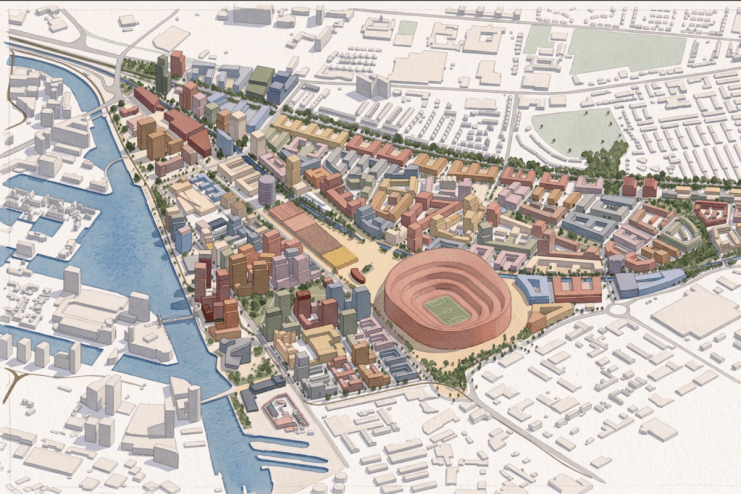
Alan Sendorek explains why we are seeing a third revolution of football stadium development on these shores.
The third football stadium revolution in England is underway. At least two-thirds of Premier League clubs, and a substantial number lower down the pyramid, have either recently completed a major stadium upgrade or have one planned.
Everton and Tottenham have recently opened new grounds. Liverpool and Fulham have substantially redeveloped theirs. Man United are pursuing a 100,000-seater replacement for Old Trafford, while Leeds and Aston Villa are expanding their historic homes. Birmingham City and Luton show that the investment reaches beyond the Premier League.
McKinsey estimates that around £11bn will be invested in English stadiums and associated development over the next fifteen years.
This level of stadium development activity has not been seen since the post-1990s era, when clubs had to comply with new safety regulations, notably becoming all-seater, following the Hillsborough disaster and the Taylor Report. That led to significant changes at every club in the top two divisions and in several cases – Millwall, Bolton, Middlesbrough, Derby, Sunderland and others – a completely new ground.
The first stadium revolution took place much earlier, at the start of the twentieth century, with the rapid expansion of professional football creating a need to accommodate large paying crowds. It was the era of Archibald Leitch, who was responsible for over twenty such projects. Between 1898/99 and 1948/49, the League expanded from 36 to 88 clubs, and the total annual attendance increased from around 4m to over 40m.
Stadium revolutions of old
If the first wave was triggered by commercialisation and the second by Hillsborough and safety legislation, it is financial regulation that is driving the third.
From the relatively permissive system of the early 2000s, to Profit and Sustainability Rules (PSR) since 2013, and now Squad Cost Ratios (SCR), the regulatory direction of travel has been from limiting losses to explicitly linking squad expenditure to revenues.
What Roman Abramovich did at Chelsea – rapid sporting expansion through large owner-funded losses – is much more difficult in this era. This season, the Premier League limits relevant squad expenditure to 85 per cent of revenue plus net transfer spend. For clubs competing in Uefa competitions, the limit is 70 per cent. But spending on infrastructure is excluded from the calculation. So a wealthy owner might be prevented from spending £100m of their own money to buy a star player, but they can invest the same amount in stadium development to increase the club’s future revenues and therefore spending capacity.
Newcastle fans are all too aware that having wealthy owners is no guarantee of keeping your best players, when talent must be sold to limit losses.
So clubs must utilise their stadium for more than the 20-25 days they host matches, or generate extra income from associated regeneration. The intention is to earn money from the property asset 365 days a year, often mixing sport with hotels, restaurants, retail, entertainment, workspace and other uses.
The Premier League behemoth
This third wave of projects is more commercially ambitious than the first two waves, but also institutionally more difficult to deliver. In many cases, they look more like major place-based regeneration programmes than sports construction.
Old Trafford and Birmingham’s Sports Quarter are two good examples – stadium-led regeneration projects involving transport, housing, public realm, land assembly and commercial development, all of which need to align with public sector priorities to be delivered. The capital may be private, but the public sector dependency is critical.
The Government is gearing up to help, with a Stadium Regeneration Accelerator one of Keir Starmer’s last announcements before leaving office. It is not a fund for building stadiums themselves, but it aims to help clubs and investors navigate the potential barriers so that regeneration benefits for taxpayers can be unlocked. There could be extra incentives for regional bodies too. With fiscal devolution a priority of the new Prime Minister, Andy Burnham, there is scope for combined authorities to keep additional tax revenues generated by local economic growth, which could significantly alter the economics.
A final complication is another regulatory hurdle, which is approval from the new Independent Football Regulator. The IFR would need to be confident that a move wouldn’t negatively impact sustainability or cause harm to heritage, and that a club has sought and had regard for fan views.
The first stadium revolution was about capacity. The second was about safety. The third is about driving revenue to compete within the bounds of tighter financial regulation. With the ambition and complexity of many of these third-wave projects, unlocking them will depend on both private capital and alignment with public priorities.
Alan Sendorek is a director at Flint Global and former special adviser at FCDO and 10 Downing Street.