New York Times’ pursuit of subscribers over profit buys into a Big Tech delusion

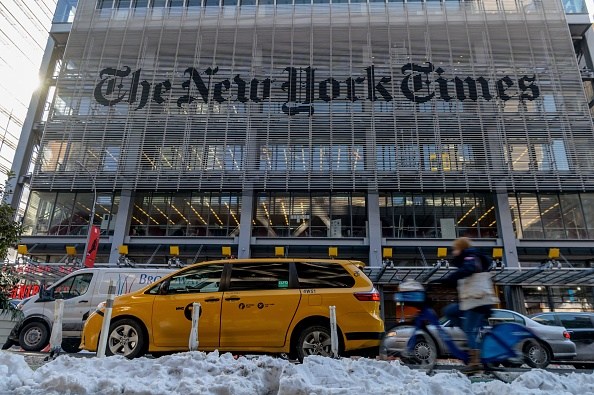
Those five, elusive letters. Only when I have found them can my day begin. Alas, they may soon become more elusive still. This week, the New York Times bought Wordle for an undisclosed, seven-figure fee. Ominously, the “Gray Lady” has promised only that Wordle will “initially remain free”.
The New York Times has been unusually acquisitive of late. The Wordle deal comes on the heels of the purchase of The Athletic, a sports news website, for $550m in January.
Known for its analytical approach to sports coverage, a cold hard look at The Athletic’s own numbers renders that valuation hard to justify. Founded in 2016, The Athletic has only and always lost its investors’ money. In 2021, revenues of $65m saw losses of $55m. In other words, for every dollar it earned, it spent nearly two.
The purchase is particularly perplexing when placed in the context of what the New York Times has itself achieved. After a period of perilous decline, with revenues falling from $3bn in 2006 to a loss-making $1.6bn in 2012, the paper’s fortunes have turned. Under the excellent stewardship of Mark Thompson, a former BBC boss, the paper returned to consistent, profitable growth – an outlier in the beleaguered news industry.
So, after a decade spent escaping unprofitability, why buy someone else’s losses? The answer is subscribers. In 2019, The New York Times set a target of 10 million digital subscribers by 2025. Today, it has 7.6 million, to which it will soon add The Athletic’s 1.3 million, and however many (or few) Wordle players it can tempt over.
This acquisition highlights the perverse consequences of setting a target that focuses on subscribers rather than profit. It is a business truism that “you get what you measure” and this is a clear example of the effect. If a business sets itself a target, it tends to pursue it with blinkers fixed. If your goal is a certain number of subscribers, with no notion of profitability, you will happily buy someone else’s loss-making readers instead of attracting profitable ones of your own.
The Athletic acquisition also illustrates a more modern business error, imported from Silicon Valley: that the acquisition of users must be prioritised, because profit will naturally follow.
This delusion is built upon the legends of a few companies for whom the formula worked. Focused relentlessly on user growth, Amazon, Alphabet (Google) and Meta (Facebook), all took years to become the staggeringly profitable companies they are today.
That this worked for a few companies, however, does not mean it will work for all. Companies who have placed a layer of software over an existing real-world product have tended to suffer. So too those operating in competitive markets.
Take Uber, for instance, whose business is still bound by the basic economics and competitive pressures of the taxi trade. There, a relentless pursuit of 93 million monthly customers has led to eye watering losses of $18.7bn over the last five years.
The same is true of Peloton, whose tech-infused exercise bikes – used by 6 million customers – lost $475m last year. Peloton’s travails should warn those who promise their investors continuous customer growth. In November, Peloton was forced to lower its growth projections and its share price tumbled to $26. A year ago, it was $162.
Until recently, investors have proved willing to fund the promise that the acquisition of users will generate profits in the future. For that reason, technology stocks have traded at extraordinary multiples of a company’s revenues.
In summer 2020, a selection of high-profile tech stocks grouped by Bloomberg, many of them unprofitable, were trading at an extraordinary thirty times their revenue. For comparison, the rest of the American stock market trades at five-times their revenue.
But things appear to be changing. With inflation upon us, and central banks likely to turn off the cheap cash taps, investors are seeking more ready returns. It is little surprise that, in recent months, overvalued tech share prices have started to slide. The neophyte tech firms, far from profit, will be in for a rude awakening. And the Gray Lady, 171 years old and counting, has chosen the wrong moment to share in their delusion.