Nuked nuts and gamma ray greens: the joy of nuclear food

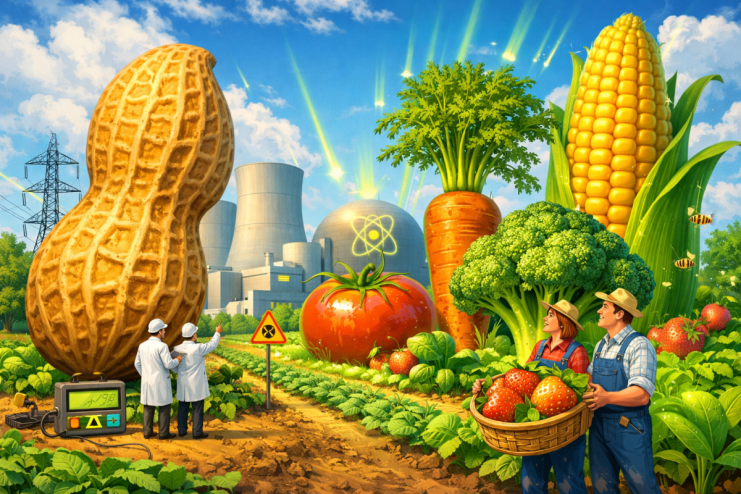
Britain needs to get over radiophobia and embrace the benefits of atomically enhanced food, says Tim Gregory
The first time I hovered a Geiger counter over a sample, the clicks made me jump backwards. I overreacted; in my lab, the radiation dose seldom exceeds background levels. (And even when it does, it’s normally far less than you find naturally in uranium-rich places, such as Cornwall.) Alas, I was infected with the radiophobia that blights our relationship with nuclear science and the inventions it enables. A major symptom is nuclear power nervousness. Minor symptoms include hospital X-ray anxiety. But we ought not fear radiation. Far from being a foe, it’s a tool we use to solve problems in imaginative ways. And with that in mind, can I interest anybody in a spot of atomic gardening?
Our ancestors started manipulating the genetic codes of plants in the tenth millennium BC. By propagating crops with desirable traits – high yield, rapid growth, tastiness – they morphed wild straggles into the lush botanical bounties that underpin modern agriculture. Every morsel we eat today is genetically modified (sorry, Greenpeace.) But traditional domestication happened at a snail’s pace because we relied on nature to do the genetic scrambling.
Artificial radiation allows us to circumvent evolutionary timescales. By showering cuttings and seeds with gamma rays and the like, we do what nature does – garble genomes – much faster. Most irradiated plants perish in the downpour, admittedly. But some, by chance, survive, and acquire new and desirable traits. There’s no way of knowing what will happen ahead of time. You have to sow them and see.
Energised by mid-twentieth century nuclear optimism, scientists bred new types of crops in ‘gamma gardens’. Their choice of isotopic Miracle-Gro? Usually cobalt-60, which – gram-for-gram – is one-and-a-half-billion times more radioactive than uranium. They used it to nurture pest-resistant beans, fast-growing rice and drought-hardened wheat for a booming population.
Radioactive flowers
Amateurs got in on the excitement, too. In the late-1950s, Tennessean dentist Clarence Speas tended radiation-modified poppies, pinks and petunias in his homemade atomic allotment. With entrepreneurial shimmer, he sold “atom-blasted seeds” in garden centres. Meanwhile, Muriel Howorth from East Sussex made headlines with her giant atomic peanut bush. Commentators described it as “the most sensational plant in Britain” that “had all the romance of something from outer space.” Howorth inaugurated the Atomic Gardening Society in 1960; new members received six irradiated peanuts and a silver bowl for whoever grew the biggest bush.
Sadly, the Atomic Gardening Society is no more. The public’s appetite for nuclear science soured after the 1986 Chernobyl Disaster and the end of the Cold War; the vision of a world in which nuclear science improved all areas of our lives wilted. But the fruits of atomic gardening still flourish. The International Atomic Energy Agency lists more than 3400 entries (or should I say entrées?) on the Mutant Variety Database. The offshoots of irradiated plants grow on all continents bar Antarctica, testaments to how strange-sounding science – with a dash of eccentricity and a pinch of creativity – delivers enormous benefits to humanity.
My favourite atomic delicacies are the gamma breeds of barley that sometimes acquire a stiffer straw, improved yields and – crucially – enhanced malting properties. They’re ripe for a spot of brewing. I’ll raise a pint to those rays any day of the week, in the gamma garden or the beer garden. My radiophobia is cured. Cheers.
Tim Gregory is an associate fellow at Bright Blue