On this day 1799: Britain’s first income tax

On this day, 9 January 1799, Britain introduced its first ‘temporary’ income tax. Workers have been vexed ever since, writes Eliot Wilson
It was the English playwright Christopher Bullock who first wrote in 1716 “’tis impossible to be sure of any thing but Death and Taxes”. It is as true today as it was three centuries ago, but the taxes Bullock had in mind looked very different to the ones we grudgingly pay today.
For most of the 18th century, the British government relied for its revenue on direct taxes on wealth, and a range of indirect taxation on consumption.
Direct taxation was imposed in two main ways. In England, the Subsidy Act 1670, refined by subsequent legislation in 1688, 1692 and 1697, provided for a land tax based on a property’s open market rental value. The Parliament of Scotland had brought in a broadly similar system in 1667. Article IX of the Act of Union 1707 brought the two systems together under the new Parliament of Great Britain.
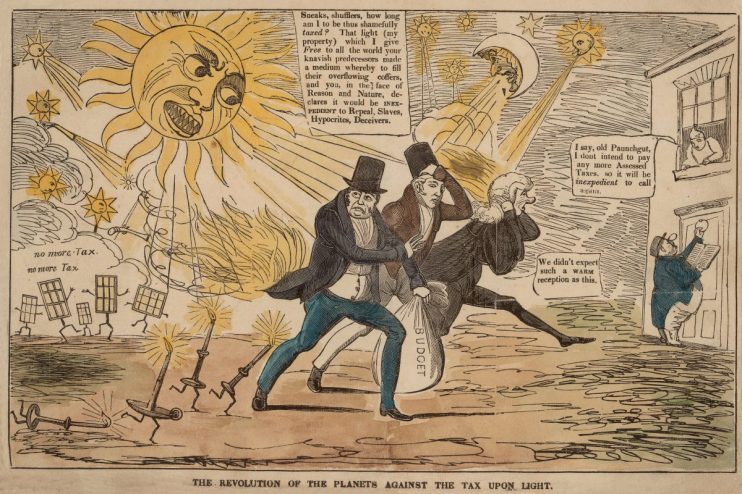
The second form of direct taxation, again a rough-and-ready attempt at taxation on the basis of wealth, was a window tax. In England, the Taxation (No. 3) Act 1695 imposed a flat charge for each house and an additional variable tax based on the number of windows above 10. After the Union, it was standardised across Great Britain.
Governments also leaned heavily on indirect taxation. Excise duties were levied on the production or sale of goods and services: household staples like salt, candles and glass, as well as luxury items such as silk, silver and gold thread and silver plate. Their counterparts were the customs duties charged on imported goods – wine, spirits, tea, tobacco.
Notable by its absence, and today the government’s single biggest source of income accounting for a quarter of total government receipts, was income tax. Land tax, window tax and some customs and excise duties were in their own way an attempt to charge the population according to its ability to pay, since the rich had more land, larger houses with more windows and consumed more luxury goods both domestic and imported.
It was not that the idea of taxing people on their income had never been conceived. On the contrary, it was alive in the minds of taxpayers, but was regarded as an unwarranted intrusion by the government into people’s personal and financial affairs. Landowners and merchants were also aware that it would be more difficult to minimise or avoid a universal income tax. A third obstacle was that the bureaucracy of 18th century government simply did not have the means accurately to assess a person’s overall income.
So an income tax, unpopular and probably unworkable, was not part of the government’s financial apparatus. But there was a growing problem: Britain had fought a number of expensive wars during the 18th century: the War of the Spanish Succession, the Great Northern War, the Seven Years War, the Anglo-Mysore Wars and the American Revolutionary War.
Income tax: a ‘temporary’ measure
Ordinary revenue was not nearly enough to fund these conflicts, but Britain had a great advantage in the Bank of England, established in 1694, which facilitated and managed the National Debt. The credit to which British governments had access allowed them to finance the country’s overseas expansion and revolutionised the power and reach of the state, but it was still debt, not free money. By the middle of the century, the National Debt had become larger than GDP and by the 1780s was approaching 150 per cent. Then, in 1793, Britain found itself at war with Revolutionary France.
William Pitt the Younger had become Prime Minister in 1783, aged only 24, and had confounded his sceptics by retaining office not for weeks or months but years. He also served as Chancellor of the Exchequer, and by the last years of the 18th century, he had grasped that to secure further borrowing and pursue a costly war against France would require a new approach to taxation. He was conscious of the unpopularity of an income tax, but several alternatives failed to generate the revenue he needed.
In December 1798, finally, Pitt included in his Budget proposals for a tax on income. It was a progressive charge which began at 2d in the pound (0.83 per cent) on incomes over £60 and rose to a maximum of 2s in the pound (10 per cent) for those whose income was more than £200.
It was on this day, 9 January, in 1799 that the became law. Britain’s first income tax was intended as a temporary measure, “to raise an ample contribution for the prosecution of the war”. Pitt hoped to raise £10m, but deep unpopularity led to widespread tax evasion, and the receipts for 1799 were just under £6m. But with total government revenue of £25m, the new charge still made a significant contribution (in fact roughly the proportion income tax represents today).
It was presented as a wartime measure, and Pitt’s successor, Henry Addington, repealed the tax in 1802 as part of the Peace of Amiens. He was compelled to revive it a year later when hostilities resumed, but it was scrapped again in 1816, a year after Napoleon’s defeat at Waterloo.
Governments with new forms of taxation are like man-eating tigers: they cross a line and can never come back. William Pitt’s political courage and acceptance of financial necessity led to a principle we now take for granted: one of the fairest and most straightforward ways of raising revenue is to charge people based on how much money they earn.
Still the pretence of an emergency measure persisted. Sir Robert Peel’s Income Tax Act 1842 was the first use of the tax in peacetime, and was again purportedly temporary. We are still waiting, I would suggest in vain, for its repeal.
Eliot Wilson is a writer and historian; senior fellow for National Security, Coalition for Global Prosperity; and a contributing editor at Defence on the Brink