On This Day: Adam Smith publishes The Wealth of Nations

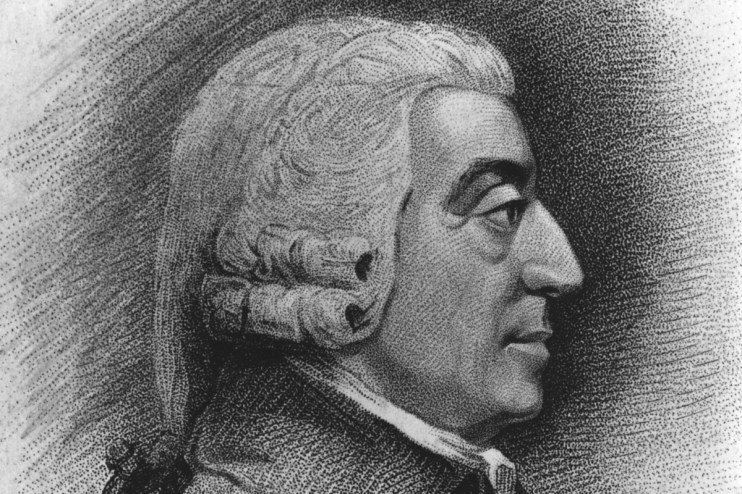
Today in 1776, 250 years ago, An Inquiry into the Nature and Causes of the Wealth of Nations was published, discovering rather than inventing the principle that free trade and efficient division of labour create general prosperity making the world richer, writes Eliot Wilson
Adam Smith was 52 and had spent most of the preceding decade in his hometown of Kirkcaldy, the “Lang Toun” which stretched along the Fife coast of the Firth of Forth. His father, who had died before he was born, had been Comptroller of Customs in the small town where linen was woven and ships were built, but Smith had ambition beyond Fife. He looked beyond the string of prosperous little ports and fishing villages which had led James V to call it “a beggar’s mantle fringed wi’ gowd”.
Smith had read moral philosophy at the University of Glasgow where the chair in the subject was held by the Ulsterman Francis Hutcheson who advocated moral sense theory and was the first professor to lecture in English rather than Latin. He then won a Snell Exhibition to undertake postgraduate study at Balliol College, Oxford, which he found stagnant and stifling compared to the vibrancy of Scotland in the early years of the Enlightenment. Returning to his native country, he gave lectures at the University of Edinburgh from the late 1740s, dealing with rhetoric and later “the progress of opulence”. He also befriended the philosopher David Hume.
In 1752, Smith was appointed to Hutcheson’s former post as Professor of Moral Philosophy at Glasgow and devoted himself to academia. In 1759, based on many of his lectures, he published his first book, The Theory of Moral Sentiments; it was a solid and popular work which reached six editions in his lifetime, and it placed Smith among the front rank of Scottish public intellectuals. For two years he tutored the future Duke of Buccleuch, Henry Scott, but in 1766 he returned to Kirkcaldy and began work on a new volume.
Simple and sprawling
Today in 1776, 250 years ago, William Strahan and Thomas Cadell of the Strand published An Inquiry into the Nature and Causes of the Wealth of Nations, the fruit of Smith’s decade or more of thinking, corresponding and writing. In two quarto volumes totalling more than 1,100 pages, Smith set out to accomplish something simultaneously simple and sprawling: he wanted to explain how nations became prosperous and what circumstances were the most propitious, as well as setting out the practical applications of what he concluded.
Smith certainly did not shy from the challenge. He argued that mercantilist and physiocratic economic models – the one maximising exports and minimising imports to accumulate resources, the other prioritising labour and land development – were flawed and outdated. Instead, he proposed that free trade and the undisturbed laws of supply and demand would create a productive economic system, and that such regulation as was necessary would be carried out by individual self-interest. What he called “the invisible hand”, which he had alluded to in The Theory of Moral Sentiments, would cause economic actors to behave in a way which benefited the public good, even if that was not their intention.
The foundations of his imagined economy were the efficient division of labour, opposition to protectionist tariffs and taxation based on proportionality, transparency, convenience and efficiency. Smith decried special interest groups, including the exclusionary guilds which would form the basis of trades unions”:
“People of the same trade seldom meet together, even for merriment and diversion, but the conversation ends in a conspiracy against the public, or in some contrivance to raise prices.”
The Wealth of Nations proved extraordinarily popular, the first edition selling out within six months. It was also influential: when Lord North, Prime Minister and Chancellor of the Exchequer, presented his Budget in May 1777, he sought Smith’s advice and introduced new taxes on manservants and property sold at auction to defray some of the costs of the war in America. In 1778, North followed up with house duty and a malt tax, again in line with Smith’s concept of political economy.
Four more editions of The Wealth of Nations appeared before Smith’s death, in 1778, 1784, 1786 and 1789. James Madison cited the book to Congress when opposing a national bank for the United States in 1791, and in 1807 Thomas Jefferson described it as “the best book to be read” on the subjects of money and commerce.
The book which today reaches its semiquincentennial established Adam Smith as the father of modern economics, and one of the most enduringly influential thinkers in the discipline. The global economy of 2026 may be more complex and interdependent than that of 1776 but Smith’s fundamental principles retain their truth: free trade and efficient division of labour create general prosperity and the world becomes richer.
There will be slips and stumbles on the way but no model can ever be perfect. The argument is strong that Smith, among the “Big Three” of economic thought, has seen off Marx and Keynes. But the battle is never won, and the fight goes on. Here’s to another 250 years.
Eliot Wilson is a writer and historian; seniorfellow for national security at the Coalition for Global Prosperity and contributing editor at Defence on the Brink