On This Day : Space Shuttle Challenger is lost

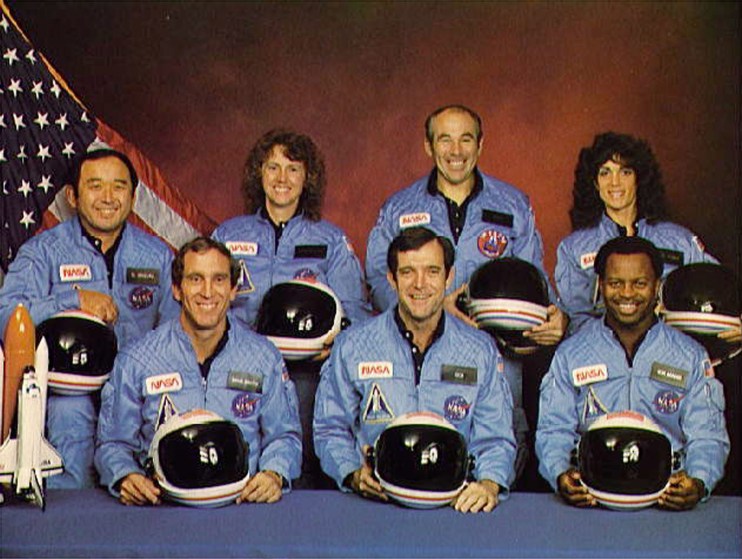
On this day in 1986, millions watched on live TV as the Space Shuttle Challenger exploded moments after launch, Eliot Wilson remembers
On this day 40 years ago, NASA was preparing to launch the 25th mission of its Space Shuttle programme, STS-51-L, using the Space Shuttle Challenger on its 10th flight. During a six-day mission, Challenger would deploy a tracking and data relay satellite as part of America’s communications network, and carry out the first flight of Spartan 203, a small satellite which would observe Halley’s Comet as it passed that year.
The mission was the first to involve a crew member from NASA’s Teacher in Space Project. President Ronald Reagan had announced the initiative in August 1984 to inspire schoolchildren, encourage interest in science and mathematics and pay tribute to teachers. The selected teachers would go into space as payload specialists – civilians rather than members of the NASA Astronaut Corps – for a single mission then return to their profession and share their experience with pupils.
An initial 11,000 applications had been reduced to a shortlist of 10 teachers who underwent training in July 1985. After assessments and interviews, Vice President George HW Bush announced on 19 July that the successful candidate was 36-year-old Christa McAuliffe, who taught social studies at Concord High School in New Hampshire. She was married to an attorney and former US Army officer, Steven McAuliffe, whom she had known since high school, and they had two children, Scott and Caroline, aged eight and five at the time of her selection.
The Space Shuttle programme was five years old at this stage, the first orbiter, Columbia, having made its maiden flight in April 1981. Challenger was the second orbiter to be built, originally intended as a test hack rather than for spaceflight, but it had been upgraded and had undertaken its first space mission in April 1983.
Challenger would take off from the Kennedy Space Center at Cape Canaveral, on Florida’s east coast. It had been NASA’s primary launch centre since 1968, the launch site for the Apollo missions which had orbited the moon (Apollo 8) and landed on the lunar surface Apollo 11, 12 and 14-17). On 28 January 1986, the Challenger orbiter, with its pair of reusable solid rocket boosters and external fuel tank which mixed liquid hydrogen and liquid oxygen, was scheduled to take off from launch pad 39B at 9.38 am.
It was cold in Florida that morning, the coldest temperature there had ever been for a Space Shuttle launch. Overnight it had been -8℃, which was expected to climb to -3℃ by the time of the launch.
Engineers from Morton Thiokol, the manufacturer of the solid rocket boosters, were anxious. There were concerns that the huge rubber O-rings, which sealed the joins between each section of the booster and contained the hot gases from the burning propellant, might lose elasticity in the cold temperature. Lawrence Mulloy, NASA’s project manager for the boosters, asked angrily if the engineers expected them to wait until April for warmer weather. Allan McDonald, Morton Thiokol’s top employee at the Kennedy Space Center, refused to sign off the launch. But under pressure from NASA, more senior figures at the company’s headquarters in Ogden, Utah, agreed to give the go-ahead.
Countdown to disaster
Launch was delayed while ice on the superstructure holding the Space Shuttle melted. An inspection at 11.18 am found the ice melting and declared T-20, clearing Challenger to launch in 20 minutes’ time. The air temperature was approaching 3℃.
At 11.38 am, its boosters ignited, Challenger rose from the launch pad and climbed towards the heavens. 58.7 seconds later, a plume appeared towards the aft of the right-hand booster. An O-ring had failed and a hole was burning through the skin of the booster, causing a drop in internal pressure. At 64.6 seconds after launch, the liquid hydrogen section of the external tank developed a leak; two seconds later the flame from the booster reached the tank.
Neither the crew nor the flight controllers knew this. At 68 seconds, Richard Covey, the spacecraft communicator on the ground, said “Challenger, go at throttle up”. Dick Scobee, Challenger’s commander, responded “Roger, go at throttle up”.
Four seconds later, the right-hand booster broke away. The last recording from the shuttle was pilot Mike Smith. His only words were “Uh-oh”. One second later, the external tank exploded with catastrophic force, and at an altitude of 46,000 feet Challenger broke up. The crew cabin remained intact, and at least some of the seven crew, including Smith, survived a few moments longer, but the Space Shuttle had no provision for the crew to escape. 165 seconds after Challenger disintegrated, the crew cabin hit the surface of the ocean at over 200 mph. The force of 200g was not survivable, and when US Navy divers located the crew cabin nearly six weeks later, a spokesman said they had found “remains, not bodies”.
That evening, President Reagan had been due to deliver the State of the Union Address to Congress. The event was postponed, and instead the President addressed the nation on television from the Oval Office. Dick Scobee, Mike Smith, Ronald McNair, Ellison Onizuka, Judith Resnik, Gregory Jarvis and Christa McAuliffe were the first Americans to die during a space mission. The former Hollywood star gave the performance of a lifetime.
“Nancy and I are pained to the core by the tragedy of the shuttle Challenger. We know we share this pain with all of the people of our country. This is truly a national loss… The crew of the space shuttle Challenger honoured us by the manner in which they lived their lives. We will never forget them, nor the last time we saw them, this morning, as they prepared for their journey and waved goodbye and ‘slipped the surly bonds of earth’ to ‘touch the face of God’.”
Eliot Wilson, writer and historian; Senior Fellow for National Security, Coalition for Global Prosperity; Contributing Editor, Defence on the Brink