On this day: The Suez Canal reopens

Today 69 years ago, on 24 April 1957, the Suez Canal reopened after six months of closure. What can history teach us about the current predicament in the Middle East, asks Eliot Wilson
A strategically vital global waterway was re-opened to maritime traffic after conflict between a Middle Eastern state and Western powers had seen its closure, causing acute problems with energy supplies. As Austrian psychoanalyst Theodor Reik observed, “It has been said that history repeats itself. This is perhaps not quite correct; it merely rhymes.” This rhyme is particularly resonant.
Today 69 years ago, on 24 April 1957, the Suez Canal reopened after six months of closure. It had been blocked on 31 October 1956 when Egyptian forces had deliberately scuttled 47 vessels, most of them in Port Said at the north end of the waterway. But the full story of the closure of the canal begins long before that.
The Suez Canal opened on 17 November 1869. It had been built and was operated by the Compagnie de Suez, 50 per cent owned by French investors and with 44 per cent originally in the hands of Mohamed Sa’id Pasha, Wāli of Egypt, then his nephew, the Khedive Isma’il Pasha. By 1875, Isma’il was in dire financial straits, and Prime Minister Benjamin Disraeli, bought Isma’il’s shares on behalf of the British government.
At 120 miles long, the Canal shortened journeys between Europe and Asia by 4,000 or 5,000 miles, 16-18 days fewer at sea. This boosted trade, and for Britain it provided a vital shortcut between home waters, Gibraltar, Malta and Cyprus, then on to Aden, the Trucial States and the brightest star in the imperial firmament, British India. Beyond lay Burma, Malaya, Singapore, Hong Kong. These were the sinews of Empire.
By the 1880s, Isma’il Pasha’s rule was reliant on British advisers and finance. A nationalist revolt in 1882 was put down by an Anglo-French intervention and a British victory at the Battle of Tel El Kebir. From then until 1914, Egypt was a de facto British protectorate, then formally occupied at the beginning of the First World War.
In 1922, an “independent” Kingdom of Egypt was established, but Fuad I and his son Farouk I, a sybaritic playboy, remained creatures of the British high commissioners, with Britain controlling the Canal Zone.
Then it all began to go awry.
In July 1952, the Free Officers Movement, Egyptian nationalist soldiers headed by Major General Mohamed Naguib and Lieutenant Colonel Gamal Abdel Nasser, overthrew Farouk in a military coup. Britain was winding down its presence and withdrawing military forces solely to the Canal Zone under the Anglo-Egyptian Treaty of 1936, but for the Arab nationalism of the Free Officers this was not enough. Egypt’s new rulers – Nasser by the end of 1954 was Prime Minister and acting President – wanted the British out.
Egypts Mussolini
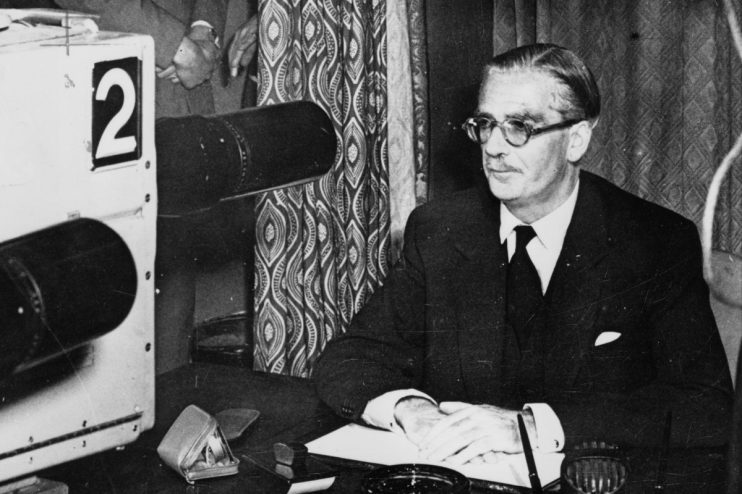
Britain’s experienced but highly strung new Prime Minister, Sir Anthony Eden, was a foreign affairs expert: he had been Foreign Secretary for 12 of the preceding 20 years. But he had become fixated by Nasser – he always pronounced it with a long ‘a’, ‘Nahsser’ – and saw him as a latter-day Mussolini. He had loathed the original so much he could now hardly bear to hear Italian spoken.
On 26 July 1956, Nasser announced a presidential decree to nationalise the Suez Canal Company with immediate effect. He portrayed this as a blow against British imperialism, and promised to use the income from tolls on the canal to fund the Aswan High Dam, a vital hydroelectricity project on the Upper Nile. It was no coincidence that the UK and the US had withdrawn an offer of finance for the dam a week previously.
Britain and France argued Nasser’s action contravened the 1888 Convention of Constantinople and the Suez Canal Company’s concession of 1858. But they saw it for what it was, a direct and dramatic challenge to their influence and rights over the vital strategic waterway and the Middle East in general. They could not allow it to stand.
Eden thought he knew a dangerous dictator when he saw one. He had resigned from the Foreign Office in protest at the Munich Agreement in 1938, and had also warned of the danger of a Nazi-Soviet pact, something few believed possible until it happened in August 1939. He was certain that Nasser had to be faced down as the fascist leaders of the 1930s should have been.
International support was limited. The UN Security Council passed Resolution 118 in October, recognising Egypt’s right of nationalisation so long as it maintained “free and open transit through the Canal without discrimination, overt or covert”. Nine days later, Foreign Secretary Selwyn Lloyd travelled to Sèvres to meet the French foreign and defence ministers, and Israeli PM David Ben-Gurion and IDF chief of staff Moshe Dayan. If the world would not act, countries with skin in the game would.
The Protocol of Sèvres would see Israeli forces invade the Sinai Peninsula and reach the Canal Zone within 24 hours. UK and French troops would then move to defend the Canal and to keep apart the combatants, Egypt and Israel. Both would be asked to halt all acts of war and withdraw at least 10 miles from the Canal Zone, and Egypt would have to accept temporary Anglo-French occupation to ensure freedom of navigation.
Israel invaded on 29 October. The Anglo-French response, Operation Musketeer Revise, began with air strikes on 30 and 31 October, after which Egypt closed the Canal. British and French paratroopers and marines then staged airborne and amphibious assaults along the Canal Zone, capturing Port Said against stiff resistance.
Military success
In military terms, the Israeli and Anglo-French actions were successful: the Egyptian Air Force was shattered and the invaders’ objectives met. General Sir Charles Keightley, Commander-in-Chief, Middle East Land Forces, was subsequently decorated by both allies. But the military dimension was never the point.
If international support had been lukewarm before, it now disappeared. More than 60,000 Soviet troops had streamed into Hungary to suppress a widespread uprising against the Communist government of Ernő Gerő. The Eisenhower administration, trying to respond cautiously but firmly to events in Hungary, pressured Eden to end the emergency: the US blocked financial assistance from the IMF and the Treasury Department prepared to sell some of its sterling bonds, threatening a catastrophic devaluation of the pound.
The enterprise unravelled. With protests at home, pressure from the US and a sudden slowing of military progress, Eden announced a ceasefire for 7 November.
The Prime Minister was terribly ill. Ever since a botched bile duct operation in 1953, he was prone to fevers, jaundice and abdominal pain. He was now taking Drinamyl for pain relief, and Benzedrine balanced by sedatives like Sodium Amytal and Secobarbital to keep him going. Eden was volatile and fractious – Rab Butler remarked that he was the sum of his parents, “half mad baronet, half beautiful woman” – and Suez was too much. At the end of November, he left the country to rest at Ian Fleming’s Jamaican estate, Goldeneye.
It was over. British and French troops withdrew from the Canal Zone to be replaced by a UN Emergency Force under Canada’s Lieutenant General E.L.M. Burns. Egypt retained control of the Canal. Eden resigned on 9 January, giving way to Harold Macmillan, three years older.
The closure of the Canal had caused petrol rationing in the UK, and a New York Times headline on 1 January 1957 declared: “BRITISH TEA HABIT IS A COSTLIER ONE: Shipping Rates Due to Suez Closure Cited–Sugar and Milk Also Are Going Up”.
The Suez Canal reopened fully on 24 April 1957. It was not the death knell of the British Empire some had claimed – that had come years earlier – but it showed the world the power even a middling state could exercise if it controlled a waterway on which the global economy relied. Imagine that.
Eliot Wilson is a writer and historian; senior fellow for national security at the Coalition for Global Prosperity; contributing editor at Defence on the Brink