Skip to content
Tuesday 11 August 2026London --:--Frankfurt --:--Zurich --:--
NewslettersSearchEN · DE
MorningWire

European business, markets and politics

FTSE 100
10,862.50
-0.35%
DAX
26,323.88
+0.02%
CAC 40
8,726.03
0.00%
STOXX 50
6,535.62
+0.18%
  • Europe
  • Markets
  • Business
  • Economy
  • Technology
  • Politics
  • Opinion
More
GermanyFranceBankingAIEnergyFintechPropertyCapital Markets
  • Germany
  • France
  • Europe
  • Markets
  • Business
  • Economy
  • Technology
  • Politics
  • Opinion
  • DE
Wednesday 30 June 2021 10:21 am  |  Updated:  Wednesday 30 June 2021 1:58 pm

Pfizer and Moderna vaccine supply limits pace of jab rollout

By: Amy O'Brien

Add as a preferred source on Google
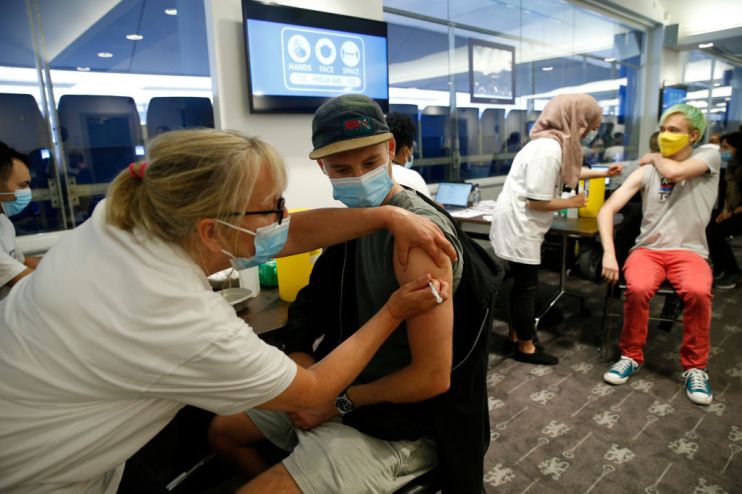
London Mayor Visits Pop-up Chelsea FC Vaccine Hub
Last month, the government’s Joint Committee on Vaccination and Immunisation (JCVI) recommended that adults in the UK aged between 30 and 39 should seek an alternative vaccine to Astrazeneca, following concerns of rare blood clots. (Photo by Hollie Adams/Getty Images)

There are not enough Pfizer and Moderna vaccines being supplied to reduce the eight week interval between doses, according to analysts.

“It appears from the data available that Pfizer and Moderna supplies are the pace-limiting factor,” Matt Linley, an analyst at Airfinity, a data company tracking the vaccine rollout, told The Times.

Last month, the government’s Joint Committee on Vaccination and Immunisation (JCVI) recommended that adults in the UK aged between 30 and 39 should seek an alternative vaccine to Astrazeneca, following concerns of rare blood clots.

Now that the invitation to book a jab has extended to all adults over the age of 18 in England, this has put significantly more pressure on the supplies of the two main alternative vaccines – Pfizer and Moderna. Unlike the Oxford-Astrazeneca jab, these have to be imported.

The top government priority is to get as many people as possible a first dose, amongst rising cases of the more transmissable Delta variant of the virus in the UK. This led to Boris Johnson delaying the UK’s full reopening by four weeks from June 21 to July 19 in order to get more of the population vaccinated.

In order to administer as many first doses as possible, the NHS is being instructed to maintain an eight-week interval between the first and second dose of the Pfizer and Moderna jabs.

The decision to maintain the 8-12 week gap was bolstered by data that the government’s Joint Committee on Vaccination and Immunisation (JCVI) said suggested the Oxford/AstraZeneca vaccine is still effective when doses are administered 12 weeks apart.

However, Pfizer has said it only tested the vaccine’s efficacy when the two doses were given up to 21 days apart.

A spokesperson for the NHS told City A.M: “NHS operational guidance is clear that second doses should be offered from 8 weeks to ensure maximum protection, and this is in line with JCVI and government advice for people aged 40 and over.”

“The NHS is also proactively contacting those who are eligible to bring forward their jab,” they added.

Airfinity told City A.M that according to its model, all UK adults will have had their first dose by July 24.

So far, almost 85 per cent of UK adults have had their first dose, and 62 per cent have had their second.

Read more

Fine dining and The Jab: A Michelin dinner with the Ozempic set

Ozempic tablet on a plate highlighting medications role in weight loss and diabetes management in healthcare news.

Share this article

  • Facebook
  • X
  • LinkedIn
  • WhatsApp
  • Email

Similarly tagged content:

Sections

  • News

Categories

  • Business

Related Topics

  • AstraZeneca
  • Coronavirus
  • Vaccine

Trending Articles

  • Nottingham Forest owner Marinakis sues Crystal Palace for defamation

  • Back to basics: Sainsbury’s gradual retreat from the British high street

  • Thames Water faces fresh threat to survival after pensions regulation breach

  • Hargreaves Lansdown orders staff back to office

  • As it happened: Intel, Arm shares slide; Oil climbs higher

More from Morning Wire

  • Fine dining and The Jab: A Michelin dinner with the Ozempic set

    Life&Style
    Ozempic tablet on a plate highlighting medications role in weight loss and diabetes management in healthcare news.
  • Energy minister says AI must ‘bring down bills’ as data centres squeeze the grid

    Tech
    National Grid has raised billions from investors for the energy transition
  • Astrazeneca share price tumbles on $400bn megamerger talks

    Investing
    Astrazeneca headquarters with logo, reflecting commitment to reduce US medicine prices after Trump administration pressure
  • Astrazeneca explores $400bn megadeal with US rival 

    Markets
    AstraZeneca building exterior with logo, glass facade, UK flag, and wildflowers in foreground.
  • Sweeping job cuts at GSK to fund £400m Cambridge campus

    Pharma
    Modern GSK Cambridge campus buildings with sky bridge, green spaces, and people walking and cycling.
  • Verdiva Bio Appoints Cardiometabolic Leader Steve Marso as Chief Medical Officer

    Business Wire
  • Astrazeneca and Jaguar Land Rover given power to endorse talented migrants for visas

    Politics
    Jonathan Reynolds addressing the SMMT's annual International Automotive Summit (image courtesy of SMMT)
  • Grid delays force Starmer-backed AI data centre to seek alternative power

    Tech
    Sir Keir Starmer's government has prioritised investment data centres as a major pillar of its plans to boost economic growth.
MorningWire

Independent European business, markets and political news for decision-makers.

Morning Briefing

Europe

  • Germany
  • France
  • Europe
  • UK & Ireland

Business

  • Markets
  • Banking
  • Technology
  • Energy
  • Property
  • Fintech

Editorial

  • Opinion
  • Editorial Policy
  • Corrections
  • Contact

Company

  • About Morning Wire
  • Privacy Policy
  • Terms of Use
  • Cookie Policy
© 2026 Morning Wire Ltd · Published by Morning Wire Media, Bahnhofstrasse 65, 8001 Zürich, Switzerland
Privacy · Terms · Cookies · Facebook