Skip to content
Thursday 20 August 2026London --:--Frankfurt --:--Zurich --:--
NewslettersSearchEN · DE · FR
MorningWire

European business, markets and politics

FTSE 100
10,751.22
+0.07%
DAX
25,985.36
-0.41%
CAC 40
8,464.01
-0.45%
STOXX 50
6,427.92
-0.26%
  • Europe
  • Markets
  • Business
  • Economy
  • Regulation
  • Politics
  • Opinion
More
GermanyFranceEU InstitutionsCompetitionPublic AffairsBankingTechnologyEnergy
  • Germany
  • France
  • Europe
  • Markets
  • Business
  • Economy
  • Regulation
  • Politics
  • Opinion
  • DE
Thursday 16 December 2021 6:15 am  |  Updated:  Wednesday 15 December 2021 4:59 pm

Precaution is a useful thing, but designing policy based on maybes is a dangerous road

By: Paul Ormerod

Add as a preferred source on Google
Boris Johnson Leads Coronavirus Press Conference
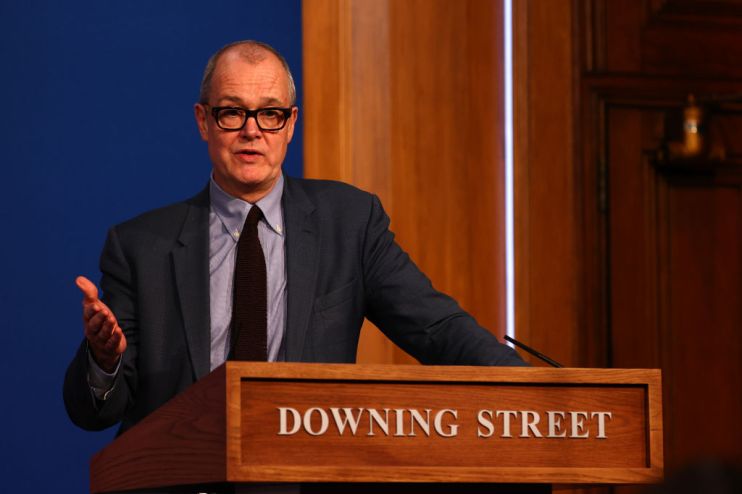
Patrick Vallance is the Government Chief Scientific Adviser. (Photo by Adrian Dennis-WPA Pool/Getty Images)

It is is so familiar, the script almost writes itself. Health professionals start to call for more restrictive measures at the slightest whiff of bad news. The government initially dismisses the concerns. Gradually, ministers – many of them almost wholly innumerate – are beaten into submission by projections of what might happen.

If we were lacking proof, we only need to look at deputy Prime Minister Dominic Raab’s faux pas on Tuesday: he misspoke, and said there were 250 people in hospital with Omicron. There are only 10. Elsewhere, Neil Ferguson of Imperial College warned there “could” be 10,000 hospitalisations a day. With the protection vaccines offer from serious complications, that would be a spectacular downfall of the inoculation. For context, that’s more than double the previous peak in January.

The making of government policy with a hefty reliance on “could”s and “might”s is a dangerous precedent as we tread the weary track of another winter.

For anyone with a reasonable degree of mathematical competence, it is trivially easy to set up a standard epidemiological model using opensource software and generate a wide range of scenarios. Almost any number of cases, hospitalisations and deaths can be produced from the model in the course of an afternoon.

If the range is sufficiently wide enough, one of them will be proved “correct”. Though even this simple task has sometimes eluded the deeply pessimistic epidemiologists. It was just over a year ago that Patrick Vallance,the government’s chief scientist, cited forecasts which claimed that deaths could rise to 4,000 a day by the end of 2020 if a second lockdown was not imposed. The actual figure was barely one-tenth of this. Vallance’s statement was judged to be so implausible that it earned him a rebuke from the official statistics watchdog, the UK Statistics Authority.

In summer this year, government scientists said that the full lifting of lockdown on 21 June “could” lead to 1,000 deaths a day and 10,000 hospitalisations a day. We now see these projections were absurd.

It is straightforward to criticise the projections. But there is a far more important point at stake. In the late spring and early summer of 2020, a small number of economists drew attention to the massive costs of lockdown. Both David Miles of Imperial, a former member ofthe Monetary Policy Committee, and Bob Rowthorn, former head of the economics department at Cambridge, concluded independently that the costs of lockdown far exceeded the benefits on any plausible set of assumptions.

Their analyses were impressive. But, unlike the epidemiologists, their predictions about the costs have proved spot on. Hardly a day goes by without further strong evidence emerging of these costs.

The NHS, despite having huge amounts of money thrown at it, has been unable to prevent a massive rise in waiting lists. Mental illness has risen, millions of children have fallen behind at school, domestic and child abuse is up sharply. The list goes on. It is a devastating indictment of lockdown.

For the epidemiologists, this is of no consequence. Most of them live in their own little bubble, solely concerned with their “forecasts”.

Economists, by contrast, look at the broader picture. They know that every aspect of public policy involves a tradeoff. Each decision will have its own costs and its own benefits.

Read more

Rentokil shares slide almost 20 per cent as demand weakens in North America

Domestic rat with brown and white fur, looking up inside a wire cage, its pink nose and whiskers visible

Share this article

  • Facebook
  • X
  • LinkedIn
  • WhatsApp
  • Email

Similarly tagged content:

Sections

  • Opinion

Categories

  • Opinion

Trending Articles

  • Jobless Banquet: Youth unemployment surge ‘sends Neets to KFC’

  • City law firm sues prominent Emirati business family

  • Amanda Blanc has worked her magic at Aviva

  • As it happened: Miners fuel FTSE 100 recovery; oil jumps as Trump claims Strait of Hormuz

  • House prices in wealthy London boroughs fall by up to £300,000

More from Morning Wire

  • Rentokil shares slide almost 20 per cent as demand weakens in North America

    Markets
    Domestic rat with brown and white fur, looking up inside a wire cage, its pink nose and whiskers visible
  • I drove 3,000 miles and saw the America AI is leaving behind

    Opinion
    Rusty MOTEL sign, classic cars, and Route 66 Kix on 66 sign in Tucumcari, NM for a US road trip
  • World Cup gives London restaurants and retailers Deliveroo boost

    Retail
    Soccer players competing in the World Cup, showcasing intense action on the field with a stadium full of cheering fans
  • OpenAI’s rogue agent doesn’t scare me – the millions of others do

    Opinion
    Breaking news concept with digital globe and graphs, symbolizing global financial trends and data analysis on a business w...
  • The 2026 World Cup had its flaws, yes, but it was a resounding success for Fifa

    Sport Business
    Getty Images logo on a digital display, symbolizing stock photography for news and business publications
  • Anthony Hamilton’s cars – including a special jaguar – just sold for £2.9m, here’s why

    Life&Style
    Light blue David Brown Automotive Speedback GT sports car, front 3/4 view, at an auto show display.
  • Why the Bank of England museum is a one-of-a-kind

    Toast the City
    Gold bar stamped PAMP SA SWITZERLAND on display at the Bank of England Museum, showcasing financial assets.
  • Big Tech faces earnings test after AI spending spree

    Tech
    Googles modern Kings Cross headquarters showcasing innovative architecture in Londons dynamic tech district
MorningWire

Independent European business, markets and political news for decision-makers.

Morning Briefing

Europe

  • Germany
  • France
  • EU Institutions
  • Europe

Business

  • Markets
  • Business
  • Economy
  • Regulation
  • Competition
  • Public Affairs

Editorial

  • Opinion
  • Editorial Policy
  • Corrections
  • Contact

Company

  • About Morning Wire
  • Privacy Policy
  • Terms of Use
  • Cookie Policy
© 2026 Morning Wire Ltd · Published by Morning Wire Media, Bahnhofstrasse 65, 8001 Zürich, Switzerland
Privacy · Terms · Cookies · Facebook