
Promising research on synthetic corneas from London university

Aisha Memon, graduate from University College London and Dr Hirak Patra, Associate Professor of Nanomedicine and Regenerative Medicine at the University College London.
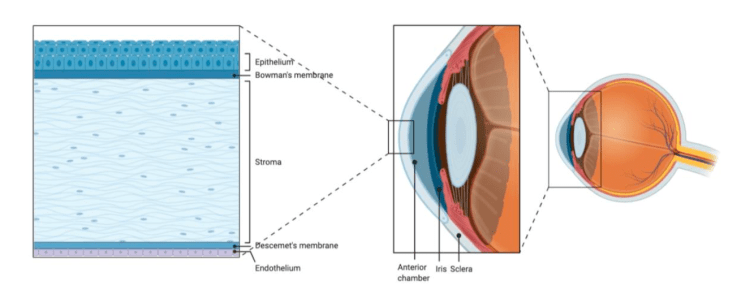
The cornea is an avascular and clear structure present in the anterior part of the eye. It is responsible for mechanical support and protection as well as for light refraction, making it an essential component for visual acuity. It is made of 5 membranes, as depicted in figure 1, which work together to play a key role in maintaining healthy sight.
Due to its significant function, diseases of the cornea can result in vision loss and blindness. Diseases of the cornea are one of the most significant causes of blindness, with over 12.7 million people experiencing corneal blindness worldwide. What we are observing is that patients, primarily in low and middle income countries, will experience corneal injuries and pathologies that are left untreated or misdiagnosed. This results in disease progression past the point of treatment, rendering them blind to a condition that was entirely avoidable. The only viable treatment option for such progressive pathologies is to preform a cornea transplant, also known as a keratoplasty. The transplant is done using human donor tissue, which is used to replace the diseased cornea of the patient. Generally, this procedure has excellent success rates, with an incredible restoration of visible observed in a majority of patients.
Even though cornea transplants are a successful intervention for restoring vision, this procedure comes with its limitations. The supply of viable, healthy human donor corneas is limiting the rate at which these procedures can be preformed. Currently, there is a worldwide shortage of donor corneas, and this means that only one in 70 patients on a waiting list will be able to receive a crucial transplant. The discrepancy initially existed due to general donor shortages. Efforts such as the ‘Opt-out’ system in the UK attempt to relieve this by automatically making all UK citizens organ donors, however there are still limitations to this. The social and cultural taboo related to eye tissue donation means that 10% of people on the donor list choose to exclude eye tissue from the donation (1). Because of this, waiting lists for the procedure are extensive. This problem has only been exacerbated by the COVID-19 pandemic. First of all, the possibility of viral transmission due to transplantation of an infected cornea is unknown, making tissue from COVID-19 positive patients unusable. Furthermore, reports of covid related ocular surface infections and conjunctivitis further excludes a huge number of donors. Therefore, not only have the guidelines for eye banking changed but also the processing of donor tissue has become much stricter with more stringent conditions imposed. Secondly, the worldwide travel ban further restricted the movement of human tissue samples, donors and related staff. This has made procurement and distribution more challenging, impacting the overall supply chain. Eye banks worldwide report a reduction in donor tissue retrieval due to limitations of the pandemic, including patient/donor mobility, staff shortages and donor covid status (2). Interestingly, there are also reports of corneal transplant rejection post infection or vaccination, due to the increased inflammatory response in the patient. These factors combined with pre existing limitations has resulted in a further reduction in the donor supply. As we recover from the pandemic, we are seeing a recovery in the trend however reaching pre-covid rates is not enough to meet the demand of corneal transplants. How can we not only overcome the shortage caused by the pandemic, but also address the pre-existing shortages to ensure complete access to corneal transplants?
Biosynthetic alternatives to human tissue could be a viable route to help address donor shortages. The concept here is quite simple. Collagen, a protein found throughout our body and in our corneas, can be extracted and processed to form a cornea-like biomaterial. This collagen material can be moulded and shaped to replicate the human cornea. With the size and shape mimicked, the biosynthetic cornea can be used instead of human tissue for performing a transplant. The image below is taken from a clinical trial conducted on a successful model of a biosynthetic cornea. As shown in the image, the artificial cornea (a) is the size and shape of a human cornea, and is completely clear for light refraction. Image b) shows the artificial cornea post surgery sutured to the patient’s eye. The report indicates that recovery of visual acuity was successful with very limited side effects that were well managed. This seemingly simple intervention has been shown to be greatly successful as a replacement for human donor corneas, and could potentially be used in the clinic to support the donor pool.
The basic biosynthetic implant can be further modified, opening up new avenues for research. Not only can we replace human donor tissue, we can design these implants to target the patients specific conditions. One example to illustrate the benefit of this is to look at herpes infections. 70% of the adult population in the United Kingdom is a carrier of HSV-1 (herpes simplex 1). An active HSV-1 infection can manifest in the eye, results in ocular keratitis. Routine management of the condition results in complete recovery, however sometimes herpes simplex infections of the cornea can be severe. End stage disease progression can require a keratoplasty for vision recovery. Inflammation from the previous infection, or due to recurring infections, can reduce the success rate of implantation. One way we can target this is by embedding the implant with anti-herpetic drug containing nanoparticles. These particles, embedded in the collagen material mentioned before, will slowly release the protective drug into the eye and surrounding tissue. This will protect the patient from recurring infection post transplantation, increasing the chances of implant integration. This simple modification to the implant can significantly improve patient outcomes. This same concept can be applied to other comorbidities of the cornea, including surface bacterial and fungal infections. We can also help accelerate nerve regeneration in the cornea by embedding nerve growth factor into the material, or target epithelium healing by embedding epithelial growth factors. The opportunity for patient personalisation is endless.
Research in the field looks promising for the clinical translation of this product, and studies from pre-clinical to clinical are all reporting positive results. There are barriers to the mainstream application of the biosynthetic cornea. The main thing to consider here is the cost of this technology and its actual demand. Wealthy countries, such as the US, are entirely self sufficient in corneas. There would be no application of the biosynthetic alternative there. Countries that are facing extremely dire shortages are middle to low income countries. Is it feasible to create a medical device that can not even used by the countries that need it the most? It is important to consider not only the impact of the research being done, but also to understand where the impact is going and if we are actually making a significant difference through our research.
References
https://nhsbtdbe.blob.core.windows.net/umbraco-assets-corp/27122/section-10-cornea-a
ctivity.pdf
https://www.frontiersin.org/articles/10.3389/fmed.2022.844601/full
https://www.ncbi.nlm.nih.gov/pmc/articles/PMC7774160/
https://www.nature.com/articles/s41587-022-01408-w
The Tej Kohli & Ruit Foundation is a restricted fund operating under the auspices of Prism The Gift Fund, registered UK charity number 1099682.