Putin’s war in Ukraine must make us wonder about our military capabilities

Last week all changed, changed utterly; on the eastern fringes of Europe, a war is now happening. Not a border skirmish or some cyber jousting—the Russian army has invaded Ukraine and men and women are losing their lives in a struggle for territory and power.
Taken by surprise by this resurrection of old methods of statecraft, the West has responded awkwardly. There have been loud, almost Churchillian condemnations, dire threats, and some economic sanctions. Our soft power has been deployed across social media. But what hard power response can we offer?
The prime minister, Boris Johnson, hinted that such an option has not been ruled out.
In his television address last week, he warned “Diplomatically, politically, economically and—eventually—militarily, this hideous and barbaric venture of Vladimir Putin must end in failure.”
Already the UK has supplied arms and equipment to Ukraine, and the effect has been felt: Russian armour has been destroyed by British-origin anti-tank weapons. But as yet there is no suggestion that the UK, or indeed any other NATO member, will put “boots on the ground”.
Should we? Could we? Setting aside for a moment the fact that UK forces engaging their Russian counterparts would escalate the war in a geopolitical sense, there is the question of capability.
In recent years, as Vladimir Putin’s actions and rhetoric have grown more aggressive and expansionist, NATO has made a point of shoring up its defences in the Baltic states of Estonia, Latvia and Lithuania. It has long been expected that these would be the first target of any substantive Russian move against NATO.
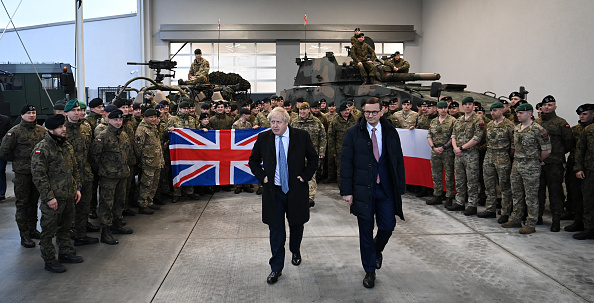
In recent days, the UK has upped the ante. Last week, it moved the 1 Royal Welsh battlegroup, 850 men and their tracked fighting vehicles, from its base at Sennelager in Germany to Estonia to reinforce NATO’s Enhanced Forward Presence Battlegroup (eFP). The force also includes Challenger 2s of the Royal Tank Regiment, and is supported by Apache attack helicopters of the Army Air Corps.
This is not a force ready to take on Russia, which has more than 100,000 soldiers engaged in its invasion of Ukraine.
But it is, perhaps, a stiff tripwire, and deliberately placed. Last year’s Integrated Review, which sought to bring together the UK’s foreign policy, security and defence strategy, identified Russia as our “most acute threat” and added that “Russia will remain the most acute direct threat to the UK” for the rest of the decade. We are, at least and at last, acting in a strategically coherent way.
This overlooks, however, the fact that our capability to launch any serious expeditionary force is severely limited. The British Army currently stands at around 76,000 men and women. It is planned that this will be reduced to 72,500 by 2025. And that is total strength, from a battle-hardened tank commander to a gourmet chef in the Logistics Corps.
For context, at the beginning of Operation Telic, the 2003 invasion of Iraq, the UK deployed 46,000 troops. Putin’s hordes would be a tougher proposition than the Iraqi army.
Simply put, we are no longer prepared, equipped or structured for a conventional land war against a peer or near-peer opponent. The Russian invasion of Ukraine has been oddly old-fashioned after decades of irregular and hybrid warfare, fighting insurgencies in Iraq and Afghanistan, and operating precision strikes with total air superiority. We may be better equipped than the Russians, but, as military types are fond of quoting, quantity has a quality all of its own.
Putin has exposed a question in our strategic thinking that we have not yet been brave enough to address. We have identified him and his kleptocratic regime as our “most acute” threat, but we have not decided whether we are going to equip ourselves to deal with him militarily.
On current numbers and projected strength, we cannot, except, in extremis, as part of a full NATO operation. Therefore, as Russian troops surge further into Ukrainian territory, the question is: do we put down our hand and act as spectators, or do we get more cards?