
Q&A: why tackle harmful deforestation – and how?

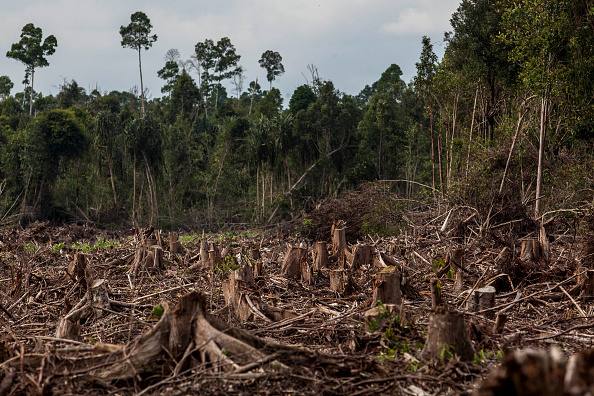
With around 80% of terrestrial biodiversity existing in forests, deforestation poses a critical threat.
It also has a broader impact on climate change, human rights and even global health, as the Covid-19 pandemic has brought to light through a suggested link with zoonotic disease (explained below).
If tropical deforestation were considered a country, it would be the third most polluting nation in terms of carbon emissions.
It is clear deforestation is a big issue, which is why Schroders is putting a focus on analysis and active engagement in this area.
What are the drivers?
The causes of deforestation include pasture for cattle, croplands for soy and palm oil and tree plantations for timber. Tropical forests hold more carbon than any other type of woodland and are home to the greatest diversity of species. They also face the greatest pressures from large-scale agriculture, with the bulk of tropical deforestation occurring in Brazil and Indonesia.
What are the main impacts?
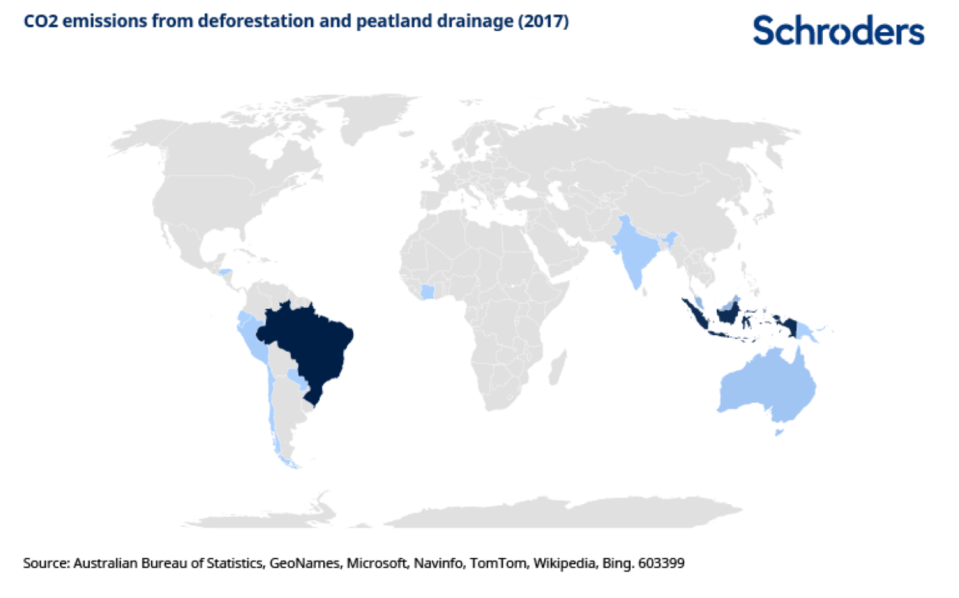
Impacts include the loss of carbon sinks, reduced rainfall and increased risk of drought and human rights impacts such as displacement of indigenous people, workers’ rights and public health issues.
In Brazil, where deforestation accounts for close to half of the country’s carbon emissions, the Amazon region is already experiencing reduced rainfalls and shorter growing seasons.
Complex links between habitat destruction, human disturbance, land use change and biodiversity loss have been linked with increased prevalence of zoonotic disease, according to the Intergovernmental Science-Policy Platform on Biodiversity and Ecosystem Services (IPBES).
Zoonotic diseases are those transmitted between species, including from animals to humans, such as Lyme disease, rabies and coronaviruses.
What kind of products are associated with harmful deforestation?
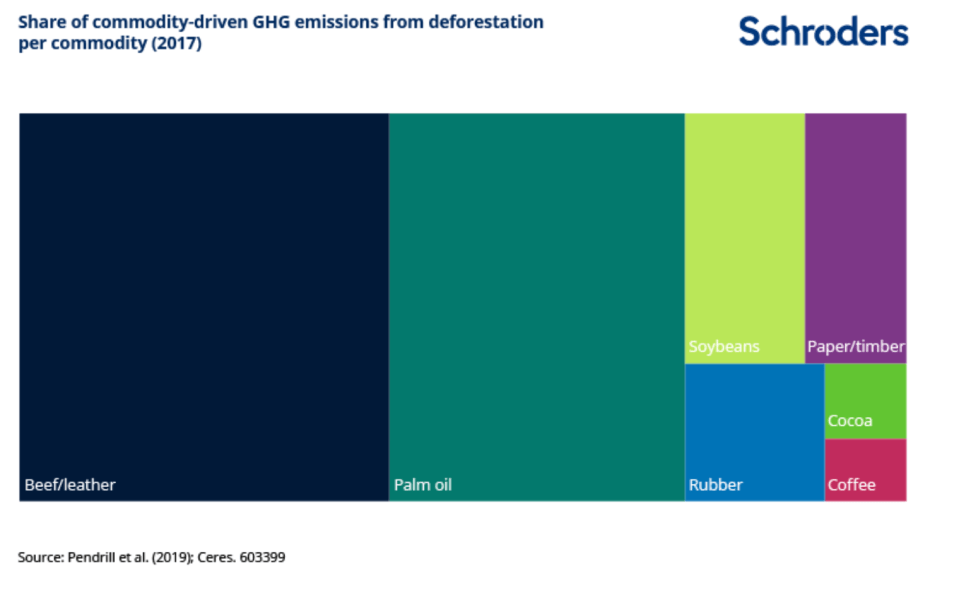
More than half of global emissions associated with deforestation are the result of commodity drivers, according to the Intergovernmental Panel on Climate Change (IPCC).
Beef and leather and then palm oil are the commodities accounting for the biggest share of greenhouse gas emissions from deforestation.
Which are the main countries of production for these commodities?
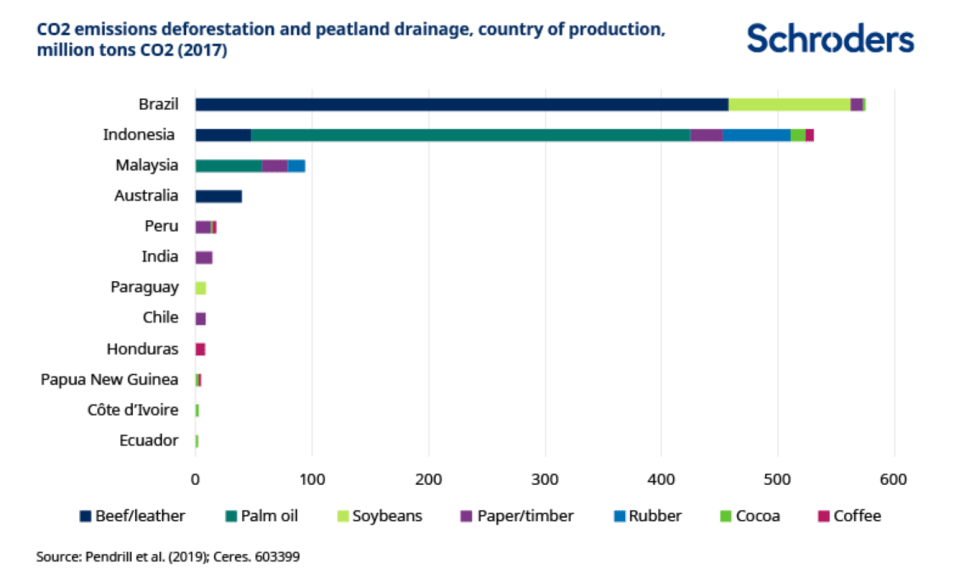
The table below highlights the emissions produced from these commodities by their country of origin. In Brazil, cattle-related products and soybean production dominate, while in Indonesia palm oil and rubber account for the largest share of deforestation-related emissions.
But it’s not as simple as that, is it? Which are the biggest importers and exporters?
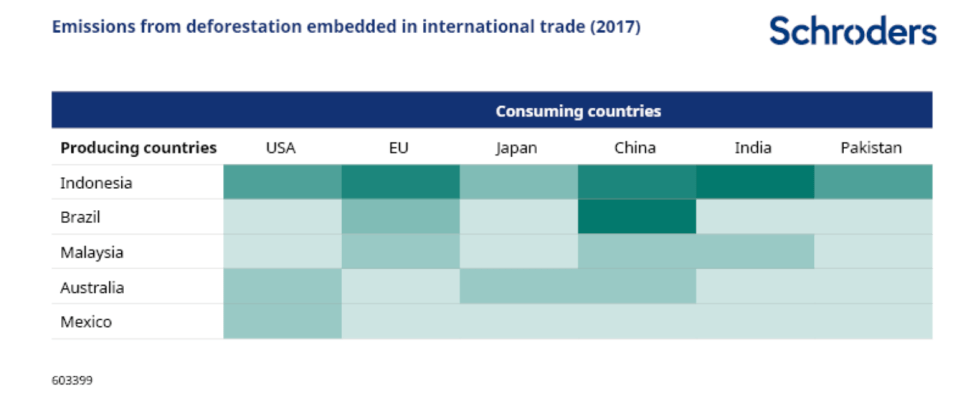
Looking at the country of production alone only paints a fraction of the picture, given the global and interconnected nature of supply chains. An analysis of deforestation-related emissions embedded within international trade highlights that Indonesia is the largest exporter of these commodities, given high levels of domestic consumption in Brazil. China is the largest importer, followed by the European Union and India.
Which sectors and industries are exposed?
The consumer staples sector, for example through household and personal products and food goods, has exposure from paper products for packaging. In the consumer discretionary sector, e.g. autos suppliers, textiles, hotels and leisure, exposure is from leather and rubber, wood pulp and timber, and food commodities for restaurants. In the materials sector, exposure comes from timber and paper for containers and packaging.
Discover more by visiting Schroders’ insights or click the links below:
– Read: Outlook 2022: UK equities
– Listen: Outlook 2022: Things will never be the same again
– Read: Three graphics that will help you picture what 2022 might look like
What are our priorities for research and engagement?
Our research and engagement priorities for deforestation centre on: companies’ commitments and policies, governance and risk management, supply chain mapping and traceability, certification and targets and disclosures in line with emerging best practice.
What will we be looking for?
We will be calling on companies to improve disclosure around forest-related risks. We hope to raise corporate awareness, encourage knowledge-sharing on best practice and increase transparency across industries that are exposed. We will seek to differentiate between leaders and laggards in this area to help investors form decisions.
How will we determine leaders and laggards?
We have built a scorecard that measures companies’ exposure to and management of forest-related risks, using publicly available data from a range of sources. This scorecard will give a quantitative indication of company exposure and performance, which we can then build upon through dialogue with a number of key companies.
– For more visit Schroders insights and follow Schroders on twitter.
Topics:
Important Information: This communication is marketing material. The views and opinions contained herein are those of the author(s) on this page, and may not necessarily represent views expressed or reflected in other Schroders communications, strategies or funds. This material is intended to be for information purposes only and is not intended as promotional material in any respect. The material is not intended as an offer or solicitation for the purchase or sale of any financial instrument. It is not intended to provide and should not be relied on for accounting, legal or tax advice, or investment recommendations. Reliance should not be placed on the views and information in this document when taking individual investment and/or strategic decisions. Past performance is not a reliable indicator of future results. The value of an investment can go down as well as up and is not guaranteed. All investments involve risks including the risk of possible loss of principal. Information herein is believed to be reliable but Schroders does not warrant its completeness or accuracy. Some information quoted was obtained from external sources we consider to be reliable. No responsibility can be accepted for errors of fact obtained from third parties, and this data may change with market conditions. This does not exclude any duty or liability that Schroders has to its customers under any regulatory system. Regions/ sectors shown for illustrative purposes only and should not be viewed as a recommendation to buy/sell. The opinions in this material include some forecasted views. We believe we are basing our expectations and beliefs on reasonable assumptions within the bounds of what we currently know. However, there is no guarantee than any forecasts or opinions will be realised. These views and opinions may change. To the extent that you are in North America, this content is issued by Schroder Investment Management North America Inc., an indirect wholly owned subsidiary of Schroders plc and SEC registered adviser providing asset management products and services to clients in the US and Canada. For all other users, this content is issued by Schroder Investment Management Limited, 1 London Wall Place, London EC2Y 5AU. Registered No. 1893220 England. Authorised and regulated by the Financial Conduct Authority.