Skip to content
Tuesday 11 August 2026London --:--Frankfurt --:--Zurich --:--
NewslettersSearchEN · DE
MorningWire

European business, markets and politics

FTSE 100
10,849.08
-0.12%
DAX
26,395.37
+0.27%
CAC 40
8,717.07
-0.10%
STOXX 50
6,552.54
+0.26%
  • Europe
  • Markets
  • Business
  • Economy
  • Technology
  • Politics
  • Opinion
More
GermanyFranceBankingAIEnergyFintechPropertyCapital Markets
  • Germany
  • France
  • Europe
  • Markets
  • Business
  • Economy
  • Technology
  • Politics
  • Opinion
  • DE
Monday 29 September 2014 8:28 pm  |  Updated:  Friday 07 June 2019 11:43 am

QE or not QE? Mario Draghi’s policy dilemma – CNBC Comment

By: Catherine Boyle

Add as a preferred source on Google

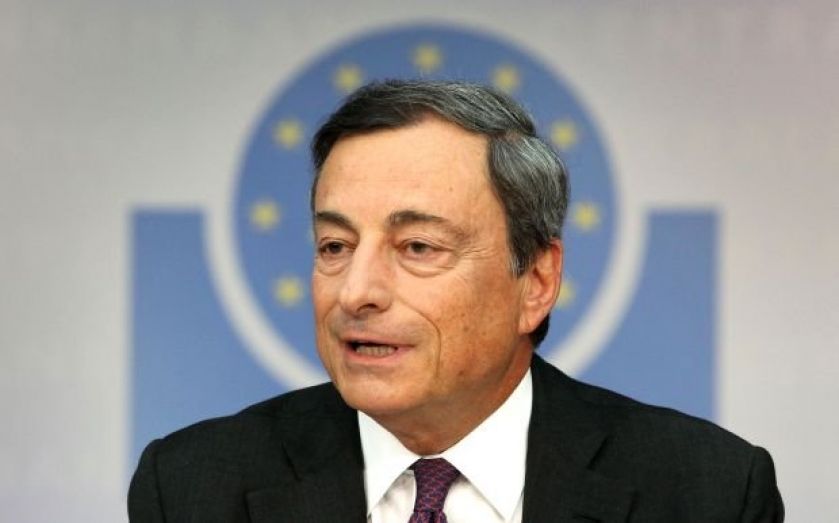
It seems as if the European Central Bank (ECB) has been debating whether to head down the QE path forever. ECB-watchers have been reduced to pondering what the shade of Mario Draghi’s (usually blue) tie might mean for future asset purchases.

But no matter how reluctant Draghi might be to label it as such, this week, the central bank is expected to announce the details of its first round of what many are reading as private sector QE. When first announced, the mass buying of private sector assets seemed to be the fillip markets had been hoping for – especially as, if it follows the pattern established by the US Fed, public sector asset purchases may follow soon after (within six months, according to Mark Wall, chief economist at Deutsche Bank).

Yet is this really the best thing for the increasingly stagnant economies of the Eurozone? The widening of Eurozone government bond spreads last week, following yet more weak economic data for the single currency region, suggests both markedly less confidence in the region’s weaker economies and reduced expectations of a QE bazooka. Further, the example of Japan, which had its worst economic quarter since the 2011 earthquake in April to June this year, is rapidly becoming less encouraging. If there were huge confidence in the ECB’s ability to deliver the right kind of economic stimulus, why would slightly weaker data deliver this reaction in the bond markets?

Of course, the ECB cannot do everything, and the market reaction is partly due to an increasing lack of confidence in politicians’ ability to deliver the fiscal and structural policies that would reduce the need for asset purchases.

Yet there are also valid concerns about the disconnect between the cheap money pumped into the European banking system and the take-up by the real economy. Loans to non-financial borrowers are still slowly falling, as deposits rise, and this appears increasingly to be down to lack of demand. If businesses are feeling confident, why are they not borrowing to fund their future expansion?

And if the ECB, as expected, plans to buy top quality asset-backed securities and covered bonds, this may reduce the amount of the best quality assets held by banks, just as the crucial asset quality review focuses attention on who is holding the least secure assets.

There is also the question of whether the ECB will find enough assets in this round to meet its targeted €1 trillion growth of its balance sheet. With a worse-than-expected take-up of its targeted longer-term refinancing operations programme, it may be forced to expand beyond the private sector remit faster than planned.

Share this article

  • Facebook
  • X
  • LinkedIn
  • WhatsApp
  • Email

Similarly tagged content:

Sections

  • News

Categories

  • Morning Wire Content

Related Topics

  • Mario Draghi
  • People
  • Quantitative easing

Trending Articles

  • Five-star Mayfair hotel hit with HMRC winding-up petition

  • Nottingham Forest owner Marinakis sues Crystal Palace for defamation

  • Back to basics: Sainsbury’s gradual retreat from the British high street

  • Hargreaves Lansdown orders staff back to office

  • As it happened: Intel, Arm shares slide; Oil climbs higher

More from Morning Wire

  • Revolut lands fresh banking licence after wrestling with Europe friction

    Fintech
    Revolut Banque Française ad on a Morris column in Paris, with the July Column and blurred traffic in the background.
  • RS2 Financial Services GmbH Selected to Participate in ECB Digital Euro Pilot

    Business Wire
  • Dream Accelerates Growth of Asset Management Platform With Acquisition of Chancerygate, a Leading U.K.-Based Industrial Asset Manager and Developer

    Business Wire
  • Surely Gary Stevenson is smart enough to know a wealth tax won’t work?

    Opinion
    Gary Stevenson speaking at a Patriotic Millionaires event, addressing wealth inequality and economic reform proposals.
  • Britain needs a Marshall Plan for civic life

    Opinion
    Harry Truman, smiling in a fedora, and Winston Churchill in a bowler hat, seated together in a car.
  • Four charts revealing scale of Andy Burnham’s economic challenge

    Economics
    Due to the lack of article title, content, categories, and tags, its impossible to create a specific, keyword-rich alt tex...
  • Dream Industrial REIT Announces Entry Into U.K. Multi-Let Industrial Market and Growth of Strategic Private Ventures in Europe

    Business Wire
  • Hold interest rates but ‘sound hawkish’, Morning Wire Shadow MPC tells Bank of England

    Economics
    Andrew Bailey, Governor of the Bank of England, with the Bank of England building and Union Jack flag in the background
MorningWire

Independent European business, markets and political news for decision-makers.

Morning Briefing

Europe

  • Germany
  • France
  • Europe
  • UK & Ireland

Business

  • Markets
  • Banking
  • Technology
  • Energy
  • Property
  • Fintech

Editorial

  • Opinion
  • Editorial Policy
  • Corrections
  • Contact

Company

  • About Morning Wire
  • Privacy Policy
  • Terms of Use
  • Cookie Policy
© 2026 Morning Wire Ltd · Published by Morning Wire Media, Bahnhofstrasse 65, 8001 Zürich, Switzerland
Privacy · Terms · Cookies · Facebook