Recovery Vouchers on the Blockchain

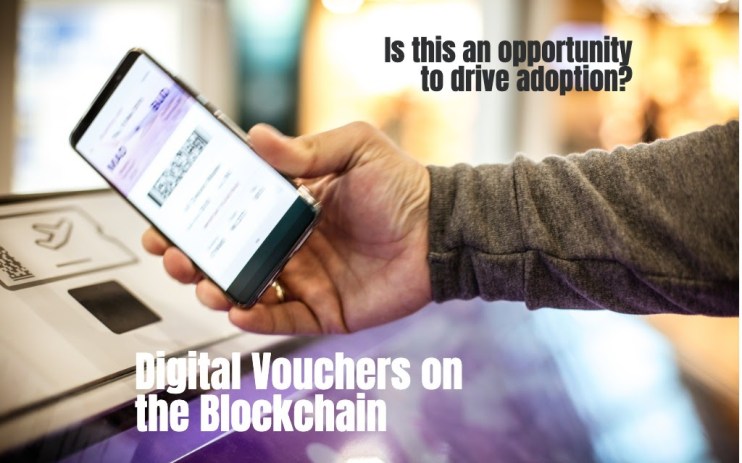
In Sunday’s Morning Wire it was reported that Chancellor Rishi Sunak is considering plans to hand £500 to every adult and £250 to every child to spend with businesses that are most affected by COVID-19 lockdown. The initial proposals include making these payments available via vouchers, travel cards or mobile phone credits.
How could the government deploy these vouchers? How would it be possible to validate merchants who were accepting the vouchers? Would all of the transactions be in fiat? And how would merchants reconcile all of these vouchers back into fiat currency?
Recovery vouchers present a fantastic opportunity for the blockchain community to come together and provide a solution.
Numerous areas make deploying this voucher system challenging. There are issues of potential fraud, personal data, misuse of the credits and redeeming the vouchers back into fiat currency.
Starting at the top of the process, merchants would need a simple way to register themselves and their businesses. Any system would need to check existing business registries and make an instant decision if their business was eligible to receive vouchers. Once registered, merchants can be approved. Redeeming vouchers is limited to approved merchants.
The general public would need to have a means of securely receiving the vouchers and ensuring that there were no double claims.
The general public would need to have a means of securely receiving the vouchers and ensuring that there were no double claims. Ideally, the system will grant vouchers without the need to share excessive personal data. Public blockchains are well established in providing pseudonymous access.
If provided on a public blockchain, the entire system would be accessible by anyone wishing to check the efficiency of distribution of the funds. The ledger could also contain data related to the redemption of the vouchers.
Using blockchain for this solution has all of the core functionality of maintaining balances, preventing double-spend and full audit capability built-in.
Once redeemed by the public, merchants would have instant access to funds which they could submit back to the government to be converted back into currency and deposited into their accounts if they wanted to.
Although I’m sure the Chancellor might initially object, the funds collected from vouchers could even be used immediately to return to employees. Or the funds could be used to pay other merchants in their supply chains. Every transaction would be recorded on the blockchain so there would be no opportunity for tax evasion. It would substantially accelerate the liquidity in the market and get help to the businesses who needed it in a low friction way.
It would be possible to use an existing public blockchain (like Ethereum), or it could be that an entirely new public blockchain was created just for this purpose. Who would run that blockchain, and why?
In a public blockchain, there are incentives to the people who maintain the ledger. The same could apply here. Thousands of blockchain enthusiasts would sign up to be part of a project like this and would, in turn, earn a small amount from every transaction for their efforts. The merchants would bear the costs, but they would far less than the fees they pay to the current credit card network.
The idea of using blockchain to support this system isn’t without its challenges.
The idea of using blockchain to support this system isn’t without its challenges.
An estimated 5% of the British public does not own a mobile phone. There would need to be a method of giving these people access to the vouchers safely and securely. Fortunately, the idea of a paper wallet already exists and could be easily adapted for this program. Using blockchain would also address the estimated 4.7% of the British public who are unbanked.
A significant obstacle to the adoption of bitcoin has been the user experience. There are issues of managing private keys, lack of customer support and more. None of these issues goes away in this system – and some of them become more exaggerated.
However, with mass adoption comes real opportunities to learn and of course, to innovate.
As the blockchain would be public, there would be opportunities for anyone to check their voucher balance on a public blockchain explorer. These could be accessible via web, mobile phone app or even through some form of a kiosk. It would also be possible to integrate into existing payment systems like PayPoint or Payzone.
Renewals of the voucher program on a blockchain system simplify future disbursements. Extending the idea beyond vouchers to spend in the hospitality industry, new amounts could be distributed on a separate set of smart contracts to cover everything from housing benefit to winter fuel allowances.
Promotion and marketing of this system are one of the most critical aspects. For that reason, the words blockchain and cryptocurrency should never be mentioned. The focus must be on the value the system brings to the public, merchants, the government and the economy – not on the blockchain.
As I have said before, blockchain is best when it is invisible.

Get in touch with us [email protected] / Twitter @igetblockchain
Troy Norcross, Co-Founder Blockchain Rookies