
Red card to business cards? Not just yet

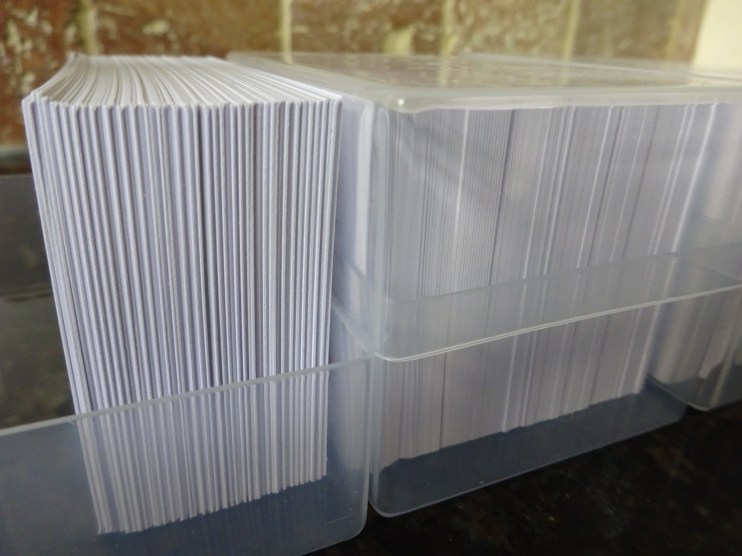
For many entrepreneurs and start-ups, it is one of the most exciting elements of launching a company: ordering business cards. The very act of commissioning and receiving shipments of 88x55mm cards showcasing your new enterprise is a visible and tangible sign that you’re ready for business.
Could the increasing number of new companies springing up as the pandemic continues – often people starting anew and alone in understandably unforeseen circumstances – trigger a wave of orders? Or has social distancing guidance – and the consequential reduction in face-to-face meetings – rendered business cards nearly redundant? After all, if meetings are taking place via phone- or video-call, handing over a card as you shake hands with a new connection is impossible.
This topic gained unexpected prominence this week after a report that the Conservative Party’s annual conference, which is taking place ‘virtually’, would feature a ‘virtual business card fishbowl’: a digital equivalent of the glass bowls that many trade show exhibitors use as a lead-generation tactic.
‘Rebound’ in demand – and new forms of usage
As general manager for Vistaprint UK & Ireland, Emily Shirley has an ideal perspective on the business card market – the company produced more than five billion business cards globally last year. Overall, it has seen global business card revenue rocket from less than $3m in 2000 to more than $430m (about £319m) in 2019.
“Similar to many businesses, we saw a decline in global demand for business cards as the stay-at-home orders settled in around late-March. However, we didn’t see an outsized decline in business card demand relative to other categories,” she tells Morning Wire. “In the same vein, we saw a rebound in demand commensurate with the rebound of Vistaprint overall and the small-business community in May, June and July.”
The company has also observed new or reinvigorated types of use for business cards in the wake of the pandemic, such as loyalty cards, name tags, safety procedures and contact-tracing information.
‘Habits of a lifetime hard to break’
But as many meetings have – for now – become digital, can business cards do the same? My Business Client is a Hampshire-based SME that launched an electronic product, My Business Card, four months ago, partly as a reaction to COVID-19’s restrictions on physical cards.
Its product is stored by people on their mobile-phone and can be sent to clients or contacts via text message. Its background can be changed for promotional or seasonal reasons and – importantly – updates if the holder changes role (rather like LinkedIn). Advantages to the ‘card’-carrier include environmental aspects – no printing – and furthermore if the person’s business updates its logo, for example, the card automatically updates.
The company’s co-founder, Andrew Nice, believes that electronic cards are likely to grow in popularity for reasons including the shift towards flexible and home-working, as well as other digital trends. But he sees a future for paper business cards, too. “It will take many years, as the habits of a lifetime are hard to break,” he says.
Symbolic of human connections
Gavin Megaw, managing director of London-headquartered PR agency Hanover’s corporate and brand communications team, also believes the physical business card has plenty of gas left in the tank.
“Maybe there’s an opportunity for someone to create something we didn’t know we needed – akin to the iPad, iPhone or Kindle. But, at heart, virtual business cards will always be little more than contact details to store on a CRM [customer relationship management] system. They lack what has made physical business cards important – human connection,” he says.
“Coronavirus has demonstrably shown that we all need to see and meet people,” Megaw continues. “Business cards symbolise a human connection has been formed when they have been handed over. More than a piece of paper, they are a physical memory that engagement has happened. People wrote books off many years ago. Some of us may have bought ‘the future’ in Kindles, but physical books are selling more than ever. Business cards, like books, will still be with us for the long haul.”
Cards ‘remain a staple’ for small businesses
Vistaprint’s Shirley, naturally, believes that business cards have such a variety of users and uses that their prevalence will continue. “While many business owners are migrating to digital for marketing purposes, we find that the simple 85x55mm business card remains a staple for small businesses,” she says.
“When a business owner shares their business card, they’re not only sharing their logo and contact information, they’re projecting their business and brand for potential customers to see. Whether it’s for contact information, building leads, rewarding loyal customers or announcing promotions, the fact remains that one of the most cost-effective, memorable ways to do so is with a business card. We don’t see this changing any time soon, as people still appreciate the sentiment of face-to-face exchanges,” she reflects.
It’s difficult to imagine the whirlwind of business-card swapping that accompanies exhibitions, events and professional gatherings returning any time soon. But beyond the typically office (or home)-based City or professional services workforce, demand endures and evolves.
“For small businesses – the corner bakery, local shops, landscapers and jewellery makers – the business card remains a powerful promotional product as they are operating up close and personal – socially distanced, of course,” says Shirley.