Regent’s Crescent: How John Nash’s iconic Georgian terrace is being reborn

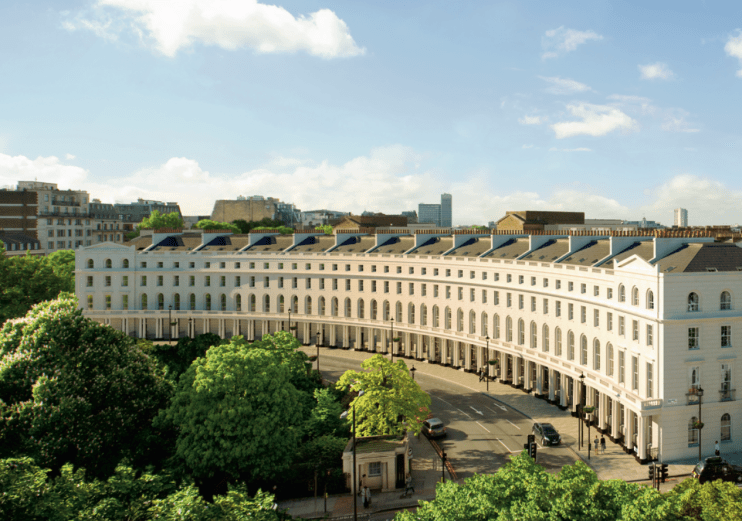
Walk around London’s west end, your eyes skywards, and you’d be hard pressed not to spot the work of John Nash. The architect to the Prince Regent (later George IV) built countless buildings in central London – from Marble Arch, to Clarence House, to All Souls Church on Langham Place.
And then there’s Park Crescent. It sits pretty, this 19th century crescent at the top of Regent Street. To get to it from Oxford Circus, one passes the Royal Institute of British Architects at 66 Portland Place. Just 100 metres from Regent’s Park underground station, and a seven-minute walk from Marylebone High Street, Park Crescent is at the centre of its own polite universe. For some years hoarding has covered its famous white stucco but this month it came down to reveal the restoration of one of Nash’s famous crescents to a new, modern standard of luxury.
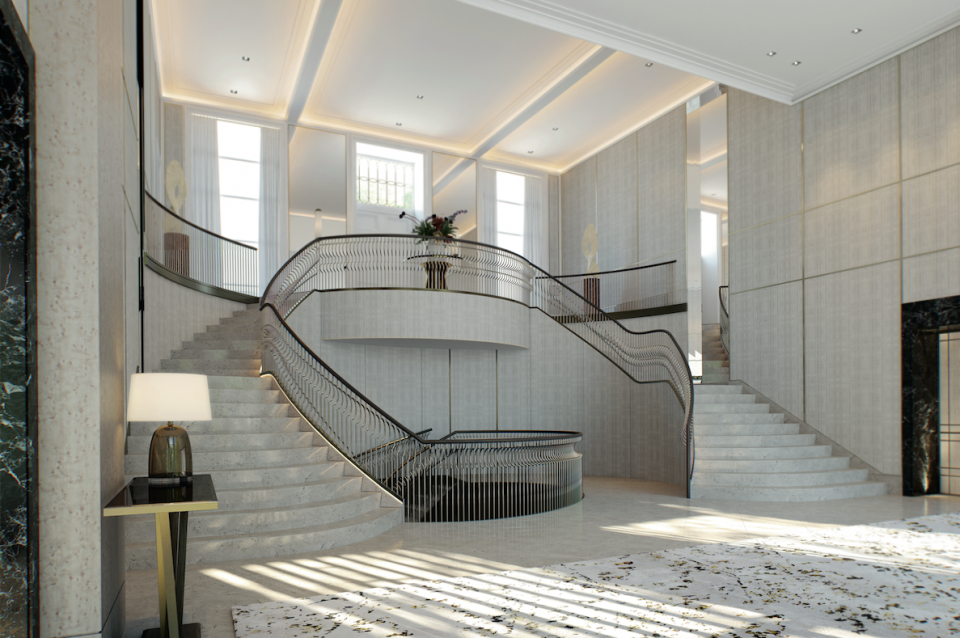
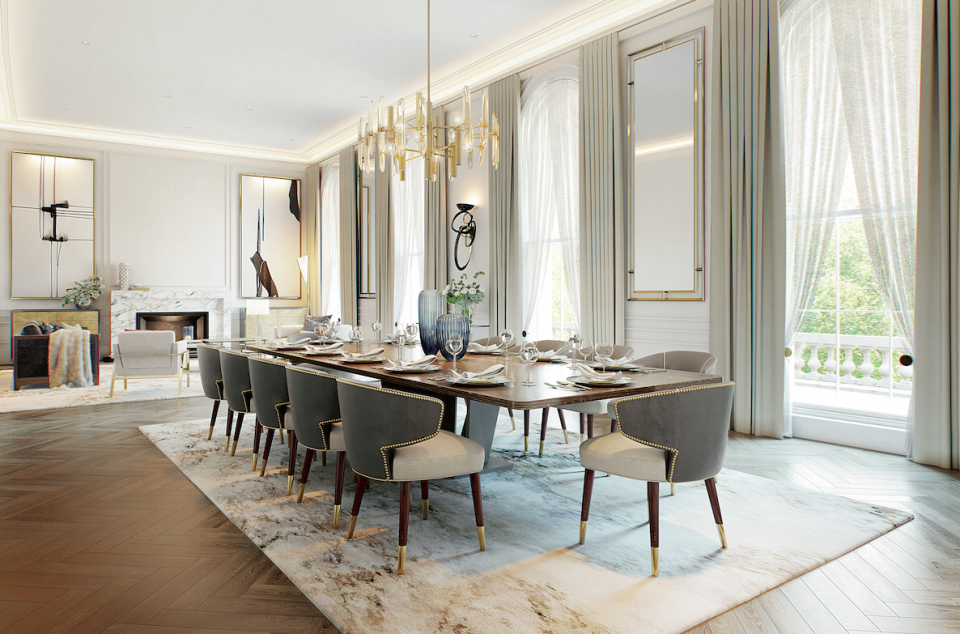
Yes, it’s another new development. Regent’s Crescent, by developer CIT, is a collection of 67 two to five-bedroom apartments due to launch in 2020, with a 9,000sqft basement containing the amenities commonplace in such buildings, amongst them a spa, 20-metre swimming pool, cinema and parking.
Around the back, a series of 16 lower-ground one-bedroom apartments can be acquired for staff usage, visitors, or as additional investment opportunities. Prices for the main apartments begin at £2.9m. All of this in a Grade I-listed building.
The history of Park Crescent is key to the project, says Henry Barrow, sales manager at CIT. “It isn’t something we need to manufacture.” Rare too is a historical development of this scale. “When you get a refurbished property in a period building, it’s usually just one unit, or you might get a house with four one- or two-bedroom flats. To repeat something like this is going to be hard for any developer – where are they going to get a whole crescent to do it?” These are in limited supply. There are about 70 streets containing the word “crescent” in London, the most notable being Pelham Crescent in South Kensington, and Hans Crescent in Knightsbridge.
Research conducted in 2014 by Wetherell estate agents found that properties with “crescent” in the address commanded an average price of £2,103 per sq ft, 40 per cent higher than the average for central London.
“Crescents are cool,” says Nicholas Boys Smith, founder of Create Streets, a housing and planning research institute. “We should create more of them.” Research by Create shows “that people like walkable streets with a sense of enclosure, some level of symmetry, and a sense of place. We like patterns that remind us of natural forms.”
Curved streets – crescents – do this brilliantly. The word “iconic” is ubiquitous, but it is the correct one to ascribe to London’s crescents, says Dr Geoffrey Tyack, emeritus fellow at Kellogg College Oxford and author of John Nash: Architect of the Picturesque. “They were part of the way that people planning towns thought about bringing together the urban and the rural image. Regent’s Park, as Nash conceived it, was a pastoral vision incorporated as part of what was by that time one of the largest cities in the world.”
Work on Park Crescent was completed in 1821, having begun in 1806. Nash’s original proposal for the scheme would have made it a “circus”, one of three including Oxford Circus and Piccadilly Circus, to link Whitehall and Westminster with what is now Regent’s Park. When this scheme proved too ambitious, a private garden, Park Square, was built, an alternative entrance to Regent’s Park. When complete, the houses around Park Crescent filled up with residents – MPs, a judge, peers and a Portuguese man-about-town were listed in an 1841 directory of the street.
Later, Joseph Lister, a pioneer of antiseptic surgery lived at number 12. These properties were pricy then, too: in 1826, number 10 sold for £7,200, equivalent to around £700,000 in today’s money. Following the Second World War, when parts of Park Crescent were badly damaged, houses around the crescent on both sides found other uses – as council facilities, and hostels for overseas students visiting the UK.
Despite the damage, given the significance of Nash’s work, it was decreed that the crescent must be retained. A report published in 1947 on the future of the Regent’s Park terraces determined that Park Crescent was one of seven that would be kept at all costs, and “preserved so long as possible with the present facade… the gaps left in it by bombing should be made good by new building.”
That a developer has come in to rejuvenate the building, says classical architect Francis Terry, is of little consequence. “I don’t mind… whether that building is actually by Nash or whether it was built yesterday – it’s a good piece of civic architecture.” The interiors don’t matter either: “These buildings have been all sorts of things.”
The debate surrounding the merit of pastiche in architecture is a tedious one, says Terry. “Nash didn’t invent the ionic order, or the sash window. The whole history of classical architecture is copying – Nash copied the Romans, the Romans copied the Greeks, the Greeks copied the Assyrians, the Assyrians copied the Egyptians.”

But who is going to buy at Regent’s Crescent? Will Watson, head of London for Knight Frank’s The Buying Solution has his money on the international market. “I’ve got a US buyer coming in a few weeks who wants to look at it for a pied a terre – he loves Marylebone and Mayfair but there’s nothing close to what he wants in those areas.” For now, the development is unlikely to be too tempting to domestic buyers, says Barrow. “When the building wrap comes down we’ll start to see the domestic market pick up – they prefer to buy completed stock.”
Londoners who do come to Regent’s Crescent are likely to be local. “We’ll probably have a lot of downsizers, people coming from St John’s Wood,” Barrow reckons. “With the domestic buyer it will be where they live full-time, so they want to get things right.”
The work of John Nash, in whatever form it is presented – in the original, or rebuilt – is critical to London’s architectural landscape, says Dr Tyack. “With the exception of Sir Christopher Wren in Canada, Nash’s contribution is the most important of any other architect.”
This owes to the scale of his work. “If you go from the top of Regent’s Park to Trafalgar Square, what you’re looking at is a scheme prepared by Nash.” He is integral to the city. “The way we look at the west end of London is to a large extent determined by what Nash did.