Reinventing the wheel (or the sail) can actually change an industry

The history of the maritime industry is a long one. Ocean-based shipping routes are the oldest method for real trade and transport from A to B: the first traces of seafaring vessels are found as far back as Ancient Egypt. These ships were powered by oar – manpower and by sail – wind-power.
A fair bit has changed in the last 5,000 years or so, but some inventions are timeless. Engines may have replaced manpower, but the trusty sail endures as a highly effective method of generating speed at sea; albeit, until now, largely reserved for the realm of leisure, yachting, and competitive sailing.
The importance of global shipping and its impact on civilizations cannot be understated. In recent history, for example, most industrial goods were transported around the world on cargo vessels by the 1980s, which was a major catalyst for globalisation.
When working on a solution for what is, frankly, an existential human problem – our changing climate – the team at BAR Technologies – which is a spin off from Ben Ainslie Racing – looked at how we could marry British innovation and our country’s proud maritime heritage, to tackle this 21st century crisis.
Huge growth in demand by consumers and industry for goods, raw materials (and fuels) has seen a boom across the entire spectrum of shipping, much to the delight of ship owners, charterers and brokers in Canada and elsewhere.
This boom, however, means that solutions for carbon-neutral cargo shipping have become an immensely important and increasingly pressing concern for operators (and regulators) of shipping worldwide.
So, how to create propulsion for a 100,000 or 200,000 tonne cargo ship in a way to significantly reduce fuel consumption and protect the valuable assets on board?
Like many engineers, designers and mathematicians, it can be tempting to over-complicate or over-design.
After many rain-soaked walks in Portsmouth, over four years of development (and enough coffee to sink the Titanic all over again), we decided that maybe we should reinvent the wheel, or, more specifically, the humble sail.
We name our inventions in the “Ronseal” way – it does what it says on the tin and so consequently, the “WindWing” was born.
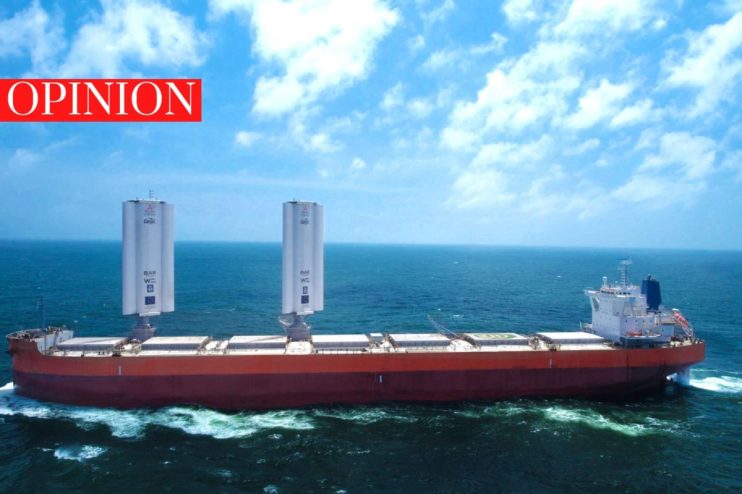
Even though we say so ourselves, the WindWing is a 37.5m example of British ingenuity. Designed, engineered and constructed using the marine grade steel and glass composite that can be retrofitted to the legacy fleet vessels en-masse.
After years of development, earlier this month, innovative WindWings set sail on open waters, bringing cutting edge wind propulsion to commercial shipping for the first time.
The Pyxis Ocean, owned by Mitsubishi Corporation and chartered by Cargill set sail halfway across the world from Singapore to Brazil, equipped with two WindWings, anticipated to reduce the vessel’s fuel consumption by 3 tonnes per day and CO2 emissions by around 4.5 tonnes per day. The Kamsarmax-size vessel could have had three wings fitted which would have seen both fuel and CO2 reduced by as much as 30 per cent.
Wind power is not only zero emissions and used at source with minimal losses but it is also a non-depleting and hugely predictable resource. It has the cumulative benefit of both cutting costs, as well as carbon.
On an average global route, WindWings can save 1.5 tonnes of fuel, per WindWing, per day – with the possibility of saving more on trans ocean routes. This can translate into vessel owners saving heavy fuel oil (HFO) at c$800 per tonne and a carbon tax of $100 a tonne. These efficiencies will become even more important when saving against future fuels, which are expected to rise. This will place WindWings as a key enabler allowing the most progressive owners to make the move to zero emission fuels.
The maritime industry faces a huge challenge to reduce average CO2 emissions. The revised IMO GHG Strategy includes an enhanced common ambition to reach net-zero GHG emissions from international shipping close to 2050, a commitment to ensure an uptake of alternative zero and near-zero GHG fuels by 2030, as well as indicative check-points for 2030 and 2040.
It’s a massive challenge for the entire industry but with WindWings – and perhaps other wheel reinventors – one that British businesses are well positioned to tackle with the same gusto as revolutionary Egyptian sailors charting a course down the Nile and on to yet-to-be-discovered countries, 5,000 years ago.