Remember the Russian super yachts? They could be sold to rebuild Ukraine

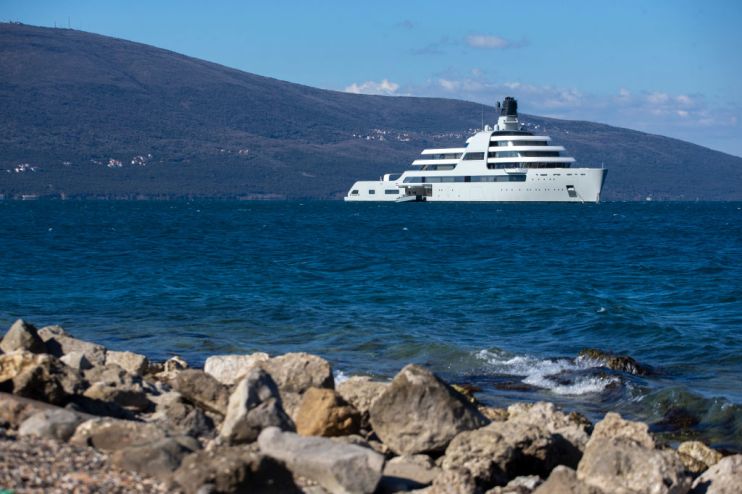
In Europe, some places are inherently associated with wealth. Think St. Tropez in France, or Portofino and Porto Cervo in Italy. On a stroll in these marinas, you see yacht after yacht after yacht – each one bigger than the other. It’s impossible not to stop and wonder who owns them.
These superyachts have long been a symbol of a narrow world – that of the mega rich. Some have pointed at these floating houses as proof of the excess that takes place when extreme wealth is accumulated in the hands of very few. Jeff Bezos, the Amazon founder, wanted Rotterdam to dismantle a bridge so that his new yacht could transit – it was so big it would get stuck.
In recent months, as Russia made its violent way into Ukraine, superyachts have been under the spotlight again. European authorities mobilised to seize the possessions of oligarchs allied with Putin. Names like Lena and Lady M made the headlines after Italian authorities took control of these giant toys – respectively 132 and 215-foot long.
Now the discussion amongst Ukraine’s allies has shifted: the yachts have been seized, and governments must decide what to do with them.
There is a clear distinction between freezing and confiscating assets. In the first case, the economic benefits of owning the assets are taken away, but the seized property will come back to the owner once the conflict or dispute ends. Confiscation means taking the property and selling it off, to use the proceedings for a specific purpose.
It is the latter that has seen world leaders and politicians, from Joe Biden to Charles Michel, flirt with the idea of using the superyachts to help rebuild Ukraine once the war is over. In the US, Biden has tried to make this a reality through Congress, pushing for a brand-new legislative package. In Brussels’ circles, the idea has taken new momentum.
The total economic damage to Ukraine could amount to $600bn, according to the Kyiv School of Economics. President Zelensky’s allies will have to help with reconstruction: the EU has a responsibility to after accepting Ukraine’s candidacy to become part of the Union, and the UK risks losing face if it doesn’t, especially after the leadership role that Boris Johnson played in galvanising efforts to support Zelensky. Using the yachts is tempting.
Yet it might be difficult. European countries have strong property laws. To gain the power to confiscate assets, some countries like Germany would have to go as far as to change their constitution. “The path the EU is trying to take is creating a new crime that would be around evasion or breaking sanctions laws”, says Zach Meyers, research fellow at the Centre for European Reform. Member states would have to prove that Russian oligarchs have tried to move their money around in ways that make it hard for EU member states to identify – which might prove as complex as it sounds.
The UK is considering an alternative route, through a little-known legal avenue known as the Unexplained Wealth Orders. The Orders allow legal authorities to ask an individual to explain where their money comes from, when there is a suspicion that the wealth is coming from illegal means. If the individual refuses or the explanation is not convincing, the courts have the power to confiscate the assets. It’s been used only in a handful of cases – for instance against Zamira Hajiyeva, the wife of the jailed former chairman of the International Bank of Azerbaijan.
Yet according to Dan Dodman, partner at law firm RWK Goodman, the concept is still “quite alien to what happens in the UK”, where property and financial laws are strong. This doesn’t mean it would be impossible – it simply means it would be hard.
Using Russia’s foreign reserves instead could be more feasible legally. The US and other countries have already frozen around $300bn of Russia’s reserves. There is more precedent there – President Bush seized Iraqi assets after invading the country in 2003. Before him, Iranian assets were seized during the hostage crisis. But circumstances were very different. Not the US nor any European countries have declared they’re at war with Russia, while the US was at war with Iraq at the time. In the second case, the Iranian reserves were used as a bargaining chip at the negotiating table – not sold off beforehand.
There is time to fight, and time to rebuild, and we can only hope the latter comes soon for Ukraine. But if allies want to help, they’ll need to find a way that is lawful and justifiable. When it comes to setting an international precedent, governments are always better off thinking twice.