Remembering Norman Tebbit

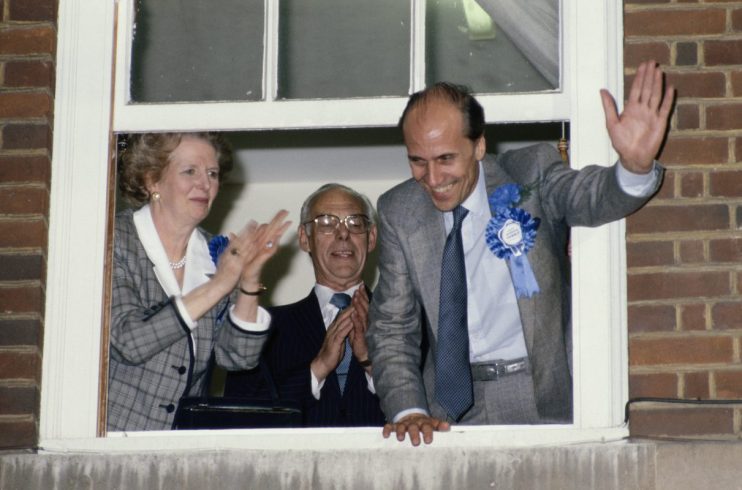
Norman Tebbit died one year ago today. He remains a mnemonic for the high days of the high days of Thatcherism, writes Eliot Wilson
A year ago today, former Conservative Cabinet minister Lord Tebbit died at the age of 94. The media coverage was extensive for a man who had left office nearly 40 years before; even more so given he had been in Cabinet for less than six years overall and had never held a government role of the first rank.
Gaunt and severe, he was a gift to caricaturists. There was something of the Puritan about him: dour, stern, unforgiving of weakness, an unbending advocate of self-reliance and hard work. It was summed up when he addressed the Conservative Party conference in 1981. After a summer of riots in Brixton, Toxteth, Moss Side, Handsworth and elsewhere, some blamed the violence on the high rate of unemployment. This was anathema to Tebbit, whose response was icily contemptuous.
“I grew up in the ’30s with an unemployed father. He didn’t riot. He got on his bike and looked for work, and he kept looking till he found it.”
The Tory faithful loved it.
Norman Beresford Tebbit was born on 29 March 1931 in the working-class north London suburb of Ponders End. The party conference barb was no myth: his father lost his job managing a jeweller’s and pawnbroker’s, and the family moved to a series of short-term lets in Edmonton. Tebbit attended the county grammar school and already was drawn by his experiences to the Conservative Party rather than Attlee’s Labour.
“I felt you should be able to make your own fortune,” he recalled. “You should be master of your own fate.”
Tebbit joined The Financial Times as a trainee journalist, but in 1949 was called up for National Service in the RAF, flying Meteors and Vampires. Remaining with the Royal Auxiliary Air Force he joined BOAC as a pilot and navigator but was drawn increasingly to politics. In 1969, he was selected as Conservative candidate for Labour-held Epping after a speech that encapsulated his credo: privatisation, trades union reform, stricter immigration control and an attack on the permissive society.
Unreconstructedly right-wing
He won Epping by 2,575 votes in 1970, switching to Chingford in 1974. As a Member of Parliament he was unreconstructedly right-wing, dogmatic and abrasive. Inevitably he found no preferment in Edward Heath’s government, but he also remained a backbencher under Margaret Thatcher, whom he found much more congenial in ideological terms. He revelled in the bitter, hard-fought industrial disputes of the 1970s, and was given an invaluable image by Michael Foot when he asked the Leader of the House an unnecessarily barbed question.
“It is really time for him to try to let the nicer side of his nature emerge. It is not necessary that every time he rises he should give his famous imitation of a semi-house-trained polecat.”
It was a fitting image for the thin, fierce, unrelenting Tebbit, bettered only when Spitting Image portrayed him as a shaven-headed, leather-clad bovver boy, meting out violence to Thatcher’s opponents.
Tebbit finally reached the front bench when the Conservatives won the 1979 election, being made a junior trade minister. If it was a lowly berth after nine years in the House, he then picked up speed. At the beginning of 1981 he moved to the Department of Industry as deputy to Sir Keith Joseph, whom he genuinely adored, and nine months later he was brought into Cabinet as Employment Secretary, the “bad cop” after his predecessor Jim Prior’s “good cop”.
The Employment Act 1982 restricted the closed shop and trades unions’ legal immunity. Arthur Scargill, President of the National Union of Mineworkers, could not have given a more helpful reaction: “We should say, ‘We will defy the law’”. Tebbit rated it his greatest achievement as a minister, “one of the principal pillars on which the Thatcher economic reforms have been built”.
Shortly after the 1983 general election, Tebbit was moved to be Trade and Industry Secretary. Thatcher had wanted to make him Home Secretary in the post-election reshuffle, which would have been a polecat among the pigeons, but her loyal and influential deputy, Willie Whitelaw, had vetoed the appointment.
The Brighton bomb
In October 1984, the Grand Hotel in Brighton, where the Conservative Party conference was taking place, was bombed by the Provisional IRA. A chimney stack collapsed through the building and brought with it the room in which Tebbit and his wife were sleeping. They were extracted four hours later, having been buried under tons of rubble. Tebbit had severe crush injuries to his shoulder, ribs and pelvis; Margaret’s neck was broken and she would spend the rest of her life in a wheelchair.
He was never quite the same man again. By October 1985 Thatcher concluded, rather unfairly, that he was “not a first-class administrator”, and moved him from the DTI to be Conservative Party Chairman to prepare for the next general election.
Tebbit was an effective Party Chairman, but cracks had begun to appear between him and Thatcher. Minor policy differences made the Prime Minister suspicious of his long-term ambitions, exacerbated by polls which suggested he would be a front-runner to lead the party if a vacancy occurred. This in turn made her reluctant to take at face value forthright advice about the election campaign in 1987. It was a fractious and prickly time, yet Thatcher led the Conservatives to a third emphatic victory and a majority of 102.
Politically he was done. Tebbit had told Thatcher at the beginning of the election campaign that he would be standing down to look after his wife, and he stayed in the Commons for one parliament as a backbencher then went to the House of Lords. He was only 56 when he left office; he remained a public figure, ready to voice typically trenchant opinions, but his long retirement did his image little credit.
Economically he remained as “dry” as ever and combative towards trades unions. Like Thatcher, he adopted a stance towards Europe far more hostile than that he had displayed in office, and some of his opinions had an air of caricature about them: homosexuals should not be allowed to be Home Secretary; civil partnerships might allow a man to marry his own son to avoid inheritance tax; liberal society looked “after the foreigners not the British”.
Tebbit had not changed; the world had. What made him reliable copy also diminished his potential influence. He became a final reminder of the high days of Thatcherism, 40 years before, for those with long memories and those who had not been there. But elevating his importance did not flatter his career.
Norman Tebbit was a good and determined Employment Secretary, with more guile than he let on, at a time when that was sorely needed. He was also instrumental in the election victories of 1983 and, especially, 1987; and in the first Thatcher government he was vital to her position as one of the very few “true believers” in Cabinet.
Those are no small achievements in public life. But as Home Secretary after 1983 he might well have been disastrous, and his record at Trade and Industry is impossible to judge because of the Brighton bombing. It is very hard to imagine him as Prime Minister, and Thatcher herself was sceptical about the notion. He stands now as a kind of mnemonic prompt of 1980s politics, and that famous line, “He got on his bike and looked for work”. Will he still be remembered 20 years from now? That’s a hard question to answer.
Eliot Wilson is a writer and historian