
Responsible innovation: how can European asset managers lead?


By Alejandro Hiniesto, CFA, Fabrizio Palmucci, CFA and Rhodri Preece, CFA
Technology, regulation, and competition, as well as macroeconomic and geopolitical headwinds, mean the investment industry stands at a pivotal juncture.
Pressure on profit margins and evolving client expectations serve to underscore that ‘business as usual’ is no longer sufficient. How can firms and practitioners adapt?
Responsible innovation, which prioritises purposeful capitalism, could be a key aspect of the solution.
AMI-ing high
The Asset Management Innovation (AMI) Initiative aims to position Europe’s asset management industry at the forefront of responsible innovation.
More than 20 industry practitioners gathered in late-November in Madrid to examine responsible innovation through the lenses of business models, products and distribution.
MADRID MEETING: Asset Management Innovation (AMI) discussion participants
| Olatz Aurrekoetxea | Josina Kamerling | Rhodri Preece, CFA |
| Gary Baker, CFA | Ulrich Koall, CFA | Massimiliano Saccone, CFA* |
| Mirari Barrena | SamLivingstone, CFA* | John Siska, CFA |
| Tatjana Bojkovska, CFA, CIPM | Brunno Maradei, CFA | Jean-Bernard Tanqueray |
| Primož Cencelj, CFA | Ruben Nieto Martin-Vares | Sergio Álvarez Teleña |
| Eelco Fiole, CFA | José Luis Gil-Gallardo, CFA | Elisabeth Vishnevskaja, CFA* |
| Lorenzo Garcia | Edward O’Loghlen, CFA | David Wahi |
| Alejandro Hiniesto, CFA* | Fabrizio Palmucci, CFA* | Irina Zilbergleyt |
| Cristina Rodriguez Iza, CFA |
* Members of AMI; discussion held in the Spanish capital in late-November 2019
The discussion was the first in a series of European workshops that will harvest recommendations from both the ‘old world’ of traditional asset managers and the ‘new world’ of fintech. It produced three overall reflections.
1. Blockchain and AI could transform business models
With operating margins often exceeding 30%, asset managers have felt little pressure to evolve, while increased regulation has deterred competition.
When asset values and fund flows are rising, the traditional pricing model – a fee based on assets under management (AUM) – discourages innovation.
But two technologies – blockchain and artificial intelligence (AI) – could have transformative implications.
Blockchain’s potential is enormous. Not only can it transfer and record something of value, such as ownership of assets, and help raise capital through the issuance of smart contracts, it can improve cybersecurity and help protect client assets. But digital wallets and keys based on blockchain require more robust protections. Moreover, blockchain may be slower than expected and transaction approval could take additional time as networks grow more complex.
While fintech providers are developing hardware and protocols to protect digital keys, there is a fundamental trade-off between how quickly a firm can deploy new technology, and the robustness of its operating platform. The earlier a new technology is introduced, the more risk to its operating platform. The later a new technology is adopted, the more market share the firm risks losing.
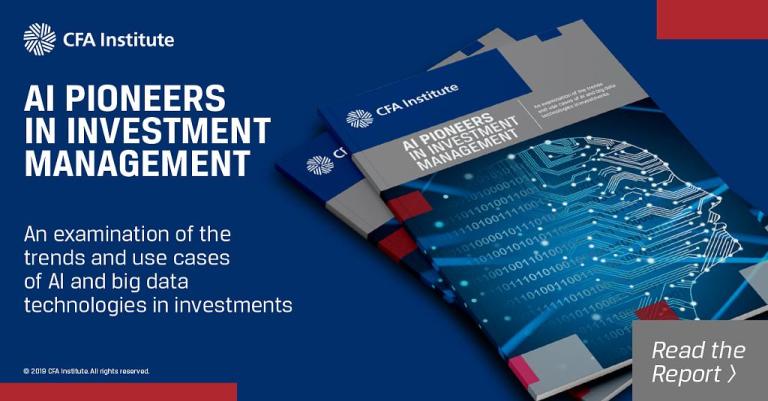
Several AI advancements – machine-learning algorithms, natural language processing (NLP), computer vision and voice recognition – can streamline investment processes and improve decision-making. But there are potential pain points. Data can be noisy and difficult to parse. But investment professionals will have to understand technology and know-how to collaborate with data scientists and programmers in developing strategies and products.
Lastly, since human advice means higher fees, asset managers have had little incentive to automate. For example, one participant is teaching IBM’s Watson AI question-answering computer system to provide investment advice to wealth managers through a virtual assistant. The technology is widely used in other sectors, it has only just begun to be applied to financial advice.
2. New products should punish poor performance
Effective communication is essential when marketing AI-driven investment products. Clients must understand how AI is being used and the additional value it may bring.
More generally, product innovations often provide little insight into the underlying investment strategy. For example, environmental, social, and governance (ESG) investing is a recurring theme, yet the marketing of such products makes it difficult for clients to assess how well the investment approach may fit with their objectives.
NLP could transform unstructured textual data into more easily exploitable structured information. This could give investors access to alternative data sources and help determine sentiment analytics from social media, for example.
Ultimately, responsible product innovation comes down to aligning incentives. Product manufacturers and distributors should be incentivised to create products that put client interests first and have appropriate deterrents – built into fees, for example – to poor performance.
3. Realising cost and time savings
Sales channels in Europe are inefficient. Differences in national practices and regulations inhibit continent-wide distribution and create barriers to scale in distribution platforms. It is a fragmented market.
Financial services’ lack of uniformity and heavily regulated nature will make it difficult for an Amazon-like entity to enter the investment product distribution space. Buying an investment fund is not like buying shoes from an online store. For the individual, it requires in-depth decision making.
The distributor has to follow extensive rules and regulations in selling products. This may complicate how products are recommended based on browsing histories or personal preferences, for example.
Buying and selling funds via blockchain, if developed, could eliminate the need for local transfer agents and duplicative reconciliation processes between fund administrator and depositary.
This would strip out costs that are currently borne by the end-investor. By moving transactions to the blockchain, settlement times could be reduced or eliminated. With one transparent ledger and proof of ownership for all parties, asset managers would no longer have to maintain their records for fund transactions and could pass savings to clients.
Ensuring sustainable competitive advantage
A key test of any innovation, we concluded in Madrid, is whether it increases revenues or reduces costs. Responsible innovation requires more: it must transcend business interests and address social and environmental impact.
New offerings should test for the effect on all stakeholders and build in guards against potential harms.
By embracing responsible innovation, asset managers will ensure sustainable competitive advantage and remain key actors in the future of finance.
The Asset Management Innovation Initiative will discuss these concepts in greater depth in the weeks and months ahead.
Visit CFA Institute for more industry research and analysis.
If you liked this post, don’t forget to subscribe to the Enterprising Investor.
All posts are the opinion of the authors. As such, they should not be construed as investment advice, nor do the opinions expressed necessarily reflect the views of CFA Institute or the author’s employer.
Image credit: ©Getty Images/Yuichiro Chino