
Restarting and building a resilient recovery


COVID-19 continues to create a unique set of challenges for business and society. I think it’s important, as we wrestle with those challenges, that we continue to acknowledge that we’re all experiencing this crisis in different ways and on different timelines.
The way EY has been advising businesses to manage and respond to COVID-19 is by looking at three undated time horizons which are simply Now, Next and Beyond and priorities will shift as companies move through these, from resilience to recovery to resurgence. We are working with clients across this entire spectrum, from those whose businesses are closed for the foreseeable future and struggling to keep their head above water to companies who have been dealing with the very different challenge of exceptional demand and changing priorities and behaviours.
Many companies, however, now sit somewhere in between, in what we term the ‘Recovery’ phase. They are either restarting, or preparing to, following the new government guidelines released in recent weeks and they are thinking about how to build flexibility into their operations to prepare for the uncertainty that lies ahead. This uncertainty has many layers – from unknown demand and cashflow to the possibility of future government restrictions and workforce constraints.
Which is why our Recovery phase has two areas of focus:
- Restart and adapt: the practicalities of restarting safely, how to reengage staff and adapt operations to new regulations, whilst being ready to adapt to the unknown
- Resilient recovery: ensuring your business is resilient and sustainable, given changing circumstances and the potential for more disruption ahead
How does this work in practice?
Restart and adapt
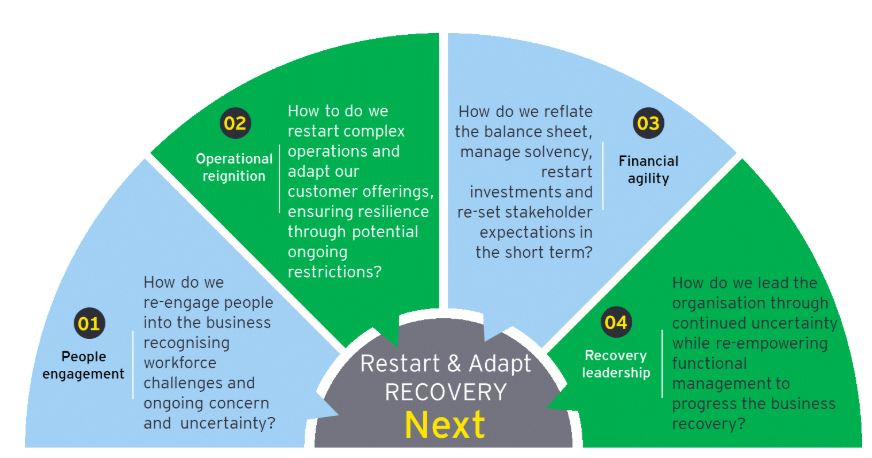
Safety is obviously critical to the restart. There is a wealth of guidance out there from government, trade bodies and companies that have continued working in terms of reconfiguring the working and customer environment and the most effective use of PPE. An important part of this process is reengagement with staff and customers to understand their concerns and priorities and to communicate changes. Communication and a demonstrable commitment to safety will help to build the necessary confidence for operations to restart.
The restart process should help focus businesses’ minds on what is truly essential. One of the biggest areas of concern for our clients is their supply chain. Companies may need to provide additional support to suppliers to help them restart their business. As we’ve discussed elsewhere, one of the biggest tests comes when weakened companies need to reflate balance sheets and restock inventory. Companies will need to maintain cash discipline and prioritise spending. A simplified proposition and operating model – and progressively scaling up complexity where it adds value – can help to ease operational, financial and supply chain pressures.
What companies do now will set the foundation for everything that comes beyond. Whilst focusing on the current challenge, management also keep in mind what happens next. Some parts of our lives will go back to what they were, but some things that have become normal in the lockdown will remain with us for a long time, perhaps indefinitely.
Resilient recovery
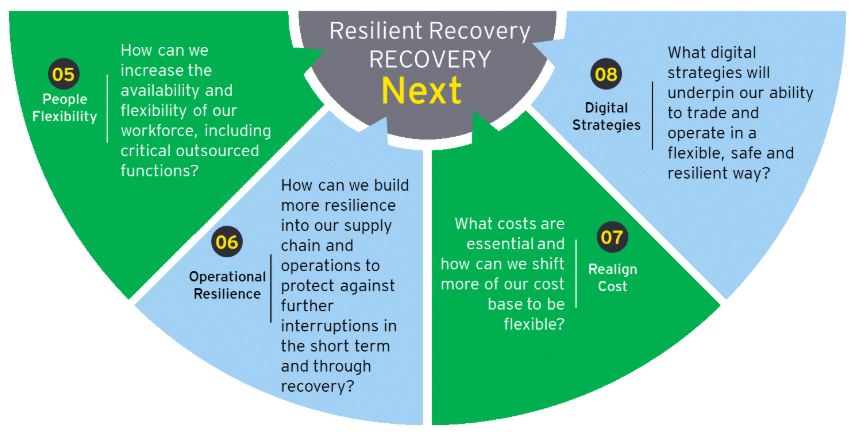
To build resilience, companies will need to think if and how they need to phase workforce return and how they could adapt to a slow and volatile increase in demand. A phased start will allow businesses to test their new working practices and make it easier to adapt if conditions change. Office-based businesses may continue with large-scale remote working, which has worked thus far, but may create new morale and cultural challenges if implemented in the longer term.
Companies’ new normal or new abnormal, also needs to be operationally sustainable in a protracted and volatile recovery. Most businesses will be operating with reduced capacity due to new operating practices and/or reduced demand. How companies use their space – be it office, hotel or factory – will change, with a lower density of workers and customers. Companies will need to consider if and how they can adapt their cost-base and products to new realities.
To build resilience, companies also need to think about ways in which they can build in more financial and operational flexibility. And of course, it remains important to manage stakeholder expectations during the restart, given the extra pressure companies will feel on their balance sheets as they realign their business. Companies will continue to raise capital and drawn down on debt facilities to meet these demands.
As my colleague Falco Weidemeyer, explores in his recent article, businesses need to embrace the challenge of adapting to the new world, shaped by different societal expectations and a better understanding of risk and technology. Companies that can stay true to their purpose and long-term values, should emerge as the strongest, most relevant forces in the resurgent new economy.
Visit EY’s COVID-19 hub for further insights and materials: ey.com/uk/covid
Webcast: The new world of work and implications for business. Register now for our 5 June webcast to hear the views of CEOs and CHROs for ASOS, bp, EDF, Pearson, TSB Bank and Unilever.