
Ricky Munday CA: ‘Reaching out for help is a sign of strength, not weakness’

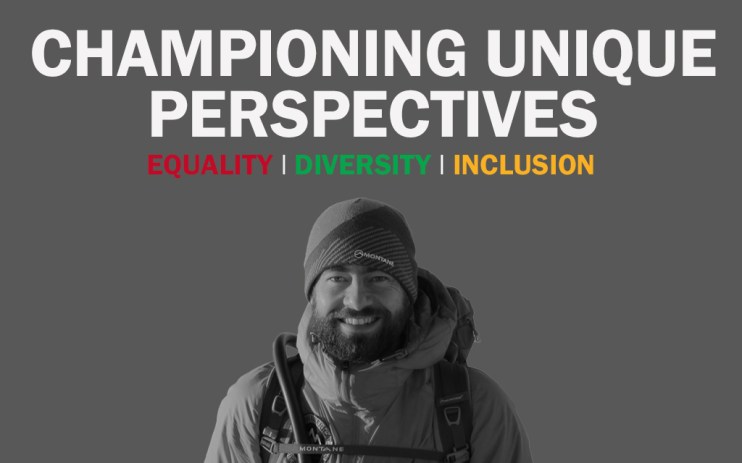
Adventurer and Inspire Alpine founder Ricky Munday CA discusses how some of his lowest moments have led to some of the best experiences of his life.
Taking on some of the world’s most gruelling and dangerous challenges you must be both mentally and physically fit. Has there ever been a time in your life when you felt that your mental wellbeing wasn’t at its best and how did you manage that?
I’ve struggled with periods of poor mental health intermittently throughout my life, mostly in relation to external events. I do still suffer from anxiety, but I’ve learned to manage those feelings much more carefully, so it doesn’t have the same impact on my life that it used to have.
I was always quite socially anxious when I was growing up. When I was in my teenage years, I relied on alcohol and drugs to self-medicate and allow myself to feel less socially anxious. That of course led to some unwelcome consequences. I was arrested twice in my teens and early twenties for alcohol-related offences and drinking and taking drugs had a negative effect on areas of my life like my work and my sport.
I was playing semi-professional rugby during that time and I would often turn up on match day having gone out the Friday night before. I tore my hamstring once which put me out for six months and that was purely because of being dehydrated from drinking the night before.
It was self-sabotaging because I lacked self-confidence and self-belief. It was easier for me to drink myself into oblivion than actually try something which I might fail at but learn a lot from it and try again.
I was also sitting my ICAS exams at the time and I ended up passing two and failing two. Back then, the employer I worked for had a ‘two strikes and you’re out’ policy in terms of exams, so I knew if I failed again that was going to be it.
I dropped out of university twice because of my social anxiety and I also felt that if I failed my exams and lost my job, nobody would ever hire me again. I began to have this cycle of negative thoughts in my head, and I thought not only will people not employ me again but that I’d lose my career. I couldn’t imagine my future, what could I possibly do?
My mood just became very low, and I did become depressed. I went to see my GP and he prescribed me a course of anti-depressants to deal with the chemical imbalance and he referred me for counselling with cognitive behavioural therapy (CBT) and signed me off work for a month.
I found CBT quite powerful. The concept of your thoughts driving your feelings, which drives your behaviours was this really simple logical thing for me, and so I began to work on ways to control my thoughts or do positive self-talk and not allow myself to have negative thought cycles.
That time off work and that support really allowed me to regain perspective.
In the end, I did fail my tax exam a second time and I was made redundant, but it wasn’t anywhere near as dramatic as I had built it up to be in my mind.
During that time following your redundancy, how did you keep on top of your mental wellbeing?
During that period, I was really concerned about falling back into depression, so I needed something to focus on. While I was trying to transfer my training contract to a new employer, I entered the Marathon des Sables. It is a 150-mile ultra-marathon that takes place in the Sahara Desert and is billed as the toughest footrace on earth. That gave me a real focus for my time when I was had nothing else to do. So, I raised money and I trained for it and amongst that, I did get a new job with a small firm in Edinburgh, and I started work again. The marathon was the first time where I really had a project where I planned carefully.
I did manage to complete the marathon which was totally unexpected for me. That totally changed my life because I developed more self-confidence and I realised that if I did push myself, I could fulfil my potential. I still had a tendency to self-sabotage for a few years after that but just gradually transitioned to following my dreams and not allowing my negative thought cycles to dominate.
One of those dreams that you chose to follow was to tackle the highest peak on earth, Mount Everest. Can you share what happened on your first attempt to summit the mountain?
On that first trip, my team and I had moved up on our summit bid which meant we moved up from base camp to advanced base camp, then up to camp one at the North Col, which is just above 7,000m.
We reached the camp I completely lost my appetite; I just couldn’t eat anything. That is quite common at high altitude, but for me, I started to feel quite nauseous. The next morning it was the same, I couldn’t eat my freeze-dried food. We then moved up to camp two at 7,900 metres, but I had absolutely no energy and my teammates were all passing me. After a conversation with the team leader, I increased my oxygen flow rate to give me the boost I needed to make it to the camp.
I managed to reach the camp, but I wasn’t able to eat anything meaning I had gone around 36 hours where I hadn’t taken in any calories. The next stage of the climb to the next camp would have us go above 8,000m, somewhere I had never been before. I had no energy, my fingers were getting cold, so frostbite was becoming a worry and I had used more oxygen than planned to get to camp two, so there may not have been enough for me on my summit attempt.
It was a very tough decision, but the goal of any high-altitude mountaineering trip is to get home safe, and the second I made the decision to go down I was committed to it and had no regrets.
You then decided to make a second attempt to summit Everest a year later. What was your mindset like going into that second attempt?
My mindset was very bad, I was in a pretty dark place, but it had nothing to do with the climb. I had a bad experience at my workplace at the time. But after deciding that the time was right to return to Everest and having the experience of the first climb and the knowledge of what to expect it would do to my body, it was a ray of light for me to focus on.
What was running through your mind on the day that you started off to make your second summit attempt?
Summit day was off the scale for me – it doesn’t compare to anything I’ve done before. For the Marathon des Sables, you must be fit as it is a physically arduous undertaking, but it is mostly a mental battle in your head to push through the pain. On Everest, it’s not just the physical battle that you’re facing, you have many objective factors that you’re confronting like the weather and the extremely low oxygen level. On the summit of Everest, the oxygen level is only 30% compared to sea level values.
Oxygen is such a major consideration, and you’re always conscious that you are in a place where human beings are not supposed to be, life does not survive up there. I can’t imagine how many times I was thinking ‘Alright Ricky, you need to go down. You’re pushing us too far.’ On that day we started off with a perfect forecast, but the wind was much stronger than we thought. We got to around 8,500m and our guide turned back as he was worried about the wind and had been feeling ill and weak both on that day and the day before.
At that point, I had a constant mental dialogue, telling myself that the wind wasn’t too much of a problem and that I was feeling good, nothing like the year before when my fingers were freezing, and I was very weak. On the summit ridge, I was constantly using positive self-talk to keep myself going.
It is all about the experience. I have struggled with decisions sometimes, but I know I’ve got good experience of making good decisions in the past and I tend to trust my gut instinct.
We had set off for the summit early, so it was still dark, and I had seen a light high in the distance which I thought was another climber and guessed that we had around three hours to go. I was so tired at that point and had to just keep putting one foot in front of the other. It turned out I was wrong, and the summit was right in front of us. When I realised that, the feeling was just pure relief. I’ve never felt anything like that before. All the stresses and strains of the last two years just fell away.
What would you say to someone who may be going through a low time with their mental wellbeing?
The two most incredible experiences that I have had happened just after some of the worst experiences of my life. I failed my exams and was made redundant and then made the decision to run the Marathon des Sables, which completely changed my life. Then, having a really difficult work situation to deal with before I went back to Everest and reached the summit. I have a perspective now that although things can get really bad, and I may have a dark moment in the future, they also create opportunity.
I still do self-talk, but for me, it is more like self-shouting. If I find myself going into that worst-case scenario process, I tell myself ‘What are you doing Munday!? Get a hold of yourself!’. If anyone is struggling, reaching out is a sign of strength, not weakness. Get some support. If you need to speak to someone, a counsellor or therapist, or even a third party to discuss your issue to help you structure your thinking, it has worked for me and it might work for you.