Skip to content
Thursday 27 August 2026London --:--Frankfurt --:--Zurich --:--
NewslettersSearchEN · DE · FR
MorningWire

European business, markets and politics

FTSE 100
10,792.54
-0.79%
DAX
26,367.24
+0.31%
CAC 40
8,319.87
-1.68%
STOXX 50
6,424.73
-0.71%
  • Europe
  • Markets
  • Business
  • Economy
  • Regulation
  • Politics
  • Opinion
More
GermanyFranceEU InstitutionsCompetitionPublic AffairsBankingTechnologyEnergy
  • Germany
  • France
  • Europe
  • Markets
  • Business
  • Economy
  • Regulation
  • Politics
  • Opinion
  • DE
Tuesday 04 July 2023 6:00 am  |  Updated:  Tuesday 04 July 2023 4:35 pm

Rishi Sunak and Jeremy Hunt urged to raise investment to unlock £150bn economic boost 
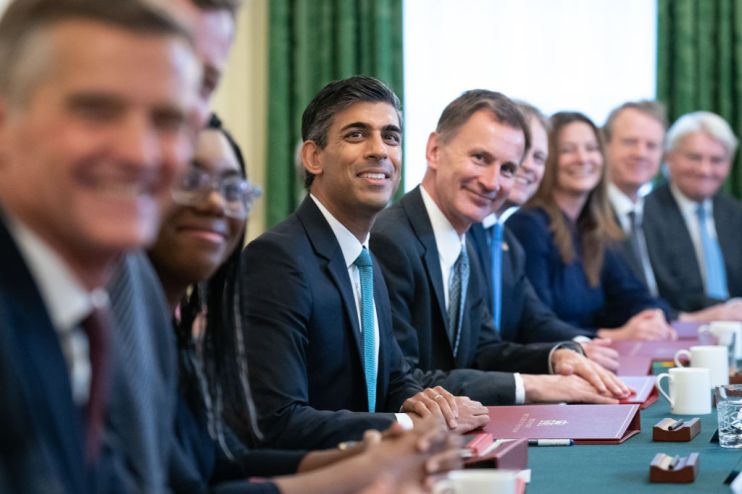
PM Rishi Sunak Holds Meeting Of Newly Formed Cabinet
Spending on quality capital projects like expanding renewable energy infrastructure and improving transport networks could “pay for itself” by yielding tens of billions of pounds in growth and tax revenues, according to a report by the Institute for Public Policy Research (IPPR) (Photo by Stefan Rousseau - WPA Pool/Getty Images)

Rishi Sunak and Jeremy Hunt should ramp up government investment spending to unlock a £149bn boost to the UK economy, an influential think tank has urged today.

Spending on quality capital projects like expanding renewable energy infrastructure and improving transport networks could “pay for itself” by yielding tens of billions of pounds in growth and tax revenues, according to a report by the Institute for Public Policy Research (IPPR).

Harnessing the government’s capacity to borrow from international investors to raise cash to channel into the economy may “unlock industries of the future, spur technological advances, and thus boost growth,” the report argued.

Fiscal hawks have said stepping up capital expenditure risks the Prime Minister and Chancellor missing their fiscal rules – getting debt as a share of the economy down and the deficit falling in five years.

Higher interest rates caused by the Bank of England and central banks globally trying to rein in screeching inflation has also made government borrowing more less affordable. UK borrowing costs have risen 13 times in a row to a near 15 year high of five per cent. They are expected to top six per cent.

Britain’s debt pile is already larger than the size of the entire economy at around £2.5 trillion, swelled by the government borrowing hundreds of billions of pounds to pay for Covid-19 support. Debt interest spending is also on track to top £100bn for a number of years.

But, according to the IPPR, an annual £30bn boost to public investment would actually skim the debt pile.

“The GDP growth benefits can still ensure alignment with falling debt to GDP ratio,” Carsten Jung, senior economist at the IPPR and author of the report, said.

“A government could borrow to invest, and thereby grow the economy more than the associated rise in debt,” he added.

Read more

Industry chief warns ‘resilience not enough’ for growth

Shevaun Haviland, British Chambers of Commerce boss, speaking at a business event, emphasizing economic growth strategies

Labour recently rolled back their commitment to inject £28bn annually into the economy via lifting green energy investment, delaying the spending boost to the second half of their term should they win the next election.

The party was contacted for comment.

UK public and private investment has been steadily falling since the 1980s. That decline has accelerated since the Brexit vote in 2016. As a share of GDP, investment is among the lowest levels in the Organisation for Economic Cooperation and Development.

Jung took aim at the UK’s fiscal rules for being overly prescriptive and preventing governments from delivering long-lasting economic benefits.

The present regime “puts all the emphasis on debt to GDP within a five year horizon… and thus ignores larger benefits that are further out than this,” he said. Similar criticisms have been made by other think tanks, including the National Institute of Economic and Social Research. 

Free-market economists have argued that governments can “crowd out” private businesses from expanding by borrowing cash on financial markets to invest. 

Crowding out is a process by which the government raises market interest rates by issuing more debt, which can make it unaffordable for some private firms to source money. 

Left-leaning economists claim governments can utilise their enormous balance sheets to take on debt to invest, thereby creating new industries that stimulate innovation and economic growth.

A treasury spokesperson told Morning Wire: “Despite the tough decisions we’ve taken to stabilise the public finances, we are maintaining record levels of capital investment with £600bn over the next five years – investing in critical infrastructure like Northern Powerhouse Rail, HS2 and Sizewell C.”

Read more

Nscale doubles London office space as UK staff grows sixfold

2024 was a transformational year for GlobalData.

Share this article

  • Facebook
  • X
  • LinkedIn
  • WhatsApp
  • Email

Similarly tagged content:

Sections

  • Markets & Economics
  • News

Categories

  • Economics

Related Topics

  • Rishi Sunak

Trending Articles

  • Pensioners to hand over bank statements in government benefits crackdown

  • Andy Burnham hints at tax rises in Autumn Budget

  • Brewdog founder James Watt hits out at ‘total silence’ over new venture

  • Lloyds Bank and Halifax users unable to use app in latest outage

  • Economists urge Bank of England to halt bond sales as borrowing costs climb

More from Morning Wire

  • Industry chief warns ‘resilience not enough’ for growth

    Economics
    Shevaun Haviland, British Chambers of Commerce boss, speaking at a business event, emphasizing economic growth strategies
  • Nscale doubles London office space as UK staff grows sixfold

    AI
    2024 was a transformational year for GlobalData.
  • UK economy weathers Iran war shocks but slowdown incoming

    Economics
    Chancellor John Healey smiling, wearing a navy suit, white shirt, and red tie.
  • Labour backbencher adds to criticism of stamp duty on shares

    Politics
    Callum Anderson, a smiling business professional in a navy suit and striped tie against a gray background.
  • Government debt repayment ‘could rise to half’ of total taxes

    Economics
    OBR chiefs told the Treasury Select Committee that a higher tax burden could stifle growth.
  • Anthropic subscriptions overtake OpenAI in the UK, fresh data suggests

    AI
    Smartphone displaying the Claude by Anthropic AI assistant app, showing the app icon and interface.
  • UK economy to ‘reverse gains’ as construction drags growth

    Economics
    Retail sales slowed in September
  • Burnham’s devolution drive could ‘push 90,000 jobs out of London’

    Economics
    In 2022, rolling Tube strikes led to massive queues for crowded buses. (Photo by Chris J Ratcliffe/Getty Images)
MorningWire

Independent European business, markets and political news for decision-makers.

Morning Briefing

Europe

  • Germany
  • France
  • EU Institutions
  • Europe

Business

  • Markets
  • Business
  • Economy
  • Regulation
  • Competition
  • Public Affairs

Editorial

  • Opinion
  • Editorial Policy
  • Corrections
  • Contact

Company

  • About Morning Wire
  • Privacy Policy
  • Terms of Use
  • Cookie Policy
© 2026 Morning Wire Ltd · Published by Morning Wire Media, Bahnhofstrasse 65, 8001 Zürich, Switzerland
Privacy · Terms · Cookies · Facebook