Skip to content
Thursday 27 August 2026London --:--Frankfurt --:--Zurich --:--
NewslettersSearchEN · DE · FR
MorningWire

European business, markets and politics

FTSE 100
10,792.54
-0.79%
DAX
26,367.24
+0.31%
CAC 40
8,319.87
-1.68%
STOXX 50
6,424.73
-0.71%
  • Europe
  • Markets
  • Business
  • Economy
  • Regulation
  • Politics
  • Opinion
More
GermanyFranceEU InstitutionsCompetitionPublic AffairsBankingTechnologyEnergy
  • Germany
  • France
  • Europe
  • Markets
  • Business
  • Economy
  • Regulation
  • Politics
  • Opinion
  • DE
Wednesday 23 June 2021 6:00 am  |  Updated:  Tuesday 22 June 2021 3:36 pm

Rishi Sunak vs Boris Johnson: to spend or not to spend?

By: Paul Ormerod

Add as a preferred source on Google
UK Government Ministers Attend Weekly Cabinet Meeting
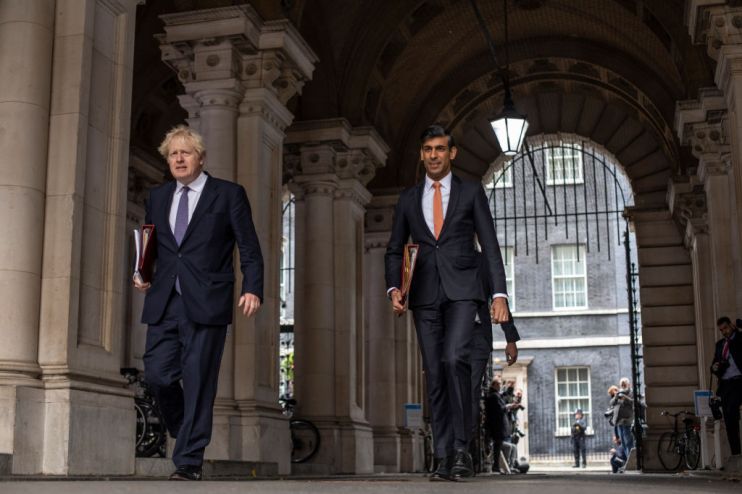
Rishi Sunak is trying to fight off Boris Johnson's continual demands to spend more and take on more debt, writes Paul Ormerod. (Photo by Dan Kitwood/Getty Images)

Rishi Sunak has directed his energy into recasting the Treasury back to its traditional role – the guardian of the public finances.

The Chancellor notched up a substantial victory after education recovery tsar, Kevan Collins, resigned earlier this month, after his demand for £15 billion for catch-up programmes in schools was beaten down to a mere one-tenth of that by the Treasury. The missiles have continued to zoom in from all directions, however. 

The main launchpad appears to be Mr Sunak’s neighbour in Downing Street, as No10 continually demands new spending commitments in a wide range of different areas. The Treasury is getting zapped across almost the entire area of government activity.

Boris Johnson wants a Marshall Plan to fund green growth in the developing world.  He wants to spend huge amounts on the levelling up agenda.  He appears to favour a scheme to cap care home costs which would require even greater amounts of money.

Does it actually matter?  Why can’t it all be paid for by simply issuing more government debt?

Public sector net borrowing soared during the financial crisis to £160 billion in 2009.  By the end of the last decade, the annual amount had been clawed back to under £50 billion.   But the Covid crisis last year saw it rise to the entirely unprecedented peace time level of more than £250 billion.

Throughout the Western world governments have been running up similarly massive amounts of debt.  But the markets appear to be taking this in their stride.  Although yields on government bonds have risen slightly , they are still at historically low levels.  Investors still seem willing to finance the debt.

Read more

Watch out, Burnham

Man in The Passage apron slicing food in a commercial kitchen, with a food allergens chart visible.

There are two main problems with the policy of just letting spending continue to rip, funded by more and more debt.

These were anticipated in the 1930s not by some zealous free-market economist, but by John Maynard Keynes himself.

Keynes’ legacy has been used to justify high public spending and government deficits. True, Keynes did advocate these in the 1930s to combat the Great Depression and unemployment rates which soared well above 10 per cent in many Western countries. But he was a much more subtle economist than almost all his 21st century disciples.

In his major work, The General Theory of Employment, he acknowledged there were two potentially serious drawbacks to the policy.

As full employment approached – and the UK is currently close to such a situation – Keynes argued that any further public spending would “set up a tendency for money prices to rise without limit”.  In other words, inflation would become endemic.

Even more importantly, Keynes recognised the market’s attitude to rising government debt was based on psychology rather than hard facts.  In essence rising debt is fine.  Until it is not.  Perception is all.  Once confidence is lost, interest rates can rise by large amounts very rapidly.

The Prime Minister is a gambler.  But his current policies involve a huge gamble with both inflation and interest rates.

Read more

Nscale doubles London office space as UK staff grows sixfold

2024 was a transformational year for GlobalData.

Share this article

  • Facebook
  • X
  • LinkedIn
  • WhatsApp
  • Email

Similarly tagged content:

Sections

  • Opinion

Categories

  • Opinion

Trending Articles

  • Pensioners to hand over bank statements in government benefits crackdown

  • Andy Burnham hints at tax rises in Autumn Budget

  • Brewdog founder James Watt hits out at ‘total silence’ over new venture

  • Lloyds Bank and Halifax users unable to use app in latest outage

  • Economists urge Bank of England to halt bond sales as borrowing costs climb

More from Morning Wire

  • Watch out, Burnham

    watches
    Man in The Passage apron slicing food in a commercial kitchen, with a food allergens chart visible.
  • Nscale doubles London office space as UK staff grows sixfold

    AI
    2024 was a transformational year for GlobalData.
  • Zanders Expands DACH Region with New Office in Vienna, Austria

    Business Wire
  • Treasury launches business rates review for pubs and hotels

    Hospitality
    London pub exterior with historic architecture and patrons enjoying drinks on a sunny day, highlighting local social culture.
  • Lehman Brothers Treasury Announces the Successful Sale of its Remaining Intercompany Claim against Lehman Brothers Holdings Inc.

    Business Wire
  • Where are Andy Burnham’s economic advisers?

    Politics
    Andy Burnham and John Healey at Number 10 North, both wearing suits and ties, with a microphone in the foreground.
  • Lehman Brothers Treasury Considers Sale and Final Wind-Down

    Business Wire
  • Budget 2026: Which taxes will Burnham and Healey hike?

    Tax
    Andy Burnham, John Healey, and Louise Haigh by a doorway, discussing tax policy for a news article.
MorningWire

Independent European business, markets and political news for decision-makers.

Morning Briefing

Europe

  • Germany
  • France
  • EU Institutions
  • Europe

Business

  • Markets
  • Business
  • Economy
  • Regulation
  • Competition
  • Public Affairs

Editorial

  • Opinion
  • Editorial Policy
  • Corrections
  • Contact

Company

  • About Morning Wire
  • Privacy Policy
  • Terms of Use
  • Cookie Policy
© 2026 Morning Wire Ltd · Published by Morning Wire Media, Bahnhofstrasse 65, 8001 Zürich, Switzerland
Privacy · Terms · Cookies · Facebook