Rishi Sunak vs Liz Truss: Last night’s Tory leadership debate fact-checked

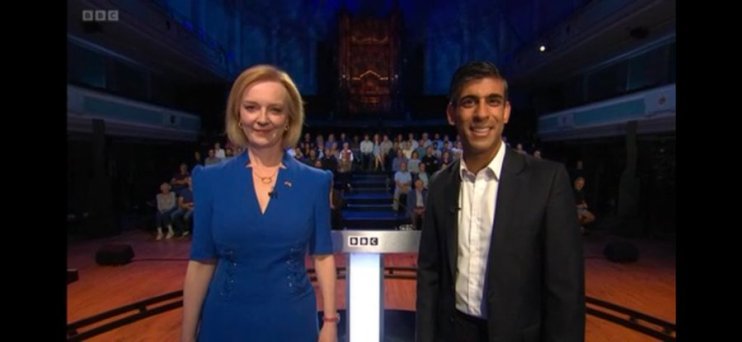
Last night Tory leadership hopefuls Rishi Sunak, a former chancellor, and Liz Truss, the current foreign secretary, went head to head in a live TV debate on the BBC.
Following the debate, Morning Wire caught up with Will Moy, chief executive of Full Fact, to fact check the various statements that were made during the discussion.
“Tonight Rishi Sunak and Liz Truss were challenged by an audience of 2019 Conservative voters about the importance of honesty in politics,” Moy said this morning, as he pointed out that “both candidates spoke about the importance of principles, integrity and keeping promises.”
The final two Conservative leadership candidates discussed their views on tax and the economy. Let’s dive in.
Spending plans
The debate saw considerable focus on how much Truss’s plans to cut taxes would cost.
Sunak claimed that Truss had promised £40bn of “unfunded” tax cuts, and Truss responded by saying this was “not true”.
While Sunak didn’t give a source for the £40bn estimate, the figure appears to come from analysis carried out for the i newspaper by tax advisory firm Blick Rothenberg.
Other estimates do exist, and are largely over £30bn. The IFS has said that Truss’s tax cuts alone would “cost more than £30bn – possibly considerably more”, depending on the precise details.
On the BBC Today programme on 21 July, russ was asked if her plans would cost £38 billion. She replied that figure was “slightly high but it’s around that”.
“There is already headroom of approximately £30bn in the budget”
Liz Truss last night
In March, in response to the Spring Statement, the Office for Budget Responsibility did say that there was £30bn of headroom against the fiscal targets. However, the rise in inflation since then may have affected this figure.
As mentioned above, the IFS has said Truss’s proposed tax cuts may cost more than £30bn, and it’s said that without counteracting measures like cuts to overall spending “this would likely result in the current fiscal rules being broken”.
There are currently four fiscal rules set by the government, which constrain what it can do on spending and taxes.
Truss seemed to refer to one of these rules when she said in the debate that debt should be on course to fall as a share of national income in three years’ time. However, the IFS has also noted that Truss has “hinted” she may change the current fiscal rules.
Finally, Sunak claimed that Truss’s own economic adviser had said her plans for the economy “would mean that interest rates would have to go up to around 7 per cent.”
Sunak was referring to Professor Patrick Minford, who has been cited by Truss as an economist who agreed with her plans to cut taxes.
It was reported that Professor Minford told the Times last week: “Interest rates have to go up and it’s a good thing […] A normal level is more like 5-7 per cent and I don’t think it will be any bad thing if we got back to that level.”
According to the BBC, Professor Minford has since insisted he never said interest rates of 7 per cent would be OK.
The Times article also noted that Truss’s team had said Professor Minford was not a formal adviser and that she would not allow interest rates to rise this high.
Recession looming
Truss claimed: “The OECD has described [Sunak’s] policies as contractionary. That means it will lead to a recession.”
In an economic forecast summary for the UK published in June 2022, the Organisation for Economic Co-operation and Development (OECD) did indeed describe the current overall fiscal policy of the UK government as “contractionary”.
A contractionary fiscal policy refers to a policy which typically sees lower government spending and tax increases.
This kind of policy slows economic growth, but it does not necessarily mean that a country is heading towards a recession, which is defined as two consecutive quarters of negative economic growth.
The OECD’s update does not say that the UK’s current policy will lead to a recession. It states that “GDP is projected to increase by 3.6 per cent in 2022, before stagnating in 2023”.
Later in the debate, Truss claimed again that “we’re now predicted a recession”, but other forecasts on this are mixed.
In May, the Bank of England warned of a possible recession, and predicted the economy would contract by almost 1 per cent between October and December.
But the Bank also forecasts growth at the start of 2023, which would mean we avoid two consecutive quarters of falling GDP (which is the technical definition of a recession).
The vast majority of the independent forecasts compiled by HM Treasury don’t predict a technical recession in Q2 and Q3 this year, though these forecasts don’t go beyond Q3.
The most recent overview of fiscal risks published by the Office for Budget Responsibility does however say the country is at risk of recession. And the National Institute of Economic and Social Research has forecast consecutive contractions in Q3 and Q4 this year.
Tax
Sunak claimed that his plans include the first cut to income tax in 16 years, and that his plans would “deliver tax cuts in this parliament for working people”.
It is true that the government’s existing plans, announced in March when Sunak was still Chancellor, include a cut in the basic rate of income tax of 1p in the pound in 2024—by which point it will be 16 years since the basic rate was last reduced in April 2008.
The additional rate—for incomes over £150,000—was cut from 50 per cent to 45 per cent in 2013.
However, there have been many other changes announced in the system of taxes and benefits that affect how much money working people keep, and receive, from the government. These include the rises in the National Insurance rate and threshold, and the freezing of these thresholds over the coming years.
Overall, talking about the effect on all people, whether working or not, the IFS says that the changes implemented by the current government so far have been “broadly progressive”, raising the incomes of poorer households and taking more in tax from richer ones.
The changes to come under the government’s current plans are also progressive, according to the IFS, taking much more in tax from richer households, but will amount to a tax rise overall.
“The high-inflation environment means that the freezing of income tax and [National Insurance contributions] thresholds is a much bigger tax rise than originally intended,” the IFS says.
Sunak as chancellor
Finally, Truss also claimed with reference to Sunak’s previous job that “this Chancellor has raised taxes to the highest rate for 70 years”.
This is broadly true.
Recently, the overall tax burden was forecast to soon become the highest for 70 years in the wake of the National Insurance rise, though others claimed taxes would rise to the highest-ever level, the highest in peacetime, since 1950, or since 1969.
As we wrote at the time, these varying claims were all based on slightly differing estimates for the predicted and historic tax burden.
But since then, the Office for Budget Responsibility has updated its forecast, and it estimates by 2023/24 taxes will account for 36 per cent of GDP, the highest level since 1949.