Risk of blood clots after vaccine much lower than with Covid-19, researchers conclude

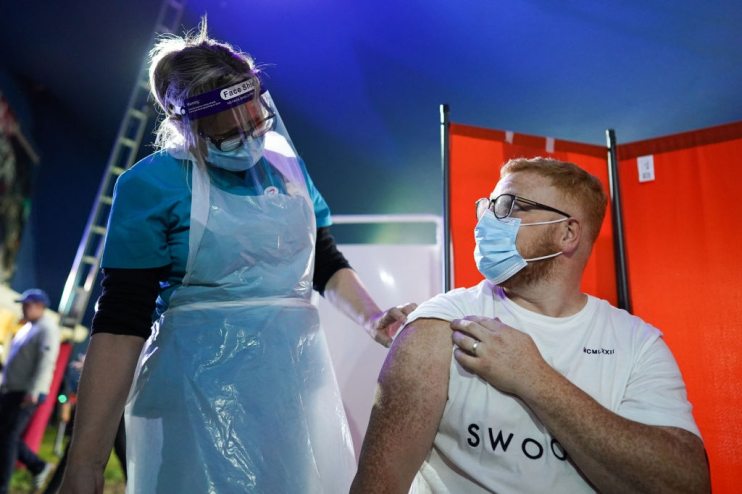
The increased risk of blood clots after a coronavirus vaccine is much lower than with Covid-19, one of the lead authors of a large study has said, adding that the vast majority of people will be “absolutely fine” after their jab.
The findings of what is believed to be the largest study on vaccine side effects to date came a day after an inquest heard that an award-winning BBC radio presenter died due to complications of the AstraZeneca vaccination.
Lisa Shaw died aged 44 in May, just over three weeks after she had her first dose.
The coroner said she had developed a vaccine-induced thrombosis and thrombocytopenia, which was described as “a rare and aggressive complication associated with the AstraZeneca vaccine, which was the underlying cause of her death”.
But University of Oxford professor Julia Hippisley-Cox said while such a death is “very sad”, any potential risks of the vaccine compared with Covid-19 infection must be put into context.
She told BBC Radio 4’s Today programme: “It’s very sad, and condolences to the family of Lisa.
“But to put it in context, these are very rare cases, and the vast majority of patients will be absolutely fine with these vaccines.”
An expert, who was not involved in the research but who is a member of the Scientific Pandemic Influenza Group on Modelling (Spi-M) which advises the Government, said there will be always be some “tragic cases”, but it is “so much more risky to catch Covid”.
Dr Mike Tildesley said he hoped the new study, which involved millions of people, “maintains the trust in the vaccines going forward”.
He told BBC Breakfast: “I think it is about putting those risks into context.
“There are always going to be the tragic cases like Lisa unfortunately, but it still doesn’t mean that actually the risks of taking the vaccine are high, it is still so much more risky to catch Covid and develop a blood clot via that route.”
Vaccine effect
Vaccines are estimated to have now prevented more than 100,000 deaths, according to the latest information from Public Health England.
Researchers said their work is the first to compare the AstraZeneca and Pfizer vaccines with risks from Covid-19 on such a large scale.
The new research looked at more than 29 million people aged 16 or older who had a first dose of either vaccine in England between December and April.
Their findings suggest the risk of thrombocytopenia, a condition where the patient has a low count of cells, known as platelets, that help the blood clot, in someone with coronavirus is almost nine times higher than in someone who has had one dose of the AstraZeneca jab.
Professor Aziz Sheikh, one of those involved in the study, said the increased risk of thrombocytopenia seen in their work is similar to other commonly used vaccines in the UK, such as the flu jab.
They estimated that in 10 million people vaccinated with the AstraZeneca jab, there would be 107 additional cases of thrombocytopenia in the 28 days post-vaccination, compared with 934 in people with the virus.
The scientists found an association between those vaccinated with the Pfizer jab and an increased risk of stroke, but the risk was more than 10 times greater in those with the virus.
There were an estimated 143 extra cases of ischaemic stroke per 10 million people with Pfizer, compared with 1,699 cases in those with Covid-19.
The paper, published in The BMJ, said that per 10 million people jabbed with AstraZeneca, there were an estimated seven additional cases of CVST, while there were 20 in people with Covid-19.
For blood clotting in a vein (venous thromboembolism) they estimated some 66 excess events per 10 million people vaccinated with AstraZeneca, compared with around 12,614 excess events in those with Covid.
There were no associations with blood clots in an artery (arterial thromboembolism) for either vaccine, but there were some 5,000 excess events per 10 million people infected with Covid, they said.
Stroke risk
Researchers found no association for AstraZeneca with stroke risk, or Pfizer with increased risk of thrombocytopenia.
Prof Hippisley-Cox, professor of clinical epidemiology and general practice at the University of Oxford, said the increased risks they detected were only for a short time after vaccines, compared to a longer period if infected with the virus.
She said: “For stroke, with Pfizer it was just 15 to 21 days after vaccination that there was an increased risk.
“And for thrombocytopenia with the AstraZeneca it was eight to 14 days.
“So they were very specific, short periods of time, whereas the associations with infection appeared to be generally over a whole 28-day period after the infection.”
Prof Sheikh, director of the Usher Institute at the University of Edinburgh, said the study is important in “contextualising” safety findings “when compared with the risks if you get the infection” which he said other studies have not done to date.
Prof Hippisley-Cox said: “There’s always some unanticipated effects with any medicine and I think that this study design is the most robust way of looking at detecting these events and putting them in some context.”
Dr Martina Patone, a statistician at the University of Oxford, said: “We looked at hospital admission or deaths due to blood clots within 28 days of having either vaccine, and what we found is an increased risk with both vaccines, but also that the risk of blood clots is much higher if you caught Covid-19, either before or after vaccination.”