Ruling the waves is the only defence strategy that will protect our interests

One of the consequences of Russia’s intensified aggression towards Ukraine has been growing concern about whether Britain’s investment in the armed forces is sufficient to meet the threats of the future – or even of today. After all, despite a welcome uptick in outlay of some £16.5bn in November 2020, British defence investment remains at historic lows.
According to NATO statistics, UK investment in defence fell from around 5 per cent of GDP during the 1980s, to 3 per cent during the 1990s, to just 2 per cent in 2015. It rests at 2.3 per cent of GDP today. Just as Britain has cut defence investment to the bone, authoritarian states like Russia and China have poured massive resources into modernising their armed forces.
Given the geopolitical context, it is no surprise that defence investment was at the forefront of the Conservative Party leadership contest over the summer. Most hopefuls stressed their support for higher investment, with Liz Truss and Tom Tugendhat coming out for allocating 3 per cent of GDP by the end of the decade. Rishi Sunak stressed he would spend whatever it takes to keep Britain and its allies safe. But now that he’s prime minister, he has yet to commit to increasing military spending.
Given the groundswell of support for increased military investment in his party, the prime minister will find it hard not to make some increases. And any increase must not go to waste, particularly as the UK faces an increasingly confrontational international environment.
Russia may have suffered significant setbacks in Ukraine. But it still occupies large slices of Ukrainian territory and its offensive continues unabated. At the same time, China is rapidly expanding and modernising its naval forces; it has been adding a navy the size of France’s to its fleet every year for the past five years.
As with past continental rivals, the UK cannot afford to meet these opponents symmetrically. Britain is a compact maritime democracy, unable to maintain large standing armies or press hundreds of thousands of men into service at short notice.
At any rate, Britain’s global power was never born from a large population, land area or army; it was a consequence of achieving an asymmetric geostrategic advantage over opponents. Past British governments leveraged Britain’s insular geography – it is effectively an island citadel in control of all maritime communication lines in and out of Europe. They invested in technologies to deny enemies free reign over the ocean and blockade them during times of war.
Queen Elizabeth I’s armourers developed uniform iron guns which could pummel enemy galleons into submission – one of the reasons the English fleet prevailed over the Spanish Armada in 1588 despite being numerically inferior. Likewise, the development of the chronometer gave the Royal Navy the ability to plot longitude.
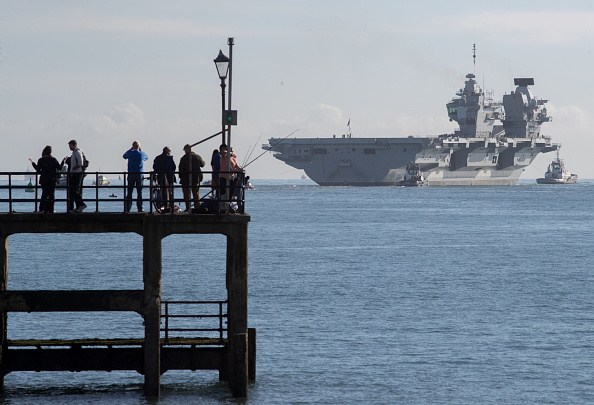
Today is no different. The only way Britain can out-compete far larger authoritarian rivals is asymmetrically at sea through superior technology. This means that any future investment in defence should be poured not into tanks or soldiers but into making the Royal Navy larger and stronger, as well as providing it with the logistical wherewithal to help it maintain naval operations far from home. As a natural seapower state, the UK needs a powerful navy with agility, lethality, and global reach.
During the summer leadership campaign, Sunak pledged to establish a “technological NATO”, with the vision of the UK setting up a new group of countries to challenge and outcompete China in its quest for technological dominance. Now that he finds himself in Number 10, he has the power to make that promising vision a reality.
While his vision focuses on next-generation civilian technologies, it could work accelerating those in the military domain. Here, AUKUS – the military and security pact between Australia, the UK and the US – might be seen as a prequel to a broader integrated technological accelerator involving Japan, European allies, South Korea and Taiwan, among others. One pillar would focus on generating or diffusing specific military capabilities, while the other would focus on advancing civilian or dual-use technology. Increases to the defence budget could then be spent on securing future technological dominance for the Royal Navy.
In this world of growing and expanding authoritarian power, remaining at the cutting edge of naval technology will be vital to securing British interests and upholding an open international order. With a naval dimension, Sunak’s proposed technology accelerator is the right initiative for a country which will never be as large as China or field as many conscripts as Russia.