Saturday Read: How worried should you be about the Indian and Nepal Covid variants?

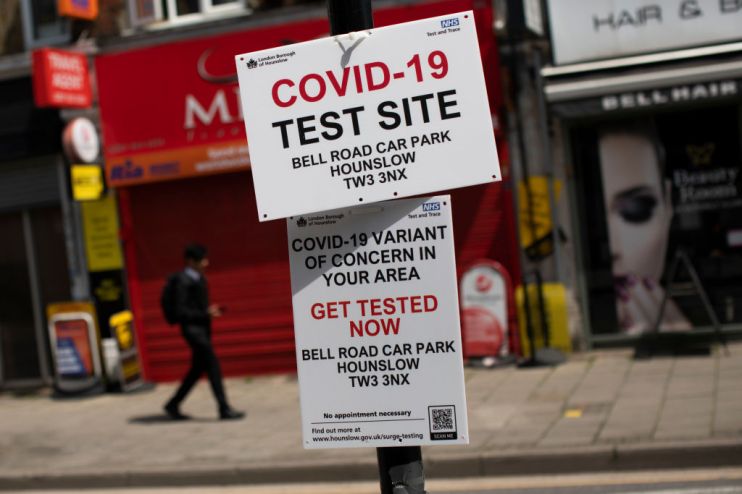
New coronavirus cases involving the Indian variant have increased by 79 per cent compared with last week, the ONS said yesterday. The strain is now believed to be dominant in the UK.
There are now 12,431 confirmed cases of the Indian variant, also known as Delta, in the UK, up from 6,959 last week.
Early evidence from Public Health England (PHE) published earlier this week suggests this version of Covid-19 may lead to an increased risk of being admitted to hospital compared with the previously dominant Kent variant.
Meanwhile, another potential coronavirus variant, thought to be linked to Nepal, has also been seen in the UK. This version is believed to be a mutated version of the Indian variant, with a spike mutation, known as K417N.
Experts believe this mutation may have the potential to make vaccines less effective – although it is too early to tell without further investigations.
Has the Indian variant spread throughout the country?
Of the 12,431 Indian variant cases so far confirmed in the UK, 10,797 are in England, 1,511 in Scotland, 97 in Wales and 26 in Northern Ireland.
In England, the cases are spread across the country, and the most affected areas include Bolton in Greater Manchester (2,149 cases), Blackburn with Darwen in Lancashire (724), Bedford (608), Leicester (349), Manchester (278) and Birmingham (223).
Dr Jenny Harries, chief executive of the UK Health Security Agency, said: “With this variant now dominant across the UK, it remains vital that we all continue to exercise as much caution as possible.
“The way to tackle variants is to tackle the transmission of Covid-19 as a whole.”
Should we be worried about the Indian variant?
Professor Neil Ferguson, from Imperial College London, whose modelling was instrumental to the UK locking down in March 2020, said the Indian variant is anywhere between 30 per cent and 100 per cent more transmissible than the Kent variant.
He said 60 per cent is “a good central estimate” at the moment, telling the BBC Radio 4’s Today programme: “Unfortunately, I mean, the news is not as positive as I would like on any respect about the Delta variant.”
Meanwhile, new data from the PHE suggests people are more at risk of hospital admission if infected with the variant – although a majority of admissions involve those who have not been vaccinated.
What about the so-called Nepal variant?
PHE said there are 23 cases of the Indian variant with the K417N mutation in the UK and that it is aware of reports linking this version of the virus to Nepal – but has not confirmed the country in which it was first detected.
The World Health Organisation (WHO) has said it is not aware of the so-called Nepal variant.
Experts believe the K417N mutation, which has also been found in the coronavirus strain first detected in South Africa (now also known as Beta), has the potential to allow the virus to evade protection from vaccines to some degree.
As the Indian variant appears to be more transmissible, scientists are carefully monitoring the K417N mutation.
Dr Mike Gent, Covid incident director at PHE, said: “PHE continuously assesses Sars-CoV-2 variants and we are aware of reports linking Nepal to Delta (the Indian variant) with the additional mutation K417N.
“This variant is present in multiple countries including a small number of cases in the UK, detected through rapid testing and whole genome sequencing. We are investigating K417N to better understand its significance.”
Do vaccines work against the Indian variant?
Meaghan Kall, an epidemiologist at the PHE, said 73 per cent of the cases involving the Indian variant are in unvaccinated people, while only 3.7 per cent cases are in people who have had both doses.
She said that only 5 per cent, or 7 hospital admissions, were people who have been fully vaccinated, “suggesting that vaccination still appears to be making an impact on spread”.
Meanwhile, new laboratory data published on Thursday suggests that people who have received the Pfizer/BioNTech vaccine have fewer antibodies targeting the Indian variant – although real-world data is needed to confirm this.
Experts say that delivering second doses promptly and providing boosters to those with weakened immune systems will help keep hospital admissions low.
What other variants of concern have been identified in the UK?
All viruses undergo small genetic changes as they make copies of themselves in the host.
Most of these mutations are harmless but some can make the disease more infectious or threatening, and evade protection gained through infection or vaccination.
The PHE has designated the Indian, Kent, South African, and Brazilian (Gamma) variants as being “of concern”.
Current vaccines have been designed for earlier versions of coronavirus, but scientists believe they should still work, although they may be less effective.
Most experts are confident that existing vaccines can be tweaked to better tackle emerging mutations.
The UK Government has a deal with biopharmaceutical company CureVac to develop vaccines against future variants, and has pre-ordered 50 million doses.
The Government has also begun negotiations with AstraZeneca to secure a “variant vaccine” that can tackle the South African variant.