Skip to content
Monday 31 August 2026London --:--Frankfurt --:--Zurich --:--
NewslettersSearchEN · DE · FR
MorningWire

European business, markets and politics

FTSE 100
10,824.26
+0.29%
DAX
26,569.99
+0.77%
CAC 40
8,401.18
+0.98%
STOXX 50
6,485.67
+0.95%
  • Europe
  • Markets
  • Business
  • Economy
  • Regulation
  • Politics
  • Opinion
More
GermanyFranceEU InstitutionsCompetitionPublic AffairsBankingTechnologyEnergy
  • Germany
  • France
  • Europe
  • Markets
  • Business
  • Economy
  • Regulation
  • Politics
  • Opinion
  • DE
Friday 11 December 2015 9:51 am

Scientists have taught robots to learn as quickly and easily as humans

By: Sarah Spickernell

Add as a preferred source on Google

Until now, robots have taken a lot longer than humans to remember things.

Typically, they have to be exposed to an object or event hundreds or even thousands of times before it sticks in their computerised minds, whereas in the case of humans just a couple of encounters tends to do the trick.

So while robots use a similar learning method to humans, the speed at which they learn falls way behind.

But by developing a new algorithm for machines, scientists at the universities of Toronto and MIT have managed to take some qualities of the human brain and replicate them in machines. This means the time it takes computers to pick up new concepts has been drastically reduced.

Read more: Darpa invents technology to let humans see beyond reality

“Our results show that by reverse engineering how people think about a problem, we can develop better algorithms,” said Brendan Lake, one of the lead researchers involved. “This work points to promising methods to narrow the gap for other machine learning tasks”.

They developed a “Bayesiasn Program Learning” framework for robots, where characters such as letters of the alphabet are represented using short computer codes. For example, the letter “A” has its own unique code, which generates examples of that letter when it is run.

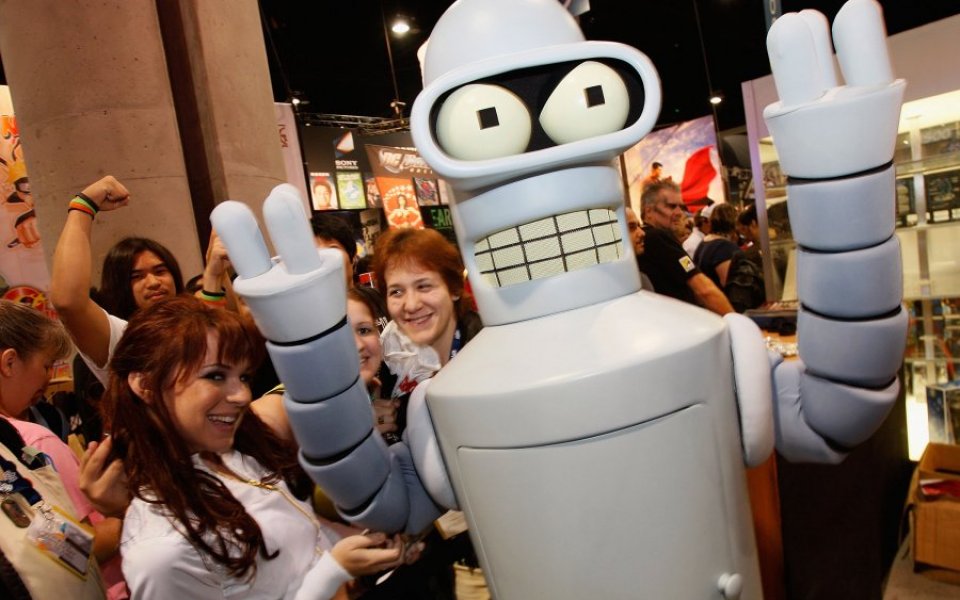
The model was applied to more than 1,600 types of handwritten characters in 50 of the world's writing systems, including Sanskrit, Tibetan, Gujarati, Glagolitic. The scientists even invented characters such as those from the television series Futurama.

By comparing learning abilities of computers that used the algorithm with those of humans, they found few differences – they asked both groups to reproduce a series of handwritten characters after being presented with a single example of each character, and the results were almost identical.

In addition to making robots operate at a faster speed than before, the researchers hope the discovery will broaden their uses to include more creative tasks. The results are published in the journal Science.

Ruslan Salakhutdinov, another lead researcher, said: "It has been very difficult to build machines that require as little data as humans when learning a new concept.

Replicating these abilities is an exciting area of research connecting machine learning, statistics, computer vision, and cognitive science.

Share this article

  • Facebook
  • X
  • LinkedIn
  • WhatsApp
  • Email

Similarly tagged content:

Sections

  • News

Categories

  • Tech

Trending Articles

  • Pensioners to hand over bank statements in government benefits crackdown

  • Jamie Carragher: HMRC petitions for Sky Sports star to be declared bankrupt

  • Jamie Vardy bags Bundesliga rights as he steps up streaming war with Neville and Lineker

  • City firms mandate phone and face-to-face comms bootcamps for Gen Z lawyers

  • Brewdog founder James Watt hits out at ‘total silence’ over new venture

More from Morning Wire

  • The best weapon against AI slop is a good lunch

    Opinion
    Pub in Leadenhall Market, London
  • Plaud Unveils Plaud One Explorer Edition, the Wearable AI Earbuds Built for the Agent Era

    Business Wire
  • Vercel Appoints Amit Agarwal, Standard Template Labs CEO and former Datadog President, to Board of Directors

    Business Wire
  • Claude to watermark AI ‘slop’ – including edited human writing

    Tech
    Smartphone displaying the Claude by Anthropic AI assistant app, showing the app icon and interface.
  • A tribute to wine legend Matthew Jukes by his friend Libby Brodie

    Life&Style
    Libby Brodie and Matthew Jukes raising a toast at a celebratory event, smiling and holding a glass, conveying joy and success
  • Watchdog takes aim at lawyers blaming juniors for AI blunders

    Legal
    Thousands of justice staff disciplined over the last three years
  • Cloudflare Gives AI Agents an Identity and a Wallet

    Business Wire
  • Vodafone pushes into legal tech market to co-develop AI platform

    Legal
    Vodafone Group has announced the appointment of Microsoft's Pilar López as its new chief financial officer.
MorningWire

Independent European business, markets and political news for decision-makers.

Morning Briefing

Europe

  • Germany
  • France
  • EU Institutions
  • Europe

Business

  • Markets
  • Business
  • Economy
  • Regulation
  • Competition
  • Public Affairs

Editorial

  • Opinion
  • Editorial Policy
  • Corrections
  • Contact

Company

  • About Morning Wire
  • Privacy Policy
  • Terms of Use
  • Cookie Policy
© 2026 Morning Wire Ltd · Published by Morning Wire Media, Bahnhofstrasse 65, 8001 Zürich, Switzerland
Privacy · Terms · Cookies · Facebook