Silence over lamb: The terrible politics of the dinner table

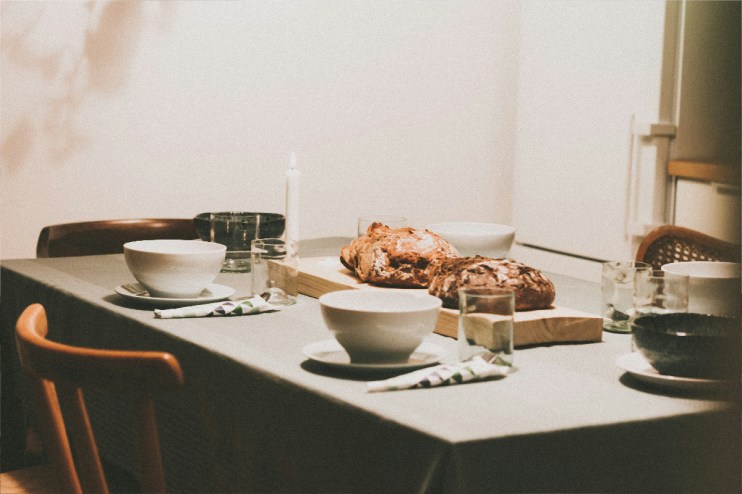
Why is the dinner table the setting for so many epic family battles? Anna Wolfe explores the psychology of dining and asks if boomers and Gen-Z are destined to clash over roast potatoes
Sunday lunch, a cherished ritual where families gather to share a meal, exchange pleasantries, and, more often than not, step into a conversational minefield. The table is set, the roast is carved—then, inevitably, someone mentions politics. Maybe climate change. Perhaps a comment on how Elon Musk is ‘misunderstood’.
At one end of the dinner table sits Uncle George, armed with decades of experience and a firm belief that common sense trumps any statistic. Opposite him, Cousin Emily, fresh from a morning scroll through social media, convinced she has the facts on her side and armed with unwavering conviction. The meal begins with polite small talk but gradually, the tone changes, the atmosphere thickens, and before the gravy cools, someone utters the familiar plea:
“Can we please have one nice dinner?”
Sitting down to eat alters social dynamics—the smell of food, the clatter of plates. Even before the first bite, your brain is responding: the cephalic phase primes digestion, while endorphins and oxytocin encourage bonding and trust. But the impact runs deeper than chemistry. Research suggests that shared experiences can subtly synchronise physiological rhythms, like heart rate variability, enhancing cooperation and social coherence. The simple act of eating together doesn’t just bring people to the table – it aligns them, physically and emotionally, in ways they may not even realise. Psychologist Dr Terri Apter, an expert in family dynamics, suggests that family arguments aren’t really about the surface issues. “They’re about identity. Beneath the surface, there’s an unspoken need to be seen as someone whose views matter.”
This explains why even casual debates over lunch can escalate. When people feel like their perspective is dismissed, it’s not just the topic at hand they’re defending, it’s their sense of relevance. In a setting where everyone is already more alert to social cues, disagreement can feel less like an exchange of ideas and more like a challenge to one’s place at the table.
Food isn’t just about nutrition either. A refused or partially-eaten home-cooked meal can be more than just a culinary critique – it can feel like rejection. As food historian professor Rebecca Earle notes: “Making food for other people involves some degree of emotional investment. That heightens the possibility of conflict.”
So while Uncle George and Cousin Emily’s sparring might feel uniquely frustrating, they’re participating in a ritual as old as the dinner table itself. “Generational divides at the table have always been visible,” sighs Earle.
Few topics divide a table quite like money. One side bought a house for three years’ salary; the other pays £1,200 a month for a damp shoebox. The British Social Attitudes Survey finds the UK increasingly split on social justice, national identity, and economic fairness. One of the biggest shifts today isn’t just what people believe, but how they decide what counts as true. The family table becomes a microcosm of these information wars. Uncle George trusts a broadsheet, Emily favours an infographic that’s been screenshotted so many times the font has melted. Both are scandalised by the other’s naivety.
Shared meals have long been spaces where identities are reinforced, social roles challenged, and hierarchies negotiated. In ancient Rome, the triclinium was a stage for political influence. Elite Romans used meals strategically, knowing that conversations over food could achieve what formal meetings could not. Centuries later, Japanese tea ceremonies created a similar dynamic. These ritualised gatherings allowed warriors, merchants and aristocrats to interact more freely. In the 18th century, picnics united the various classes over food in a way that hadn’t quite been seen before. No matter what sort of cash you had in your pocket, all walks of life gathered in the same parks to enjoy a new norm for socialising.
During World War II, the British government introduced state-run communal dining halls to provide affordable, nutritious meals during rationing. While these spaces played an essential role in feeding the population, they also carried an ideological purpose. As historian Earle explains: “State-supported canteens in the early 20th century were conceived as spaces to inculcate middle-class norms into workers and children.”
A similar project unfolded in 1940s Mexico, where the government introduced state-run national restaurants. “The organisers were very clear that they were designed to ‘inculcate good manners’ into the poorly behaved proletariat,” Earle says. These dining spaces, though intended to promote equality, reinforced societal expectations about behaviour and belonging.
So while Uncle George and Cousin Emily’s sparring might feel uniquely frustrating, they’re participating in a ritual as old as the dinner table itself
By the 1980s, the Wall Street power lunch reinforced hierarchy through seemingly small, unspoken gestures: who picked the restaurant, who controlled the conversation, who got the final word. “In business lunches, withholding comments is effective because it highlights a violation of the norm,” says Earle. “It becomes a power move.”
Silence has historically been a tool of discipline and control at the table. “In Victorian households, children were meant to be ‘seen and not heard’. That reduced the possibility of younger people arguing with their parents,” Earle says.
While words may be withheld, meaning rarely is. Even in silence, people communicate; through a glance, a shift in posture, the tightening of a jaw. A meal might be quiet, but that doesn’t mean nothing is being said. Body language often carries as much weight as the conversation itself. Whether in a boardroom, around the family table, or on a date – where a nervous shirt tug could signal either profound anxiety or head-over-heels infatuation – these unspoken signals shape our interactions in ways we rarely consciously process.
For all its tensions, the table is one of the few places where opposing views still have to sit next to each other, where eye contact replaces comment threads, and tone can’t be lost in translation. You won’t fix the world over roast potatoes but you might remember that disagreement isn’t the same as division. And if not? Well, at least the pudding is apolitical (unless someone brings up the sugar tax).